Marketing teams juggle dozens of repetitive tasks every day. Sending emails, segmenting audiences, scoring leads, and tracking campaign performance consume hours that could be spent on strategy. AI tools for marketing automation handle these tasks intelligently, freeing your team to focus on creative and strategic work.
- AI platforms learn from customer behavior and adapt in real time to send the right message to the right person at the right moment.
- Core capabilities include email automation, lead scoring, audience segmentation, content personalization, campaign optimization, and AI chatbots.
- Choose tools by business needs and scale: all-in-one for growth, specialized platforms for email or e-commerce, enterprise solutions for complex operations.
- Implement carefully: audit processes, start with one high-impact workflow, clean contact data, set clear benchmarks, train teams, and iterate monthly.
- Avoid common mistakes: do not over-automate broken processes, neglect personalization, skip compliance, or forgo testing and A/B experiments.
These platforms do more than schedule actions on a timer. They learn from customer behavior and adapt in real time. An AI-powered automation tool sends the right message to the right person at the right moment — without manual intervention. Businesses using marketing automation software powered by AI report higher conversion rates, shorter sales cycles, and significantly lower cost per lead.
What Can AI Marketing Automation Actually Do?
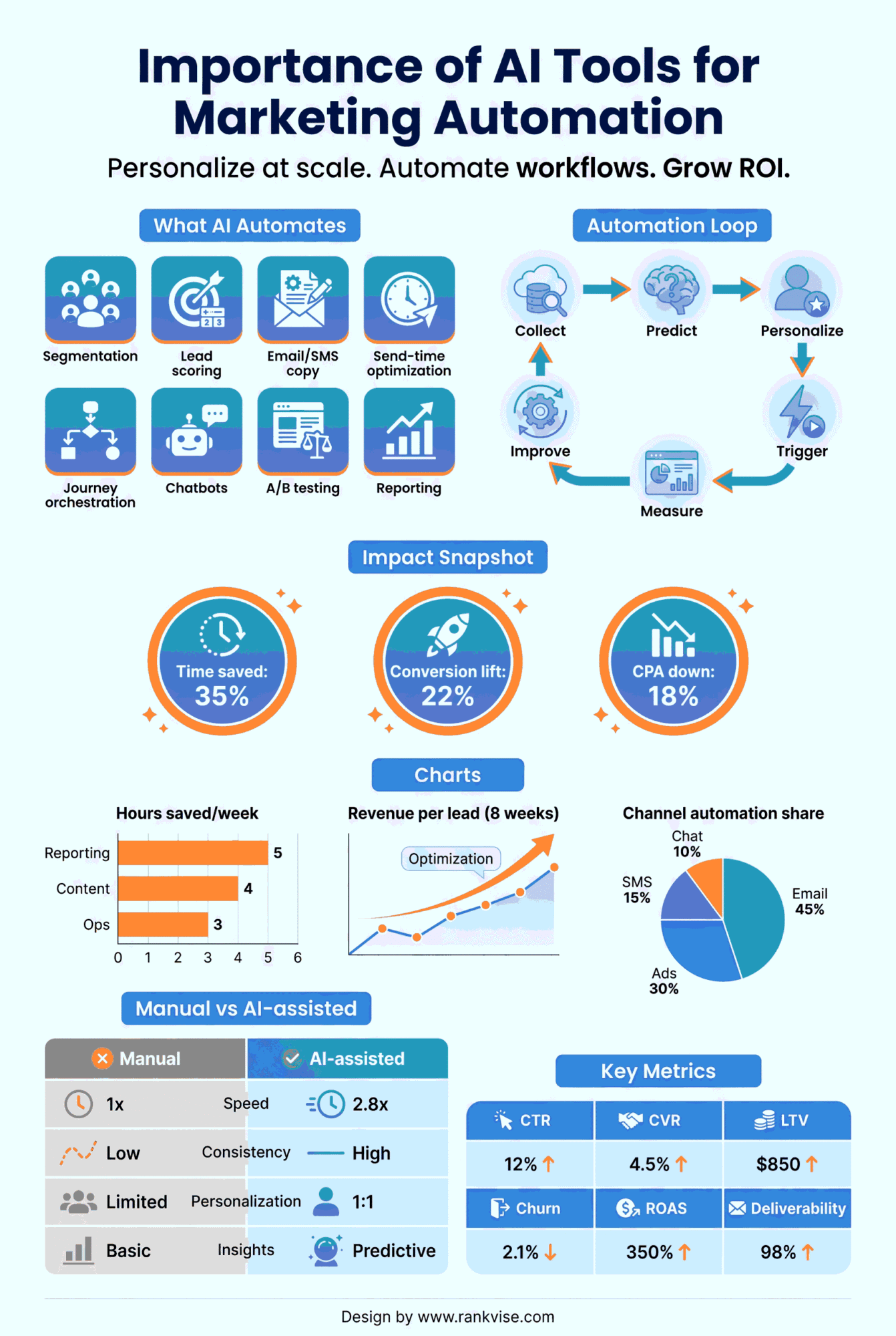
Understanding the practical capabilities of these tools helps you set realistic expectations before investing. Modern AI automation platforms handle a wide range of marketing functions.
Here are the core tasks AI marketing automation tools manage:
- Email campaign automation: Trigger personalized email sequences based on user actions, preferences, and lifecycle stage.
- Lead scoring and qualification: AI ranks leads by purchase intent so your sales team focuses on the most promising prospects.
- Audience segmentation: Automatically group customers by behavior, demographics, or engagement history.
- Content personalization: Deliver dynamic website content, product recommendations, and ad creatives tailored to each visitor.
- Campaign optimization: AI adjusts ad budgets, send times, and channel allocation based on real-time performance data.
- Chatbot and conversational marketing: AI-powered chatbots qualify leads and answer questions around the clock.
These capabilities transform marketing from a manual, reactive process into a proactive, data-driven engine that scales with your business.
The 12 Best AI Tools for Marketing Automation
1. HubSpot AI
Best All-in-One Marketing Automation Platform
HubSpot has embedded AI throughout its marketing, sales, and service platform. The AI assistant drafts emails, builds automated workflows, scores leads, and generates campaign reports. Its ChatSpot feature lets you query CRM data and trigger actions using natural language commands.
HubSpot suits growing businesses that want marketing, CRM, and automation under one roof. A free tier covers basic features. Paid marketing plans start at 800 USD per month for the Professional tier.
2. ActiveCampaign
Best for Email Marketing Automation
ActiveCampaign combines powerful email automation with a built-in CRM. Its AI-driven predictive sending feature delivers emails when each subscriber is most likely to open them. The platform also scores leads and automates follow-up sequences based on engagement signals.
Small and mid-sized businesses choose ActiveCampaign for its balance of sophistication and affordability. The visual automation builder makes complex workflows easy to create. Plans start at 29 USD per month.
3. Zapier
Best for Connecting Marketing Tools With AI Workflows
Zapier automates workflows between thousands of apps without requiring any coding skills. Its AI features now include the ability to build automations using plain language descriptions. Simply tell Zapier what you want, and it creates the workflow for you.
Marketers use Zapier to connect their CRM, email platform, ad accounts, and analytics tools into seamless automated pipelines. A free plan covers basic automations. Paid plans start at 19.99 USD per month.
4. Marketo Engage (Adobe)
Best Enterprise Marketing Automation
Marketo Engage delivers enterprise-grade marketing automation with deep AI capabilities. Adobe Sensei AI powers lead scoring, content personalization, and predictive audience segmentation. The platform handles complex, multi-touch campaigns across email, web, social, and paid channels.
Large organizations with sophisticated marketing operations rely on Marketo for scale and precision. Custom pricing applies based on database size and feature requirements.
5. Salesforce Marketing Cloud
Best for CRM-Integrated Automation
Salesforce Marketing Cloud connects marketing automation directly to the world’s most widely used CRM. Einstein AI powers predictive analytics, send-time optimization, and content recommendations. Every automated action draws from rich customer data stored across the Salesforce ecosystem.
Brands already using salesforce for sales benefit enormously from this native integration. The unified data model eliminates silos between marketing and sales teams. Pricing starts at 1,250 USD per month.
6. Drift (now Salesloft)
Best for Conversational Marketing Automation
Drift pioneered AI-powered conversational marketing through intelligent chatbots. Its AI engages website visitors in real time, qualifies leads through natural dialogue, and books meetings directly on your sales team’s calendar. The platform replaces static lead forms with dynamic, personalized conversations.
B2B companies with high-value sales cycles benefit most from Drift. The AI learns which questions and responses convert visitors into qualified pipeline. Custom pricing applies.
7. Brevo (formerly Sendinblue)
Best Budget Marketing Automation Platform
Brevo offers email marketing, SMS campaigns, WhatsApp messaging, and automation workflows at an accessible price point. Its AI assistant helps craft email content and subject lines. The automation builder supports triggered sequences based on contact behavior and transactional events.
Small businesses and startups choose Brevo for its generous free tier and transparent pricing. Paid plans start at 25 USD per month with no contact limits on most plans.
8. Klaviyo
Best AI Automation for E-Commerce Brands
Klaviyo dominates e-commerce marketing automation. Its AI analyzes purchase history, browsing behavior, and customer lifetime value to trigger hyper-targeted email and SMS campaigns. Predictive analytics forecast when a customer will buy next and what they are likely to purchase.
Shopify, WooCommerce, and BigCommerce merchants rely on Klaviyo for revenue-driving automations like abandoned cart sequences, post-purchase flows, and win-back campaigns. A free tier covers up to 250 contacts. Paid plans start at 20 USD per month.
9. Gumloop
Best for Custom AI Marketing Workflows
Gumloop lets marketers build custom AI-powered automations using a visual, no-code interface. It connects multiple AI models and marketing tools into flexible pipelines. Marketers automate tasks like competitor monitoring, lead enrichment, content research, and reporting without writing a single line of code.
Gumloop appeals to technically curious marketers who want more control than pre-built platforms offer. A free tier is available with paid plans scaling based on usage.
10. Creatio
Best for No-Code Process Automation
Creatio provides a no-code platform for automating complex marketing and sales processes. Its AI capabilities include lead management, campaign orchestration, and customer journey automation. The visual process designer makes enterprise-level automation accessible to non-technical teams.
Mid-market and enterprise businesses use Creatio to automate workflows that span marketing, sales, and customer service departments. Pricing starts at 25 USD per user per month.
11. Omnisend
Best Multichannel Automation for Online Retailers
Omnisend combines email, SMS, push notifications, and social retargeting into unified automated workflows. Its AI recommends the best channel and timing for each message. Pre-built automation templates for e-commerce use cases get campaigns running within minutes.
Online retailers who sell across multiple channels find Omnisend intuitive and effective. The free plan supports up to 250 contacts with basic automation features. Paid plans start at 16 USD per month.
12. Customer.io
Best for Behavior-Driven Messaging Automation
Customer.io builds automated messaging campaigns triggered by real-time user behavior. It supports email, SMS, push notifications, and in-app messages. The platform excels at event-driven automation where timing and context determine campaign effectiveness.
SaaS companies and subscription businesses use Customer.io to automate onboarding sequences, upgrade prompts, and churn prevention campaigns. Plans start at 100 USD per month.
Comparison Table: All 12 AI Marketing Automation Tools
| Tool | Best For | Starting Price | Free Tier |
|---|---|---|---|
| HubSpot AI | All-in-one platform | 800 USD/mo (Pro) | Yes |
| ActiveCampaign | Email automation | 29 USD/mo | No |
| Zapier | App integrations | 19.99 USD/mo | Yes |
| Marketo Engage | Enterprise campaigns | Custom pricing | No |
| Salesforce Marketing Cloud | CRM-integrated automation | 1,250 USD/mo | No |
| Drift (Salesloft) | Conversational marketing | Custom pricing | No |
| Brevo | Budget-friendly automation | 25 USD/mo | Yes |
| Klaviyo | E-commerce automation | 20 USD/mo | Yes |
| Gumloop | Custom AI workflows | Usage-based | Yes |
| Creatio | No-code process automation | 25 USD/user/mo | No |
| Omnisend | Multichannel retail automation | 16 USD/mo | Yes |
| Customer.io | Behavior-driven messaging | 100 USD/mo | No |
How to Implement AI Marketing Automation Successfully
Adopting marketing automation tools requires more than purchasing a subscription. A structured implementation approach delivers the best results and avoids common pitfalls.
- Audit your current marketing processes. Identify the most time-consuming, repetitive tasks your team performs weekly.
- Start with one high-impact workflow. Automate your welcome email sequence, lead scoring process, or abandoned cart recovery first.
- Clean your contact data. AI automation performs poorly on messy, outdated, or duplicate data. Invest time in data hygiene before launch.
- Set clear performance benchmarks. Define what success looks like before you automate. Measure open rates, conversion rates, and time saved.
- Train your team thoroughly. Even intuitive tools require onboarding. Ensure everyone understands the workflows and knows how to interpret the data.
- Iterate based on results. Review automated campaign performance monthly. Refine triggers, messaging, and audience segments continuously.
The businesses that extract the most value from AI marketing automation treat it as an evolving system, not a set-and-forget solution.
Common Mistakes to Avoid With Marketing Automation
Even the best tools produce poor results when used carelessly. Watch out for these frequent errors:
- Over-automating too quickly. Automating broken processes just scales the problems faster. Fix the process first, then automate it.
- Ignoring personalization. Generic automated messages feel impersonal and damage engagement. Use dynamic fields and behavioral triggers to keep communications relevant.
- Neglecting compliance. Automated email and SMS campaigns must comply with regulations like GDPR, CAN-SPAM, and TCPA. Build opt-in and opt-out mechanisms into every workflow.
- Skipping testing. Always A/B test subject lines, send times, and content variations. Let the data guide your optimization rather than assumptions.
FAQs
HubSpot, Brevo, and Klaviyo all offer free tiers with basic automation capabilities. Zapier also provides a free plan for connecting marketing tools into simple automated workflows.
These tools score leads based on behavior, trigger personalized nurture sequences automatically, and identify high-intent prospects faster. This shortens the sales cycle and increases conversion rates.
Yes. Tools like ActiveCampaign, Brevo, and Omnisend start between 16 and 29 USD per month. Many platforms offer free plans that cover essential automation features for small contact lists.
Email marketing focuses on sending messages to subscribers. Marketing automation covers a broader scope including lead scoring, audience segmentation, multi-channel campaigns, and behavior-triggered workflows across email, SMS, chat, and ads.
Basic workflows like welcome email sequences take one to two days. Comprehensive multi-channel automation setups with lead scoring and CRM integration typically require two to four weeks for full implementation and testing.