Marketing used to move at campaign speed. A team planned the message, built the creative, waited for results, then adjusted the next round. That rhythm feels slow now. AI marketing tools have pushed brands into a faster cycle, where ideas, tests, edits, segments, and reports can happen in the same afternoon.
- Adoption is surging, forcing brands to balance speed with control, taste, detection, and governance.
- Winning brands catch small signals, test quickly, and change course before competitors react.
- AI tools span writing, analytics, personalization, and automation; linking them into workflows multiplies value.
- Humans must set brand point of view, edit for nuance, verify claims, and decide where automation should not touch customers.
- Risks include sameness, hallucinations, privacy violations, and hidden weak thinking; governance, prompts, permissions, and review rules are essential.
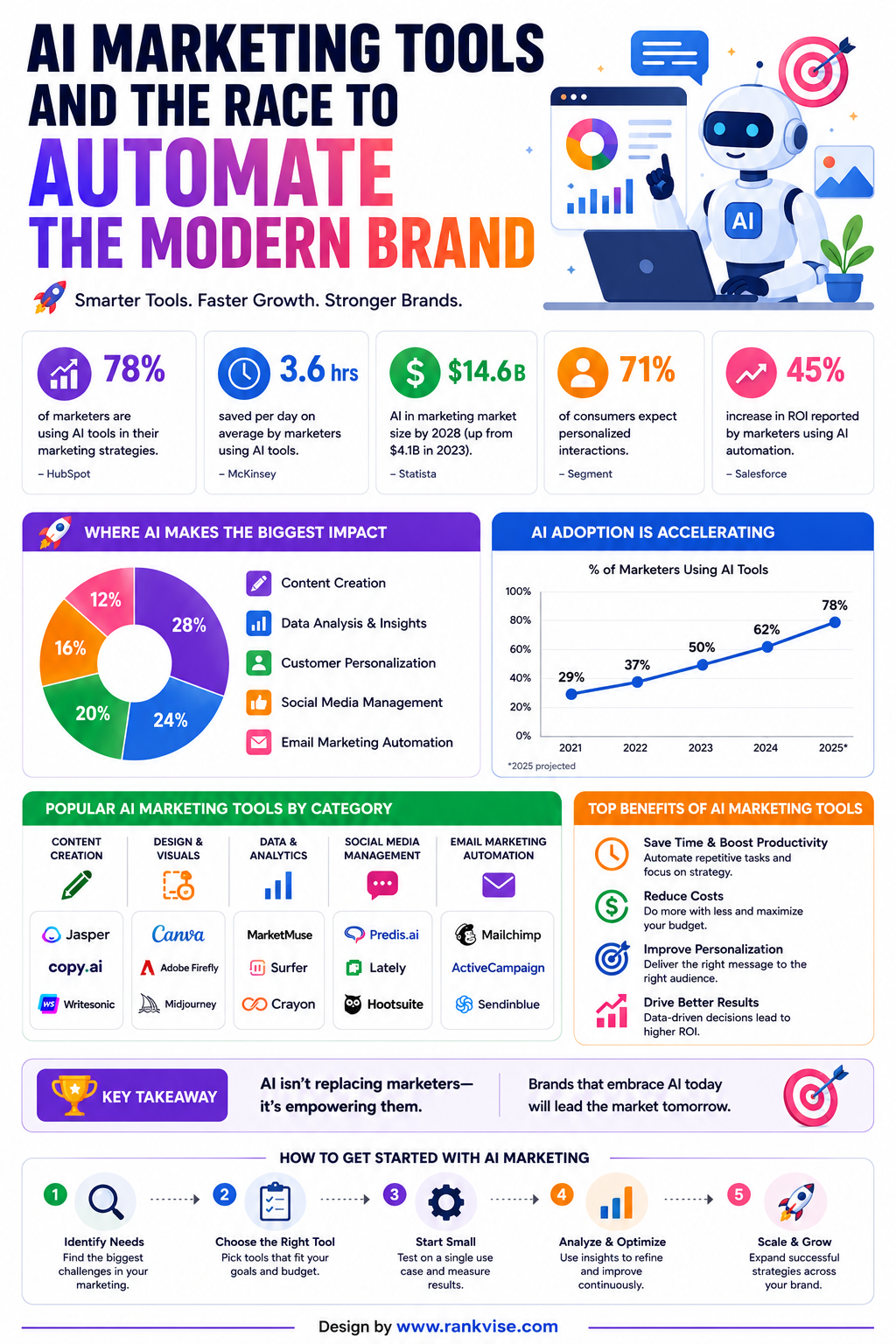
The adoption curve explains the urgency. SurveyMonkey reports that 88% of marketers use AI in day-to-day roles. CoSchedule-linked research cited by Dataslayer found that 60% of marketers use AI daily in 2026, up from 37% in 2024.
That jump shows the pressure to produce faster without letting quality collapse. For brands, the next challenge is control, taste, AI detection, and governance. The brands that handle this well will use automation to speed up the work, then rely on people to keep the message credible.
The Automation Race Has Reached Marketing
The race to automate the modern brand is happening because customer attention has become harder to win. Search is changing, social platforms reward constant publishing, and paid media gets expensive when testing is slow.
AI gives teams a way to compress the messy middle of marketing. A strategist can turn a product launch into audience angles. A performance marketer can ask for patterns across ad results before the weekly report is built.
A new race, then.
Not for the biggest budget. Not even for the loudest campaign.
For speed of thought.
The brands pulling ahead are the ones that catch a small signal, test it before it gets obvious, and change course while everyone else is still admiring last week’s dashboard.
What AI Tools for Marketing Do
The phrase AI marketing tools can sound vague because the category now covers half the marketing department. Some platforms write. Some predict. Some sort data. Some personalize a customer journey before a human reviews the pattern.
Common uses include:
- creating first drafts for blogs, emails, landing pages, captions, and product copy;
- turning campaign data into plain-language summaries for faster review;
- generating ad variations for A/B testing across search and social;
- segmenting audiences based on behavior, interest, purchase stage, or churn risk;
- recommending next actions in email, CRM, or customer support workflows.
That range matters. The real value comes from connecting these tasks into a workflow. A single prompt may save minutes. A linked system can save hours.
Why Brands Are Moving So Fast
AI looks tempting because it adds extra hands without adding extra salaries. A lean team can draft campaign ideas, sort customer data, rewrite ad copy, and prep reports before the second coffee gets cold.
The numbers explain the rush. Jasper’s 2026 AI marketing report says 63% of organizations already use generative AI and see gains in productivity, efficiency, and employee satisfaction. Another 79% plan to expand their use in 2026.
Then comes the awkward part.
The same report says 56% of marketers still use AI in scattered, disconnected ways. Even worse, 51% cannot track ROI from their AI investments.
So yes, brands are moving fast. Some are sprinting with a map. Others are sprinting because everyone else started running. The difference will show up in the results: faster launches, sharper conversion data, and customer insights that survive contact with real people.
The New Marketing Stack
The modern marketing stack no longer feels like a neat shelf of separate tools.
It feels wired.
Content nudges analytics. Ads feed the CRM. Support tickets whisper back into campaign planning. A customer complaint can become a product message, an email segment, or a paid search adjustment before the week has time to go stale.
| Tool Type | Common Use Case | Example Output | Main Risk |
| Generative writing platforms | Drafting and repurposing copy | Blog outlines, email variants, ad copy | Generic language |
| Analytics copilots | Reading campaign data | Performance summaries, trend notes | Shallow interpretation |
| Personalization engines | Matching content to users | Dynamic emails, product recommendations | Privacy concerns |
| Social listening tools | Tracking public response | Sentiment reports, topic alerts | Context loss |
| Workflow automation platforms | Connecting tasks across apps | Briefs, approvals, status updates | Over-automation |
This is why AI content marketing tools now sit inside a bigger operational shift. Content is still central, but it increasingly feeds analytics, paid media, sales enablement, and retention.
Content Production Gets the First Upgrade
The work has many repeatable parts: briefs, outlines, summaries, descriptions, title options, newsletters, and campaign variants. AI can assist with all of them.
A small brand team might use AI to stretch one webinar into a blog post, a LinkedIn carousel, three newsletter angles, and a few sales notes. A larger team might use it to tailor regional campaigns instead of staring at a blank page each time.
AI can deliver a quick draft, but it cannot feel a brand’s pulse or sense reputation risk. Human editors still decide what sounds crisp, what feels empty, and what belongs in the draft folder.
Personalization Becomes the Main Battleground
Instead of sending the same email to every lead, teams can shape messages around behavior. A repeat buyer may see loyalty content. A hesitant user may receive proof points. A customer who browses a product twice may get a different sequence from someone who abandoned a cart after one visit.
This is where the best AI tools for content marketing can support smarter journeys. They help teams match message, format, and timing to user intent.
The danger is creepiness. People like useful relevance, but they resist feeling watched. Smart brands will use personalization with restraint. A helpful recommendation feels natural. A hyper-specific message can feel invasive, especially when customers never understood how their data was used.
Data Turns Into Faster Decisions
Marketing data has never been scarce. Dashboards can show hundreds of numbers, but a marketer still needs to know what changed and what to try next.
AI helps by summarizing performance patterns and surfacing anomalies. It can flag that one segment responds better to educational emails, or that a search campaign spends on clicks that rarely convert. It can also help forecast budget scenarios.
The Human Role Is Changing
AI changes where human attention goes. The value shifts away from manual production and toward direction, quality control, and interpretation.
The strongest human tasks include:
- setting the brand point of view before tools generate copy;
- editing language so it carries rhythm, specificity, and real audience insight;
- checking claims, sources, and legal sensitivity before publishing;
- deciding when automation creates a colder customer experience;
- connecting campaign results to business strategy.
This is also why an AI detector for writing may become part of a broader review process. Teams that publish at scale need ways to check originality and make sure AI-assisted work still feels aligned with the brand.
The Risks Behind the Rush
Speed can create a strange sameness. When many brands in one category ask similar tools for similar campaigns, the results start to blur. Everything sounds optimized, yet little feels memorable.
There are also harder risks. AI systems can invent facts, repeat bias, misuse customer data, or generate claims that legal teams would reject. Automated personalization can cross privacy lines. Automated reporting can hide weak thinking behind confident summaries.
Trust becomes part of the stack. A brand needs rules for data use, source checking, approval flows, and human review. The most reliable AI detector might help with one slice of this work, but governance has to cover the full system: people, prompts, permissions, and publishing standards.
What Smart Teams Should Automate First
Teams often gain more from automating repetitive internal work than from handing over the brand voice on day one.
Good first moves include:
- campaign briefs based on product notes, audience research, and past results;
- first-round content variations for human editors to refine;
- weekly performance summaries for ads, email, search, and social;
- customer support topic clustering to identify recurring questions;
- content refresh lists based on traffic drops and outdated pages;
- internal workflow reminders for approvals, deadlines, and handoffs.
These use cases reduce friction without giving up final control. Teams can measure time saved, quality gained, and risks found before expanding automation into customer-facing systems.
The Brands That Win Will Build an Operating Model
Buying tools is simple. The harder part is teaching the team to work differently once those tools enter the room.
A modern brand needs a working rhythm: who gets access, which tasks make sense for AI, what data stays out, who reviews the output, and what success should actually look like.
McKinsey’s 2026 AI research found that many companies still have trouble turning small experiments into real, scaled results. It also points to a pattern among stronger performers: they know when model output needs human validation.
That matters. A team can pay for excellent software and still publish flat, messy work if the process is vague. Training, review rules, and creative standards will sit inside the daily routine, not in some forgotten PDF from onboarding.
Conclusion
AI marketing tools have turned automation into a race, but the finish line is not pure speed. Fast teams can draft, test, read the numbers, and revise with a speed that would have felt impossible a few years ago. Still, speed alone cannot give a brand weight.
The future belongs to teams that hand the dull work to machines and keep the fragile work close. Tone. Trust. Timing. Taste. AI can move the message faster. People decide whether anyone remembers it.