The SaaS landscape in 2026 is crowded, fast-moving, and margin-sensitive. Customer acquisition costs keep climbing. Churn eats into recurring revenue. Teams stretch thin across product, marketing, sales, and support. AI tools for SaaS address all of these pressures simultaneously.
- Choose AI tools that integrate deeply with CRM, billing, analytics, and product databases for seamless data flow and accurate insights.
- Prioritize tools that deliver actionable recommendations and rapid time to value so teams can automate workflows and act quickly.
- Use AI for sales intelligence and lead enrichment (Gong, Clay) to coach reps, predict deal outcomes, and prioritize prospects.
- Scale content and SEO with AI tools like Jasper and SE Ranking to produce consistent branded content and optimize organic acquisition.
- Reduce churn and improve support via Intercom Fin and Baremetrics using automated answers, churn prediction, and proactive interventions.
These tools automate repetitive workflows, surface revenue insights buried in data, and personalize customer experiences at scale. They help lean teams operate like much larger organizations. SaaS founders and operators who adopt AI strategically spend less time on manual tasks and more time on growth.
The shift is not theoretical. SaaS companies using AI-driven automation report faster sales cycles, lower churn rates, and stronger unit economics across the board.
What Should SaaS Teams Look for in AI Tools?
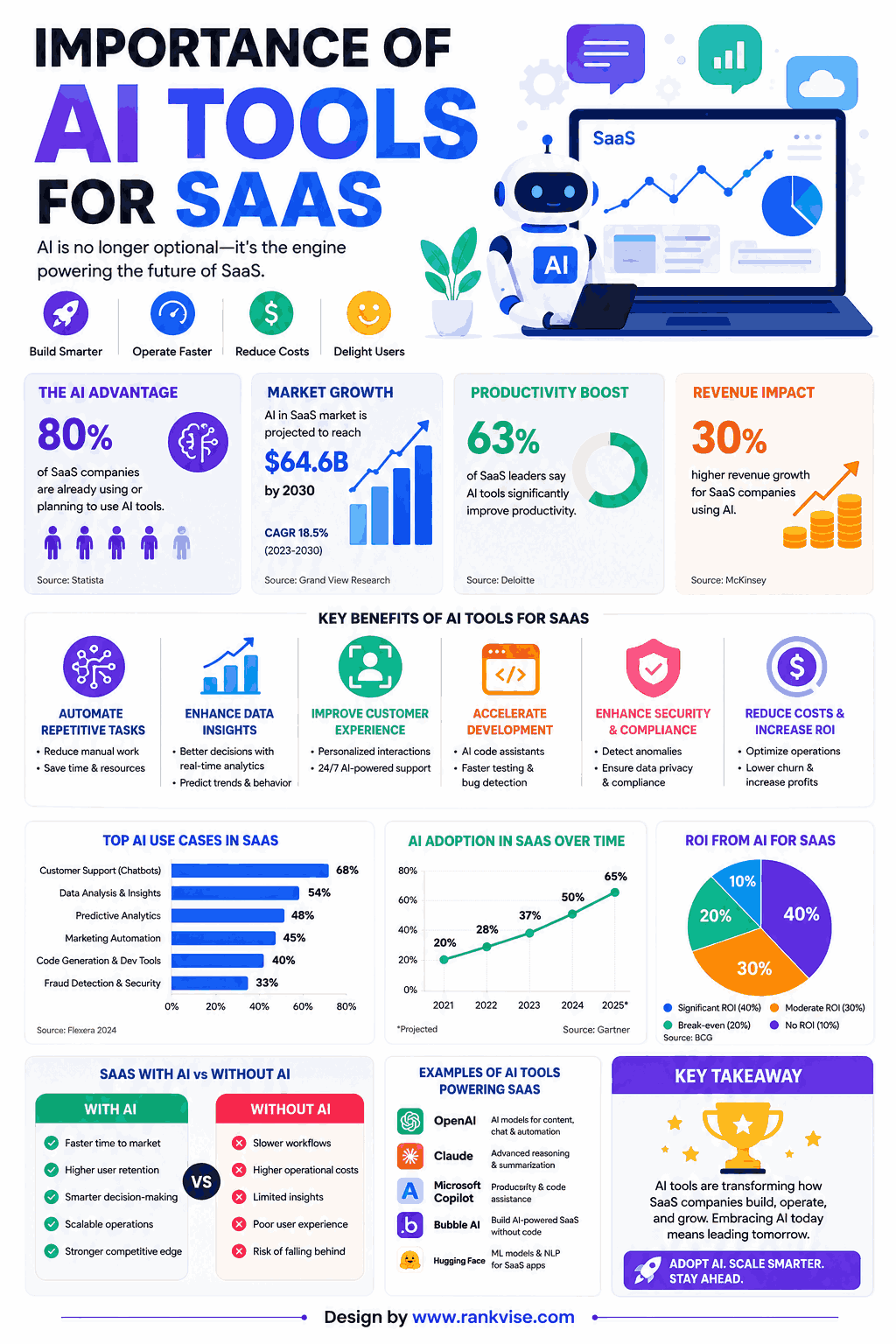
SaaS businesses have unique needs compared to eCommerce or service-based companies. Your tools must support subscription models, product-led growth, and cross-functional collaboration between marketing, sales, product, and customer success.
Evaluate AI tools based on these criteria:
- Integration depth — The tool should connect natively with your CRM, billing platform, analytics stack, and product database
- Scalability — It should handle growing data volumes and user counts without performance drops or steep price jumps
- Actionable outputs — Look for tools that recommend or execute actions, not just display dashboards
- Time to value — SaaS teams move fast. Choose tools with quick onboarding and immediate impact
- Data security — SaaS companies handle sensitive customer data. Ensure any AI tool meets SOC 2 or equivalent compliance standards
The best AI tools for SaaS feel like adding a skilled team member, not another piece of software to manage.
Top 10 AI Tools for SaaS Companies
1. HubSpot AI
CRM, Marketing, and Sales Automation United
HubSpot remains a cornerstone platform for SaaS businesses in 2026. Its AI features now span the entire customer lifecycle. The CRM uses AI to score leads, predict deal outcomes, and recommend next-best actions for sales reps.
On the marketing side, HubSpot AI generates email copy, blog outlines, and social posts tuned to your audience. Its workflow builder automates nurture sequences, onboarding emails, and re-engagement campaigns. For SaaS teams wanting one platform across marketing, sales, and service, HubSpot delivers strong unified value.
2. Jasper
AI Content Engine for SaaS Marketing Teams
Content marketing drives organic growth for most SaaS companies. Jasper accelerates content production by generating blog posts, landing page copy, email sequences, and ad creatives using AI trained on marketing best practices.
Its brand voice feature ensures consistency across every piece of content your team produces. Jasper also supports collaborative workflows where multiple team members contribute to and refine AI-generated drafts. SaaS marketing teams producing high volumes of content weekly use Jasper to maintain quality without burning out writers.
3. Zapier AI
Workflow Automation Across Your Entire SaaS Stack
Zapier connects over 6,000 apps and its AI features make automation accessible to non-technical teams. You describe a workflow in plain language and Zapier AI builds the automation for you. It handles everything from lead routing to customer onboarding sequences.
SaaS operations teams use Zapier to eliminate manual data transfers between tools. When a trial user signs up, Zapier can automatically enrich the lead in your CRM, trigger a welcome email, notify the sales team, and log the event in your analytics platform.
4. Intercom Fin
AI Customer Support Agent for SaaS Products
Intercom’s Fin AI agent resolves customer support queries using your existing help documentation. It provides accurate, conversational answers without human intervention. Fin handles common questions about billing, features, account setup, and troubleshooting instantly.
For SaaS companies, fast support response times directly reduce churn. Fin learns from your knowledge base and improves over time. It escalates complex issues to human agents seamlessly, ensuring customers never feel stuck. SaaS teams report Fin resolving over 50% of inbound support conversations autonomously.
5. SE Ranking
AI-Powered SEO Platform for SaaS Growth
Organic search is a primary acquisition channel for most SaaS companies. SE Ranking offers keyword research, backlink analysis, site audits, and content optimization powered by AI. Its competitive analysis features reveal exactly how rival SaaS products rank and attract traffic.
The platform’s AI content editor helps marketing teams create SEO-optimized blog posts and landing pages. SE Ranking tracks keyword positions daily and provides actionable recommendations for improving visibility. SaaS companies investing in long-term organic growth find it an affordable and capable solution.
6. Gong
AI Revenue Intelligence for SaaS Sales Teams
Gong records and analyzes sales calls, demos, and meetings using AI. It identifies patterns in conversations that correlate with closed deals. Sales leaders use Gong to coach reps, refine messaging, and forecast revenue more accurately.
The platform highlights objections, competitor mentions, and pricing discussions across every interaction. SaaS sales teams with complex, multi-touch sales cycles benefit most from Gong’s ability to surface what separates winning deals from lost ones. It transforms qualitative sales conversations into quantitative, actionable data.
7. Baremetrics with AI Insights
SaaS Metrics and Churn Prediction
Baremetrics connects to your billing platform and provides real-time SaaS metrics including MRR, churn rate, lifetime value, and expansion revenue. Its AI layer predicts which customers are likely to churn based on usage patterns and billing behavior.
These predictions allow customer success teams to intervene before cancellations happen. Baremetrics also offers automated dunning workflows that recover failed payments. For subscription-based SaaS businesses, understanding and reducing churn is the fastest path to sustainable growth.
8. Clay
AI-Powered Lead Enrichment and Outbound Prospecting
Clay automates the process of finding, enriching, and qualifying leads for SaaS sales teams. It pulls data from over 75 sources to build detailed prospect profiles. Its AI then scores and prioritizes leads based on fit signals you define.
Outbound sales teams use Clay to replace hours of manual research with automated workflows that deliver ready-to-contact prospect lists. The platform integrates with popular outreach tools like Outreach and Apollo. SaaS companies with outbound-heavy go-to-market strategies see immediate time savings with Clay.
9. Notion AI
Intelligent Workspace for SaaS Team Collaboration
Notion AI enhances the popular workspace tool with writing assistance, document summarization, and task automation. SaaS teams use it to draft product briefs, summarize meeting notes, generate project updates, and organize knowledge bases.
The AI works inside the tools your team already uses daily, reducing context switching. Product managers, marketers, and engineers all benefit from faster documentation and clearer internal communication. Notion AI suits SaaS teams that value operational efficiency alongside external growth.
10. Microsoft Power Automate AI
Enterprise Workflow Automation
Power Automate brings AI-driven automation to SaaS companies operating within the Microsoft ecosystem. It automates processes across Dynamics 365, Teams, SharePoint, and hundreds of third-party connectors. Its AI Builder feature adds document processing, sentiment analysis, and prediction models to any workflow.
Enterprise SaaS teams use Power Automate to streamline internal operations like contract approvals, customer onboarding workflows, and reporting pipelines. The platform scales from simple task automation to complex, multi-step business processes with built-in governance and security controls.
How to Match AI Tools to Your SaaS Growth Stage
Different tools serve different needs depending on your company’s maturity. Use this comparison to find the right fit.
| Growth Stage | Key Need | Recommended Tools |
|---|---|---|
| Early-stage (pre-product-market fit) | Content, SEO, basic automation | Jasper, SE Ranking, Zapier AI |
| Growth stage (scaling acquisition) | Sales intelligence, lead enrichment | Gong, Clay, HubSpot AI |
| Scale-up (optimizing retention) | Churn prediction, customer support | Baremetrics, Intercom Fin |
| Enterprise (operational efficiency) | Workflow automation, collaboration | Power Automate, Notion AI |
Start with the tools that address your most pressing bottleneck. A pre-revenue startup needs content and SEO tools before revenue intelligence. A scaling company needs sales and retention tools before enterprise workflow automation.
Mistakes SaaS Teams Make When Adopting AI Tools
AI tools accelerate growth when used wisely. These common missteps slow teams down:
- Buying tools before defining processes — AI automates workflows. If your workflow is broken, AI automates the mess. Fix the process first, then layer automation on top.
- Overlapping tool functionality — SaaS teams often accumulate tools with redundant features. Audit your stack regularly and consolidate where possible.
- Ignoring adoption and training — A powerful tool delivers zero value if your team does not use it. Invest time in onboarding and create internal documentation for each platform.
- Optimizing vanity metrics — AI analytics tools can track everything. Focus on metrics that directly connect to revenue: MRR growth, net revenue retention, qualified pipeline, and customer lifetime value.
- Delaying AI adoption entirely — Waiting for the perfect tool means falling behind competitors who iterate with good-enough solutions today.
The SaaS companies winning with AI treat these tools as strategic investments, not experiments.
What the Future Holds for AI in the SaaS Industry
AI will reshape SaaS operations at every level over the next two years. Expect AI agents to manage entire customer onboarding flows autonomously. Sales tools will move from call analysis to real-time coaching during live conversations.
Product teams will use AI to prioritize feature development based on predicted revenue impact. Customer success platforms will intervene with at-risk accounts automatically, not just flag them. SaaS companies that build their AI foundations now will compound their advantage as these capabilities mature and become table stakes.
FAQs
Leading AI tools for SaaS include HubSpot AI, Jasper, Zapier AI, Intercom Fin, SE Ranking, Gong, Baremetrics, Clay, Notion AI, and Microsoft Power Automate. Each addresses a different function from marketing to sales to operations.
AI tools like Baremetrics and Intercom Fin predict churn by analyzing usage patterns and billing behavior. They alert customer success teams early so they can intervene with at-risk accounts before cancellation happens.
Yes. Jasper, SE Ranking, and Zapier AI offer starter plans under 500 USD per month. Notion AI is included in Notion’s standard workspace plans. These tools provide immediate value without enterprise-level budgets.
Absolutely. Clay automates lead enrichment and scoring using over 75 data sources. Combined with outreach platforms, it builds qualified prospect lists and personalizes outreach at scale, saving sales teams hours of manual research daily.
Match tools to your biggest growth bottleneck. Early-stage companies benefit most from content and SEO tools. Scaling companies need sales intelligence and retention platforms. Enterprises focus on workflow automation and operational efficiency tools.