Managing Google Ads manually burns time and budget. Campaigns generate thousands of data points daily across keywords, audiences, placements, and devices. No human can process all that information fast enough to make optimal decisions in real time.
- Look for AI tools that automate bids, generate and test ad variations, allocate budgets, discover negatives, and detect anomalies in real time.
- Match tool choice to account size, team resources, and primary performance gap for targeted impact rather than one size fits all solutions.
- Configure and supervise AI: set clear conversion goals, feed quality creatives, maintain negative keywords, and verify accurate attribution before trusting automation.
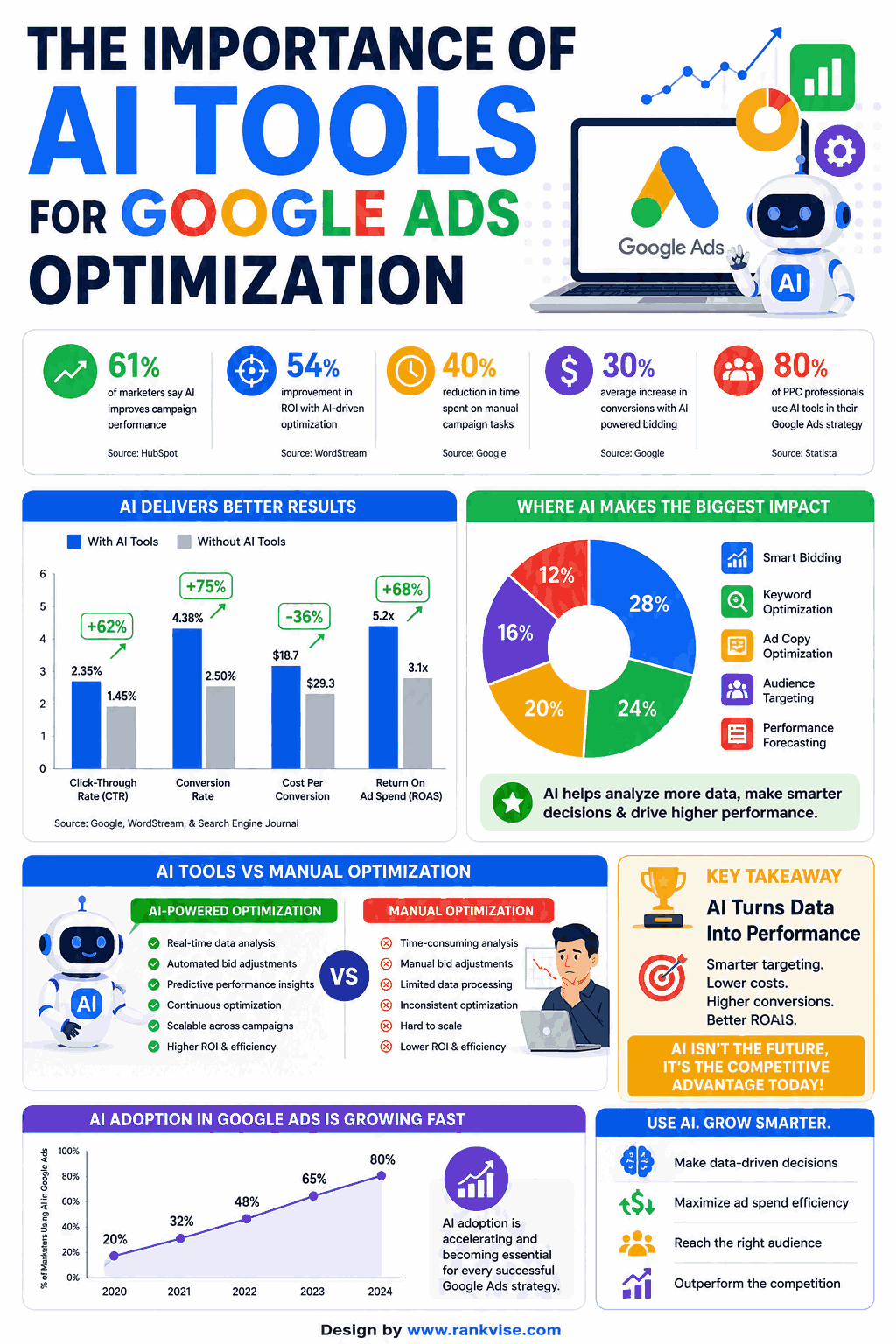
AI tools for Google Ads solve this by automating bid adjustments, testing ad variations, and reallocating budgets based on live performance data. They spot wasted spend before it drains your account. They also identify winning combinations that you would miss through manual analysis.
Advertisers using AI-powered optimization consistently report lower cost per acquisition and higher return on ad spend. The gap between AI-managed and manually managed campaigns continues to widen every quarter.
What Should an AI Google Ads Tool Actually Do?
Not every tool claiming AI integration delivers meaningful results. The best platforms go beyond dashboards and offer real automation that impacts your bottom line.
Look for these essential capabilities:
- Automated bid management — Adjust bids across campaigns in real time based on conversion probability, not just rules you set manually
- Ad copy generation and testing — Create and rotate multiple ad variations, then allocate traffic to top performers automatically
- Budget allocation intelligence — Shift daily spend toward campaigns and ad groups generating the best returns
- Negative keyword discovery — Identify search terms wasting money and add them as negatives without manual review
- Cross-campaign insights — Spot trends and patterns across your entire account rather than analyzing campaigns in isolation
- Anomaly detection — Alert you immediately when performance drops unexpectedly due to competitor changes, market shifts, or technical issues
The right AI tools for Google Ads act as a tireless co-pilot that keeps your campaigns profitable around the clock.
Top 10 AI Tools for Google Ads Optimization
1. Optmyzr
The PPC Manager’s Command Center
Optmyzr is one of the most trusted AI tools for Google Ads management. It offers one-click optimizations for bids, budgets, keywords, and ad copy. Its Rule Engine lets you build custom automation workflows tailored to your account structure.
The platform’s AI analyzes your entire account and surfaces actionable recommendations ranked by impact. Optmyzr also generates detailed PPC reports automatically. Agencies managing dozens of accounts rely on it to maintain performance without manual micromanagement.
2. Cotera
AI Agent for Continuous Google Ads Monitoring
Cotera operates as an always-on AI agent that monitors your Google Ads account 24/7. It detects performance anomalies, wasted spend, and missed opportunities in real time. When something goes wrong, Cotera alerts you with a clear explanation and a suggested fix.
The tool excels at catching issues that slip through standard automated rules. It watches for sudden CPC spikes, conversion tracking failures, and audience overlap problems. Cotera suits advertisers who want proactive monitoring without staring at dashboards all day.
3. Adalysis
Automated Ad Testing at Scale
Adalysis focuses specifically on ad testing and quality score optimization. It continuously analyzes your ad variations and tells you exactly which ones to pause and which to scale. The tool runs statistical significance tests automatically so you never end experiments too early.
Its quality score tracker monitors changes across every keyword in your account. Adalysis also flags ad group structure issues that hurt performance. For advertisers running hundreds of ad groups, this tool eliminates hours of manual ad review each week.
4. Performance Max Insights by Google
Google’s own AI capabilities within Performance Max campaigns have matured significantly in 2026. The platform automatically distributes your ads across Search, Display, YouTube, Gmail, and Discover. Its machine learning optimizes creative combinations, audience targeting, and bidding simultaneously.
Performance Max works best when fed strong creative assets and clear conversion goals. The key advantage is direct access to Google’s proprietary data signals that third-party tools cannot replicate. Treat it as a powerful baseline and layer additional tools on top for deeper control.
5. Lapis
AI Creative Generation for Display and Discovery Ads
Lapis generates production-ready ad creatives for Google Display and Discovery campaigns using AI. It automatically sizes creatives across all required formats, eliminating the need for manual design work. The tool analyzes your brand assets and produces on-brand visuals in minutes.
eCommerce brands and lead generation teams use Lapis to test dozens of creative variations quickly. Its AI learns which visual elements drive clicks and conversions, then prioritizes similar styles in future outputs. This accelerates the creative testing cycle dramatically.
6. Dynares
AI Budget and Bid Optimization for Founders
Dynares targets founders and small teams running Google Ads without a dedicated PPC specialist. Its AI manages bids and budgets autonomously, making adjustments multiple times per day based on real-time conversion data.
The platform simplifies complex account structures into clear, actionable insights. You see exactly where your money goes and what it returns. Dynares removes the steep learning curve of Google Ads management, making it practical for business owners who need results without PPC expertise.
7. Adzooma
Simplified AI Campaign Management
Adzooma provides AI-driven recommendations for Google Ads, Facebook Ads, and Microsoft Ads from a single dashboard. Its optimization engine scans your campaigns weekly and delivers prioritized suggestions for improving performance.
The tool applies changes with one click once you approve a recommendation. Adzooma also offers automated reporting and performance scoring. Small businesses and agencies appreciate its simplicity and the fact that its core features remain available on a free plan.
8. WordStream
AI-Powered PPC Advisor for Small Businesses
WordStream has served small and mid-sized advertisers for over a decade. Its AI advisor analyzes your Google Ads account and highlights the highest-impact optimization opportunities. The tool covers keyword management, bid adjustments, ad copy improvements, and landing page recommendations.
WordStream’s 20-Minute Work Week feature guides users through the most important weekly optimizations in a structured workflow. This makes it ideal for business owners who manage their own campaigns alongside other responsibilities.
9. Cometly
AI Attribution and Ad Performance Tracking
Cometly solves one of the biggest pain points in Google Ads optimization: accurate attribution. It uses AI to track conversions across multiple touchpoints and attributes revenue to the correct campaigns, ad groups, and keywords.
Without reliable attribution, you optimize toward the wrong metrics. Cometly ensures your bid strategies and budget decisions are based on actual revenue data rather than inflated or inaccurate conversion counts. eCommerce and SaaS advertisers use it alongside their existing Google Ads setup.
10. PPC Signal
AI-Powered Anomaly Detection and Trend Analysis
PPC Signal monitors your Google Ads account and surfaces meaningful patterns using AI. It detects emerging trends, seasonal shifts, and performance anomalies before they become costly problems. Each signal includes a clear explanation and a recommended action.
The tool categorizes signals by type, urgency, and potential impact. This helps you prioritize which optimizations to tackle first. PPC Signal works as an early warning system that keeps your campaigns on track even during volatile market conditions.
How to Select the Right AI Tool for Your Google Ads Campaigns
Your ideal tool depends on your account size, team resources, and biggest performance gaps. Use this comparison to guide your decision.
| Primary Need | Recommended Tool | Best For |
|---|---|---|
| Full PPC management and automation | Optmyzr | Agencies and advanced advertisers |
| Real-time account monitoring | Cotera | Proactive anomaly detection |
| Ad testing and quality score | Adalysis | Large accounts with many ad groups |
| Multi-channel AI optimization | Performance Max | Leveraging Google’s native AI |
| Display and Discovery creatives | Lapis | Fast creative production at scale |
| Hands-off budget management | Dynares | Founders and solo marketers |
| Simple multi-platform management | Adzooma | Small businesses, free tier available |
| Guided weekly optimizations | WordStream | SMBs managing ads in-house |
| Revenue attribution accuracy | Cometly | eCommerce and SaaS advertisers |
| Trend detection and early warnings | PPC Signal | Data-driven campaign monitoring |
Start by identifying your biggest source of wasted spend or missed opportunity. Then choose the tool that addresses that specific gap first.
Mistakes That Waste Money in AI-Optimized Google Ads Campaigns
AI tools deliver results, but only when configured correctly. Watch for these common errors:
- Setting vague conversion goals — AI optimization depends on clear conversion signals. Track the actions that matter most to your revenue, not vanity metrics like page views.
- Feeding low-quality creative assets — Tools like Performance Max and Lapis need strong inputs to produce strong outputs. Invest in quality images, headlines, and descriptions.
- Ignoring negative keywords — Even the smartest bidding AI wastes budget on irrelevant searches if you neglect negative keyword lists. Review search term reports weekly.
- Over-relying on automation without oversight — AI handles execution, but you still own the strategy. Review AI recommendations regularly and intervene when business context changes.
- Skipping attribution setup — Inaccurate conversion tracking misleads every AI optimization layer. Audit your tracking before trusting automated bid strategies.
Treat AI as a powerful amplifier, not an autopilot you can forget about entirely.
Where AI Is Heading for Google Ads Management
Expect AI tools for Google Ads to become increasingly autonomous over the next two years. Platforms will move from suggesting optimizations to executing multi-step strategies independently. Creative generation will produce video ads alongside static formats, all tested and iterated by machine learning.
Attribution models will unify online and offline conversion data more accurately. Voice search and visual search campaigns will require new AI-driven optimization approaches. Advertisers building their AI toolkit now position themselves to adopt these advances faster than competitors who wait.
FAQs
Top AI tools for Google Ads include Optmyzr, Cotera, Adalysis, Performance Max, Lapis, Dynares, Adzooma, WordStream, Cometly, and PPC Signal. Each serves a distinct optimization function from bidding to creative generation.
Yes. AI bid management tools analyze conversion likelihood in real time and adjust bids to avoid overpaying for clicks. They also identify wasted spend on irrelevant searches, reducing overall cost per click and cost per acquisition.
Adzooma offers a free plan with AI-powered campaign recommendations. Google’s built-in Performance Max and Smart Bidding features are included at no extra cost within your Google Ads account.
AI tools improve return on ad spend by automating bid adjustments, testing ad creative variations, reallocating budgets toward top-performing campaigns, and providing accurate attribution data that prevents misguided optimization decisions.
Absolutely. Tools like WordStream and Dynares simplify Google Ads for small teams without PPC expertise. They reduce the learning curve and help small businesses compete with larger advertisers by optimizing spend more efficiently.