Compliance failures are expensive. Whether it’s a missed regulatory requirement, an improperly handled document, or a gap in your audit trail, the consequences range from deal delays to serious legal liability.
Virtual data rooms have always been the professional standard for secure document sharing in high-stakes transactions. But AI is changing what those platforms can do — and how much manual compliance work they eliminate.
This article explains exactly how AI is being applied inside modern data rooms to strengthen compliance, accelerate audit readiness, and reduce the risk of human error during critical deal processes.
The Compliance Challenge in Traditional Data Rooms
A conventional virtual data room provides a secure space to store and share confidential documents. It logs activity, enforces access controls, and produces an audit trail. That’s a strong foundation — but it still relies heavily on human judgement to work correctly.
Someone has to decide which documents require redaction. Someone has to check that folder permissions are set up correctly. Someone has to review the audit log for anomalies. In a fast-moving deal environment, these tasks are easy to rush — and the consequences of getting them wrong can surface months or years later.
This is the gap AI is filling. The best virtual data room providers are now embedding intelligence directly into the platform — automating the tedious, high-risk compliance tasks that humans are most likely to miss.
How AI Strengthens Compliance Inside a Virtual Data Room
Automated redaction
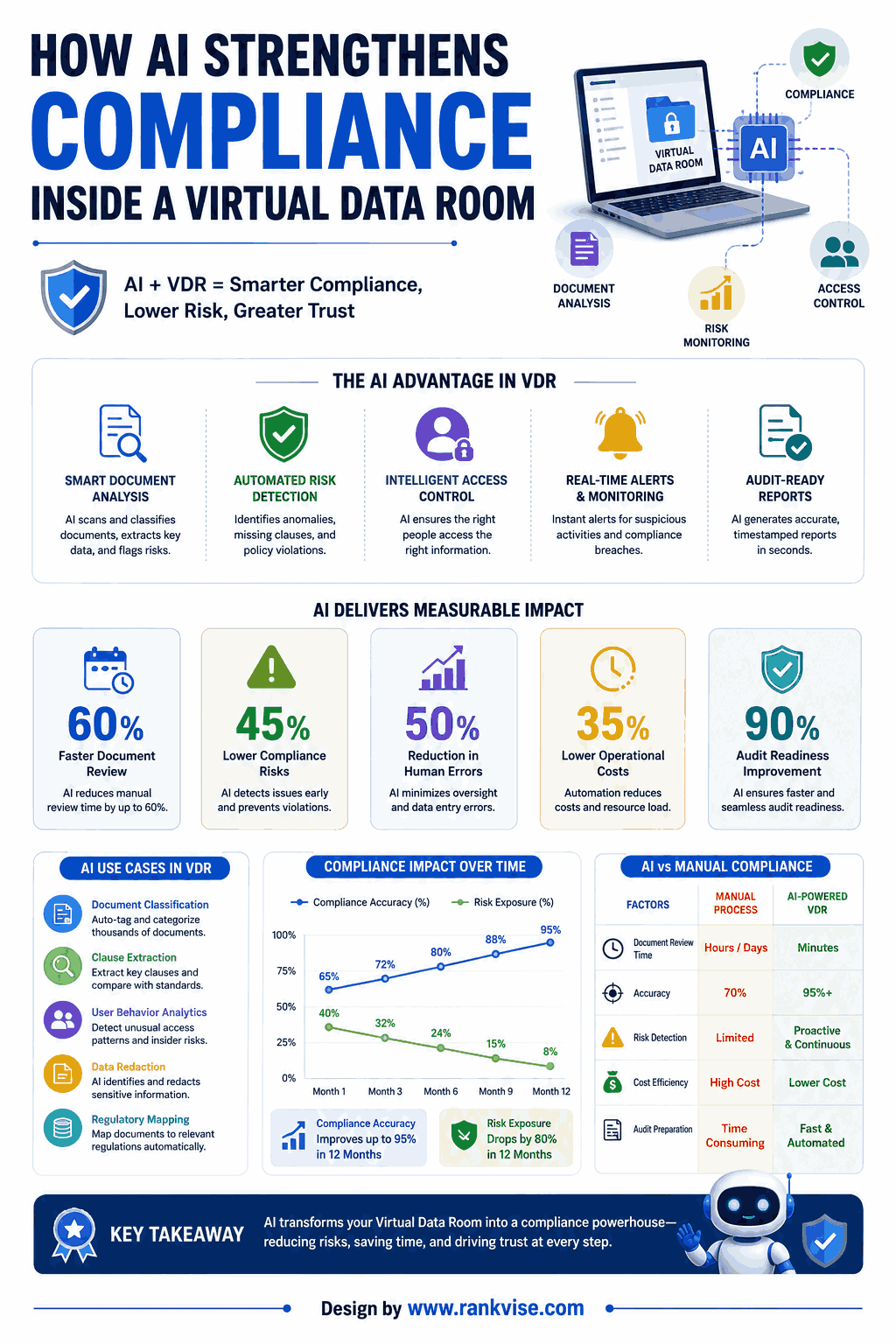
Manually reviewing hundreds of documents for personally identifiable information (PII), legal privilege, or commercially sensitive content is time-consuming and error-prone. AI-powered redaction tools scan documents automatically, flag sensitive content, and apply redactions in bulk.
This is particularly important for data room providers working in regulated sectors — financial services, healthcare, and legal — where inadvertent disclosure of protected information can trigger regulatory penalties.
Intelligent document classification
Uploading hundreds of documents to a dataroom manually and sorting them into the right folders is slow work. AI classification tools analyse document content and automatically organise files into the correct categories — financial statements, legal agreements, IP documentation, HR records, and so on.
Beyond speed, this improves compliance. Documents in the wrong folder may be seen by the wrong people. Automated classification reduces misplacement and the permissions errors that follow from it.
For teams building or managing an investor data room, these AI capabilities are especially relevant. Here is a data room for investors example that shows how modern platforms structure document organisation and permissions for investor-facing due diligence.
Anomaly detection in user behaviour
AI-powered virtual data rooms can monitor access patterns in real time. If a user suddenly downloads a large number of documents outside normal working hours, or accesses files well outside their expected scope, the system can flag the activity automatically — or alert an administrator.
This kind of behavioural monitoring is difficult to replicate manually and adds a meaningful layer of insider threat detection to the data room.
Automated compliance reporting
Generating compliance reports from a traditional audit log requires manual effort — extracting data, cross-referencing user lists, and checking access against permissions. AI automates this process, producing structured compliance reports on demand.
This matters both for internal governance and for external audits. When a regulator or counterparty requests documentation of who accessed what and when, you can produce it in minutes rather than days.
AI and Audit Readiness: What Changes in Practice
Audit readiness is about more than having an audit trail. It means being able to demonstrate, quickly and credibly, that your document handling processes were controlled, consistent, and compliant throughout a transaction.
AI improves audit readiness in virtual data rooms in several concrete ways.
- Continuous monitoring: Rather than reviewing logs after the fact, AI monitors activity continuously and flags issues in real time, so problems are caught before they become audit findings.
- Timestamped evidence chains: AI-powered data rooms generate immutable, timestamped records of every action — uploads, downloads, edits, permission changes — creating a chain of evidence that is far more robust than a manually maintained spreadsheet.
- Version control automation: AI tracks document versions automatically, ensuring auditors can view the exact state of any file at any point in time. This is critical in deals where documents are revised frequently.
- Regulatory framework mapping: Some virtual data room providers now offer AI tools that map document handling against specific regulatory frameworks — GDPR, HIPAA, SOX — and flag gaps before an audit begins.
The ISO 27001 information security standard requires organisations to maintain documented evidence of access controls and information handling practices. AI-powered virtual data rooms make it significantly easier to satisfy these requirements without dedicated compliance staff.
What to Look for in an AI-Enhanced Data Room
Not every platform that claims AI capabilities delivers them meaningfully. When evaluating virtual data room providers, here’s what to look for beyond the marketing language.
Redaction that works on scanned documents
Many data rooms can redact text in native PDFs. Fewer can handle scanned documents effectively. Ask whether the platform uses OCR before redaction — if it can’t read scanned files, it can’t protect them.
Audit reports that are export-ready
An audit trail buried inside the platform interface is only half useful. The best virtual data rooms let you export complete, formatted reports in PDF or Excel — ready to hand to an auditor or include in a compliance file without further editing.
Transparent AI decision-making
Any AI that classifies documents or suggests redactions should make its reasoning visible. You need to review, override, and approve AI actions — not simply trust them. Platforms where AI operates as a black box introduce new compliance risks rather than reducing them.
Integration with your existing compliance stack
A data room for investors or M&A doesn’t exist in isolation. Check whether the platform integrates with your document management system, legal software, or compliance tools. Data that flows automatically reduces manual re-entry errors — a common source of compliance gaps.
The Bottom Line
AI doesn’t replace human judgment in compliance — but it eliminates the routine tasks where human error is most likely to occur. For organisations using data rooms in regulated or high-stakes environments, that’s a meaningful shift.
Modern virtual data room providers are moving beyond simple secure storage. The top platforms now offer automated redaction, intelligent classification, behavioural monitoring, and on-demand compliance reporting — capabilities that used to require dedicated legal or compliance staff to replicate manually.
If your current dataroom doesn’t offer these features, it’s worth re-evaluating your options. As deals become more complex and regulatory scrutiny increases, the gap between basic virtual data rooms and AI-enhanced platforms will only grow.
Whether you’re running a fundraise, preparing for an acquisition, or building a structured investor data room, choosing a platform with meaningful AI compliance capabilities is no longer a premium — it’s quickly becoming the baseline expectation.