Studying smarter beats studying harder every time. AI study tools now summarize lectures, generate flashcards, explain complex topics, and quiz you on weak areas automatically. Students at every level gain an unfair advantage with these platforms.
- Let AI handle repetitive tasks like transcription, summarization, and organization so you can focus on understanding and higher level learning.
- Use AI tools that automate spaced repetition and active recall to boost retention and reduce study time.
- Pick one or two tools aligned with your biggest pain point, test for two weeks, then stick with what you use daily.
Whether you prepare for exams, learn new skills, or manage heavy coursework, AI handles the repetitive learning tasks. You focus on understanding while algorithms handle organization and repetition.
This guide reviews 25 ai-powered learning tools that deliver real academic results in 2026.
AI Study Tools for Note-Taking and Summarization
These intelligent note-taking apps transform messy lectures into organized study materials.
1. Notion AI
Notion AI turns your study workspace into an intelligent knowledge system. It summarizes long notes, generates action items, and answers questions about your documents instantly. The database structure organizes courses, assignments, and research in one place.
- Key Features: AI summarization, Q&A on notes, template generation, task extraction
- Quality: Excellent for organizing large volumes of study material contextually
- Pricing: Free plan with limited AI queries; Plus at 10 USD monthly
- Best For: University students managing multiple courses and research projects simultaneously
2. Otter.ai
Otter.ai records and transcribes lectures in real-time with speaker identification. AI generates summaries, highlights key points, and creates study guides from recordings automatically. Search across all transcripts to find specific topics mentioned weeks ago.
- Key Features: Live transcription, auto-summaries, keyword search, slide capture
- Quality: 95%+ transcription accuracy for clear English audio
- Pricing: Free plan with 300 minutes monthly; Pro at 16.99 USD monthly
- Best For: Students attending lectures who need searchable, organized notes without manual effort
3. Mem AI
Mem AI organizes notes using AI relationships rather than manual folders. It surfaces relevant past notes when you write new ones. Smart search understands natural language questions about your knowledge base.
- Key Features: Self-organizing notes, AI connections, smart search, daily briefings
- Quality: Strong at finding patterns across scattered study materials
- Pricing: Free tier available; paid plans from 14.99 USD monthly
- Best For: Graduate students and researchers connecting ideas across multiple subjects
4. Audiopen
Audiopen converts rambling voice notes into polished written text. Speak your thoughts after studying and AI structures them into clear summaries. Multiple output styles from concise bullets to detailed paragraphs.
- Key Features: Voice-to-text conversion, style formatting, note organization, sharing
- Quality: Impressive at making unstructured speech coherent and readable
- Pricing: Free plan with 3 minutes per note; Premium at 99 USD yearly
- Best For: Students who think better verbally and need structured written summaries from spoken ideas
AI Flashcard and Memory Tools
These ai flashcard generators use spaced repetition science to lock knowledge into long-term memory.
5. Anki (with AI Plugins)
Anki remains the gold standard for spaced repetition with AI plugins supercharging its capabilities. Community add-ons auto-generate cards from PDFs and lecture notes. The algorithm schedules reviews precisely when you are about to forget material.
- Key Features: Spaced repetition algorithm, 10,000+ shared decks, AI card generation plugins
- Quality: Proven by medical students worldwide for memorization efficiency
- Pricing: Free on desktop and Android; 24.99 USD on iOS (one-time)
- Best For: Medical, law, and language students needing to memorize large volumes of factual content
6. Quizlet AI
Quizlet uses AI to transform notes into flashcards, practice tests, and study games. The Learn mode adapts difficulty based on your performance. AI tutor explains wrong answers and suggests focus areas.
- Key Features: Auto-generated flashcards, adaptive learning, practice tests, AI explanations
- Quality: Effective for vocabulary, definitions, and factual recall subjects
- Pricing: Free basic access; Quizlet Plus at 7.99 USD monthly
- Best For: High school and undergraduate students needing quick flashcard creation from existing notes
7. Remnote
Remnote combines note-taking with automatic flashcard generation in one platform. Highlight text in your notes and it becomes a review card instantly. Spaced repetition scheduling ensures efficient long-term retention.
- Key Features: Notes-to-flashcards pipeline, spaced repetition, PDF annotation, knowledge graph
- Quality: Seamless integration between learning and reviewing eliminates duplicate work
- Pricing: Free plan with core features; Pro at 8 USD monthly
- Best For: Students wanting a single platform for notes, flashcards, and spaced repetition without switching apps
8. Wisdolia
Wisdolia generates flashcards from any webpage, PDF, or YouTube video using AI. Chrome extension creates questions while you browse study materials. Cards export to Anki for spaced repetition scheduling.
- Key Features: Auto-card generation from web content, Anki export, Chrome extension
- Quality: Good question generation that tests understanding rather than simple recall
- Pricing: Free tier with limited generations; Pro at 5 USD monthly
- Best For: Students who study from online resources and want instant flashcard creation without manual effort
AI Tutoring and Explanation Tools
These ai tutoring platforms provide personalized explanations and guided problem-solving.
9. Khan Academy Khanmigo
Khanmigo is Khan Academy’s AI tutor that guides students through problems without giving direct answers. It asks leading questions that develop critical thinking. Covers math, science, humanities, and computing across grade levels.
- Key Features: Socratic tutoring method, step-by-step guidance, progress tracking, teacher dashboard
- Quality: Pedagogically sound approach that builds understanding rather than dependence
- Pricing: Free for students; district licensing for schools
- Best For: K-12 and early college students needing patient, structured tutoring in STEM subjects
10. ChatGPT (Study Use)
ChatGPT serves as a versatile study companion explaining concepts at any complexity level. Ask it to explain quantum physics like you are five or generate practice exam questions. It adapts explanations based on your current understanding.
- Key Features: Concept explanation, practice question generation, essay feedback, study planning
- Quality: Broad knowledge but requires verification for precise factual claims
- Pricing: Free tier with GPT-3.5; Plus at 20 USD monthly for GPT-4o
- Best For: Students across all subjects needing on-demand explanations and study material generation
11. Google Gemini
Gemini processes text, images, and documents simultaneously for multimodal studying. Upload a textbook photo and ask questions about it. Real-time web access provides current information beyond training data.
- Key Features: Multimodal understanding, document analysis, real-time information, integration with Google tools
- Quality: Strong at synthesizing information from multiple sources quickly
- Pricing: Free access through Google account; Advanced at 19.99 USD monthly
- Best For: Students needing to analyze images, charts, and documents alongside text-based study materials
12. Socratic by Google
Socratic uses your phone camera to solve homework problems visually. Point at a math equation, science question, or text passage for instant explanations. AI identifies the subject and provides step-by-step solutions.
- Key Features: Camera-based problem solving, visual explanations, subject detection, step-by-step breakdowns
- Quality: Highly accurate for math and science; helpful starting point for humanities
- Pricing: Completely free with no premium tier
- Best For: High school students needing immediate homework help across math, science, and literature subjects
AI Research and Writing Assistants for Students
These ai research tools help students find sources, structure arguments, and write better papers.
13. Elicit
Elicit searches academic papers and extracts key findings automatically. Ask a research question and receive summarized evidence from relevant studies. It identifies methodology, sample sizes, and conclusions across papers.
- Key Features: Semantic paper search, automated extraction, summary tables, citation generation
- Quality: Excellent for literature reviews and evidence gathering in research projects
- Pricing: Free tier with limited papers; paid plans from 10 USD monthly
- Best For: Graduate students and researchers conducting literature reviews and systematic evidence gathering
14. Consensus
Consensus answers scientific questions by analyzing peer-reviewed research. It shows what percentage of studies support or refute specific claims. Results come directly from published academic papers with citations.
- Key Features: Science-based answers, study meters showing consensus, direct paper citations
- Quality: Highly reliable for evidence-based claims across scientific disciplines
- Pricing: Free basic access; Premium at 8.99 USD monthly
- Best For: Students needing research-backed evidence for essays, debates, and thesis arguments
15. SciSpace
SciSpace explains complex research papers in simple language paragraph by paragraph. Highlight confusing sections and AI breaks them down. It also generates literature review tables comparing multiple papers.
- Key Features: Paper explanations, highlight-to-explain, literature tables, citation formatting
- Quality: Transforms inaccessible academic writing into understandable summaries effectively
- Pricing: Free basic features; Premium at 12 USD monthly
- Best For: Undergraduate students reading their first research papers who need plain-language explanations
16. Grammarly
Grammarly catches grammar, spelling, clarity, and tone issues across all student writing. AI suggests complete sentence rewrites for better readability. Plagiarism checker compares against billions of web pages.
- Key Features: Grammar correction, clarity suggestions, tone detection, plagiarism checking
- Quality: Industry-leading accuracy for English writing improvement
- Pricing: Free basic grammar; Premium at 12 USD monthly
- Best For: All students writing essays, reports, and assignments who want polished, error-free submissions
17. Jenni AI
Jenni AI helps students write research papers with inline AI suggestions. It generates citations, completes paragraphs, and paraphrases sources. Maintains academic tone while speeding up the drafting process.
- Key Features: AI writing assistance, auto-citations, outline generation, plagiarism avoidance
- Quality: Good at maintaining academic register while accelerating drafting speed
- Pricing: Free plan with 200 words daily; Unlimited at 20 USD monthly
- Best For: University students writing research papers who need structured assistance without full AI generation
AI Exam Preparation and Practice Tools
These ai test prep platforms generate practice questions and identify knowledge gaps.
18. Prepai
Prepai generates practice questions from any uploaded study material. Choose between multiple choice, short answer, true/false, and fill-in-the-blank formats. AI creates questions targeting different cognitive levels from recall to analysis.
- Key Features: Auto question generation, multiple formats, difficulty adjustment, bulk creation
- Quality: Reliable question generation that covers material comprehensively
- Pricing: Free tier with limited questions; paid plans from 9 USD monthly
- Best For: Teachers and students creating practice tests from textbook chapters and lecture notes
19. Studdy
Studdy provides step-by-step math problem solving with camera input. Photograph a problem and receive detailed solution walkthroughs. AI explains each step’s reasoning rather than just showing answers.
- Key Features: Camera math solving, step explanations, practice problem generation, concept lessons
- Quality: Strong for algebra through calculus with clear pedagogical explanations
- Pricing: Free basic features; Premium at 9.99 USD monthly
- Best For: High school and college students struggling with math who need patient step-by-step guidance
20. Revisely
Revisely creates revision materials from UK curriculum specifications automatically. Generates flashcards, quizzes, and summary notes aligned to exam boards. Tracks progress across topics showing exactly where gaps remain.
- Key Features: Curriculum-aligned content, progress tracking, auto-generated revision materials
- Quality: Specifically calibrated for GCSE and A-Level exam requirements
- Pricing: Free plan available; Pro at 4.49 GBP monthly
- Best For: UK students preparing for GCSE and A-Level examinations with curriculum-specific materials
21. Knowt
Knowt turns lecture videos and notes into flashcards and practice tests using AI. Import content from Quizlet, Google Docs, or PDF uploads. Spaced repetition and AI-generated questions create comprehensive review sessions.
- Key Features: Video-to-flashcards, AI practice tests, spaced repetition, Quizlet import
- Quality: Effective at converting passive study materials into active recall exercises
- Pricing: Free with ads; Plus at 5.99 USD monthly
- Best For: Students who want to transform existing notes and videos into active study materials without manual card creation
AI Study Planning and Productivity Tools
These learning management platforms organize your study schedule intelligently.
22. Todoist (AI Features)
Todoist uses AI to organize tasks, set smart due dates, and suggest priorities. Natural language input creates tasks instantly. AI assistant helps break large assignments into manageable subtasks.
- Key Features: Smart scheduling, natural language input, priority suggestions, project templates
- Quality: Clean interface with reliable AI task management
- Pricing: Free plan with basic features; Pro at 5 USD monthly
- Best For: Students juggling multiple deadlines who need intelligent task organization and prioritization
23. Goblin Tools
Goblin Tools breaks overwhelming tasks into small, manageable steps using AI. Input “write research paper” and receive a detailed action breakdown. The Judge tool estimates time needed for each subtask.
- Key Features: Task breakdown, time estimation, tone adjustment, simplification
- Quality: Particularly helpful for neurodivergent students who struggle with task initiation
- Pricing: Completely free to use
- Best For: Students with ADHD or executive function challenges who need complex tasks broken into actionable steps
24. Forest App (with Study Focus)
Forest gamifies focused study sessions by growing virtual trees during undistracted work. Leave the app and your tree dies. Partners with real tree-planting organizations for environmental motivation.
- Key Features: Focus timer, gamification, real tree planting, study statistics, friend challenges
- Quality: Simple but effective at reducing phone distraction during study sessions
- Pricing: Free on Android with ads; 3.99 USD on iOS (one-time)
- Best For: Students battling phone addiction who need external motivation to maintain focused study sessions
25. Clockify (Study Tracking)
Clockify tracks study hours across subjects revealing exactly where your time goes. Free time tracking shows which subjects receive insufficient attention. Reports identify productive hours and wasted time patterns.
- Key Features: Time tracking, subject categorization, reports, productivity analysis, team features
- Quality: Accurate tracking that reveals honest study patterns without judgment
- Pricing: Completely free for individuals; team features from 3.99 USD monthly
- Best For: Students wanting data-driven insight into their study habits to optimize time allocation across subjects
How to Choose the Right AI Study Tool
Start with your biggest academic pain point. Struggling with retention? Pick a flashcard tool. Drowning in lectures? Choose a transcription platform. Failing to start assignments? Try a task breakdown tool.
Avoid installing 10 tools simultaneously. Pick one or two from different categories. Test them for two weeks before adding more. The best study tools are those you actually open daily rather than those with the longest feature lists.
Consider these selection factors:
- Your primary subjects and their format requirements
- Device preferences including mobile versus desktop study habits
- Budget constraints as a student with limited income
- Integration with tools you already use like Google Docs or Notion
Why AI Study Tools Work Better Than Traditional Methods
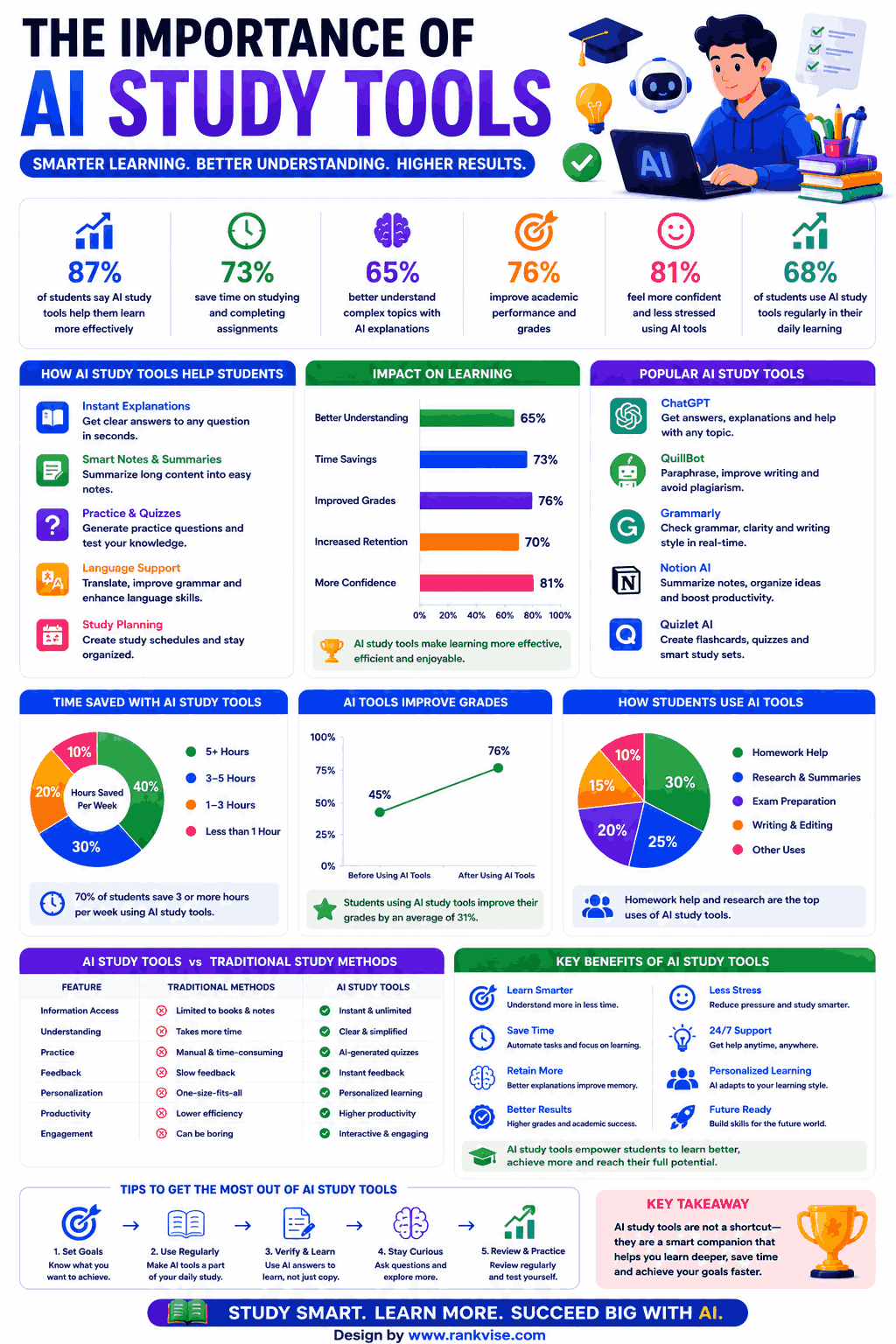
Traditional studying relies on passive reading and highlighting. Research shows active recall and spaced repetition produce 40-50% better retention. AI study tools automate these evidence-based techniques without requiring discipline to implement them manually.
These platforms also personalize learning paths. They identify your weak areas through quiz performance and focus review sessions accordingly. A textbook treats every student identically. An ai learning assistant adapts to your specific knowledge gaps every session.
The combination of personalization, active recall, and spaced repetition makes ai study tools measurably more effective than rereading notes. Students report saving 30-40% of study time while improving grades across subjects.
FAQs
Anki, Socratic by Google, Goblin Tools, and Quizlet’s free tier offer powerful study features without cost, covering flashcards, problem-solving, and task management.
Yes, tools like Prepai and Knowt generate practice questions from your materials while spaced repetition apps like Anki schedule reviews at optimal intervals for retention.
Using AI for learning and understanding is generally acceptable, but submitting AI-generated work as your own violates academic integrity policies at most institutions.
Anki dominates medical education with its spaced repetition algorithm and thousands of pre-made decks covering anatomy, pharmacology, and pathology for board exam preparation.
Absolutely. Socratic by Google, Quizlet, and Khan Academy Khanmigo are designed specifically for high school curricula and provide age-appropriate study assistance.