Finding quality leads has never been harder. Buyers are more informed, competition is fierce, and manual prospecting wastes valuable time. Traditional methods like cold calling and mass email blasts now deliver diminishing returns.
- AI enables smarter prospecting at scale by scanning millions of data points to build high-fit prospect profiles automatically.
- Predictive lead scoring ranks prospects by behavior, firmographics, and engagement to focus sales on those most likely to convert.
- Hyper-personalized outreach generates tailored emails and messages referencing industry, activity, and pain points to dramatically boost response rates.
- Select tools based on sales motion, integrations, and budget; solve one lead generation bottleneck before expanding your stack.
- Expect measurable pipeline gains within weeks as AI learns; it automates outreach and follow-up but does not replace human closers.
That is where artificial intelligence changes the game. AI tools for lead generation analyze massive datasets in seconds. They identify ideal prospects, personalize outreach, and predict which leads will actually convert. The result is less guesswork and more revenue.
Businesses using AI-powered lead generation report up to 50% more sales-ready leads. They also see significantly shorter sales cycles. These are not marginal improvements. They represent a fundamental shift in how companies build their pipeline.
How AI Transforms the Lead Generation Process
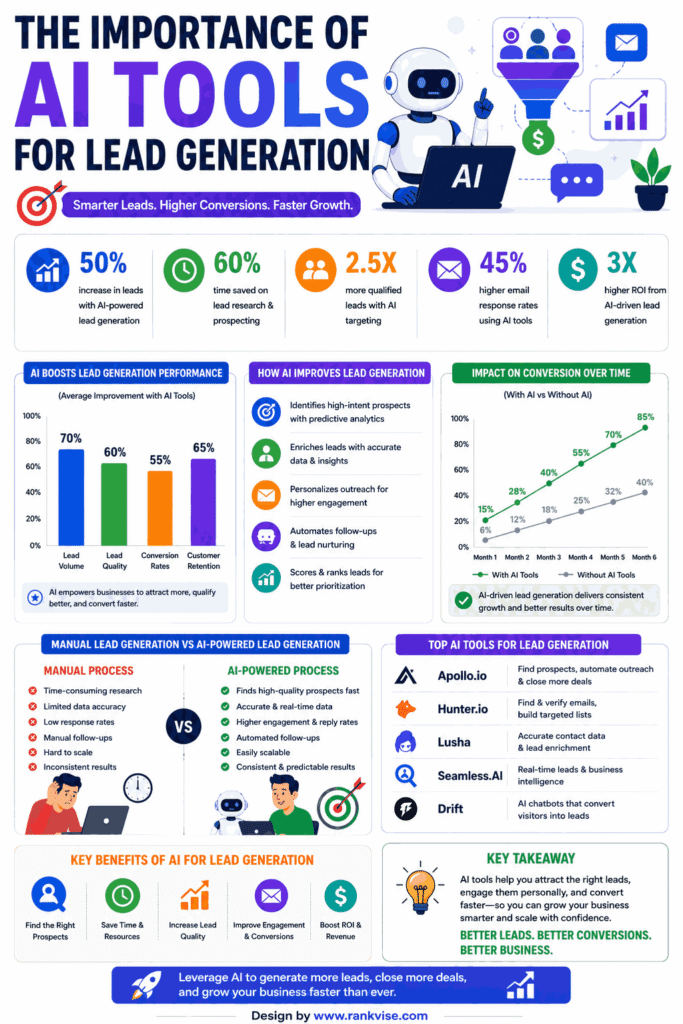
Before diving into specific tools, it helps to understand what AI actually does differently. Traditional lead generation relies on broad targeting and manual qualification. AI flips that model entirely.
Smarter Prospecting at Scale
AI scans millions of data points across websites, social platforms, and public databases. It builds detailed prospect profiles without any manual research. Sales teams receive a curated list of high-fit accounts instead of chasing random contacts.
This intelligent prospecting eliminates hours of repetitive work. Reps spend their energy on conversations, not spreadsheets. The efficiency gain compounds over weeks and months.
Predictive Lead Scoring
Not all leads deserve equal attention. AI-driven lead scoring assigns priority based on behavior, firmographics, and engagement signals. It learns from your historical conversion data to improve accuracy continuously.
A lead who visits your pricing page three times scores higher than someone who downloaded one ebook. AI detects these patterns automatically. Your team focuses on prospects most likely to buy.
Hyper-Personalized Outreach
Generic messages get ignored. AI generates tailored emails, LinkedIn messages, and ad copy based on each prospect’s unique context. It references their industry, recent activity, and specific pain points.
This level of personalization was impossible at scale before AI. Now a single rep can send hundreds of customized messages daily. Response rates increase dramatically when prospects feel understood.
10 Best AI Tools for Lead Generation in 2026
Here is a breakdown of the most effective platforms available right now, organized by their core strength.
1. Apollo.io — All-in-One Prospecting Engine
Apollo combines a massive B2B contact database with AI-powered sequencing. It identifies ideal customers based on your input criteria and automates multi-channel outreach.
- Access to over 275 million verified contacts
- AI-assisted email writing and A/B testing
- Built-in lead scoring and intent data
- Integrates with major CRMs like Salesforce and HubSpot
Apollo works well for startups and mid-market teams that need prospecting and outreach in one platform.
2. Clay — Data Enrichment Powerhouse
Clay pulls data from over 100 sources to build rich prospect profiles automatically. It then uses AI to craft personalized first lines and research summaries for each lead.
- Waterfall enrichment across multiple data providers
- AI writing assistant for outreach personalization
- Workflow automation with no-code builder
- Ideal for teams that prioritize research-driven selling
Clay is particularly valuable for account-based marketing strategies where deep personalization matters.
3. Instantly.ai — Cold Email at Scale
Instantly focuses on cold email infrastructure and AI optimization. It manages sender reputation, automates follow-ups, and uses AI to optimize send times and messaging.
- Unlimited email sending accounts
- AI-powered email warmup and deliverability tools
- Smart sequencing with conditional logic
- Campaign analytics with reply sentiment detection
Teams running high-volume outbound campaigns find Instantly essential for maintaining inbox placement.
4. Drift (Now Salesloft) — Conversational AI for Inbound
Drift uses AI chatbots to engage website visitors in real time. It qualifies leads through natural conversation and books meetings directly on sales reps’ calendars.
- AI chatbot trained on your product and sales data
- Real-time visitor identification and routing
- Integration with marketing automation platforms
- Conversational landing pages that replace static forms
Drift excels at converting inbound website traffic into qualified pipeline without human intervention.
5. Seamless.AI — Real-Time Contact Discovery
Seamless.AI uses artificial intelligence to find verified phone numbers and emails in real time. It searches the live web rather than relying solely on static databases.
- Real-time contact and company data verification
- Chrome extension for LinkedIn prospecting
- Buyer intent signals and job change alerts
- Autopilot feature for automated list building
Sales development teams use Seamless.AI to keep their contact data fresh and accurate.
6. 6sense — Intent-Based Account Intelligence
6sense detects anonymous buying signals across the web. It identifies which accounts are actively researching solutions like yours, even before they fill out a form.
- Anonymous buyer intent detection
- Predictive account scoring and segmentation
- AI-recommended actions for sales and marketing
- Deep integration with ABM workflows
Enterprise teams with longer sales cycles benefit most from the intent intelligence 6sense provides.
7. Customers.ai — Multi-Channel Visitor Identification
Customers.ai identifies anonymous website visitors and matches them to real contact profiles. It then triggers automated outreach across email, ads, and SMS.
- Website visitor identification with contact matching
- Automated email and SMS follow-up sequences
- Ad audience sync for retargeting campaigns
- Works for both B2B and B2C lead generation
E-commerce and SaaS companies use Customers.ai to recover leads that would otherwise disappear.
8. Copilot AI — LinkedIn Social Selling
Copilot AI automates LinkedIn prospecting with AI-driven messaging. It identifies high-fit connections, sends personalized outreach, and nurtures relationships through smart follow-ups.
- AI-generated LinkedIn messages based on profile analysis
- Automated connection requests and follow-up sequences
- Lead scoring based on engagement signals
- Compliance with LinkedIn usage policies
B2B teams that rely heavily on LinkedIn for pipeline building find Copilot AI a significant time saver.
9. HubSpot AI — CRM-Integrated Lead Intelligence
HubSpot has embedded AI across its entire CRM and marketing suite. Its AI features score leads, recommend next actions, and generate content for nurture campaigns.
- Predictive lead scoring within the CRM
- AI content assistant for emails, blogs, and landing pages
- Automated workflow recommendations
- Unified view of the entire customer journey
Companies already using HubSpot gain immediate value from its native AI capabilities without adding another tool.
10. Jasper — AI Content for Lead Magnets
Jasper creates high-converting marketing content that attracts and captures leads. It generates blog posts, ad copy, landing pages, and email sequences optimized for engagement.
- Brand voice training for consistent messaging
- Templates for lead magnets, ads, and email campaigns
- SEO optimization suggestions built in
- Collaboration features for marketing teams
Content-driven lead generation strategies scale much faster with Jasper handling the writing workload.
Quick Comparison: AI Lead Generation Tools at a Glance
| Tool | Best For | Starting Price | Key Strength |
|---|---|---|---|
| Apollo.io | All-in-one prospecting | Free tier available | Contact database + sequencing |
| Clay | Data enrichment | ~49 USD/month | Multi-source enrichment |
| Instantly.ai | Cold email campaigns | ~30 USD/month | Email deliverability |
| Drift (Salesloft) | Inbound conversion | Custom pricing | AI chatbots |
| Seamless.AI | Contact discovery | Free tier available | Real-time verification |
| 6sense | Buyer intent | Custom pricing | Anonymous intent data |
| Customers.ai | Visitor identification | ~199 USD/month | Cross-channel ID matching |
| Copilot AI | LinkedIn outreach | ~234 USD/month | Social selling automation |
| HubSpot AI | CRM-integrated leads | Free tier available | Native CRM intelligence |
| Jasper | Content creation | ~49 USD/month | Lead magnet generation |
How to Choose the Right AI Lead Generation Tool
Picking the right tool depends on your sales motion, budget, and team size. Here is a simple framework.
Match the Tool to Your Sales Strategy
Outbound-heavy teams need tools like Apollo, Clay, or Instantly. Inbound-focused teams benefit more from Drift or Customers.ai. Account-based sellers should prioritize 6sense for intent data.
Consider Integration Requirements
Every tool should connect with your existing CRM and tech stack. Disconnected tools create data silos. Check native integrations before committing to any platform.
Start With One Problem
Avoid buying five tools at once. Identify your biggest lead generation bottleneck first. Is it finding contacts, personalizing outreach, or qualifying inbound traffic? Solve that problem, then expand.
What Results Can You Realistically Expect?
AI tools for lead generation deliver measurable improvements, but they are not magic. Expect a ramp-up period as the AI learns your ideal customer profile and messaging patterns.
Most teams see noticeable pipeline growth within 30 to 60 days. Response rates on AI-personalized outreach typically run two to three times higher than generic templates. Lead qualification accuracy improves steadily as the system processes more data.
The biggest gains come from consistency. AI never forgets to follow up. It never skips a prospect because it is tired on a Friday afternoon. That reliability compounds into significant revenue over a full quarter.
FAQs
They are software platforms that use artificial intelligence to find, qualify, and engage potential customers automatically. They replace manual prospecting with data-driven, scalable processes.
Yes. Many tools like Apollo, Instantly, and HubSpot offer free tiers or affordable plans. Small teams often benefit the most because AI multiplies limited sales resources.
No. AI handles research, outreach, and qualification at scale. However, closing deals and building relationships still require skilled human interaction.
Most businesses notice improved pipeline quality within 30 to 60 days. Full optimization typically takes 90 days as the AI learns from your data and conversions.
Yes, when properly personalized. AI tools that reference specific prospect details achieve significantly higher open and reply rates than generic mass emails.