Online retail is more competitive than ever. Customer expectations shift fast, margins tighten, and manual marketing simply cannot keep up. AI tools for eCommerce marketing solve this problem by automating repetitive tasks, personalizing buyer journeys, and uncovering insights hidden in your data.
- Favor platforms that provide actionable automation, executing real-time actions based on data rather than passive dashboards.
- Ensure easy integration with your eCommerce platform, CRM, and ad channels to prevent data silos and speed deployment.
- Demand transparent pricing and measurable ROI through built-in reporting that ties activity directly to revenue.
- Start lean: implement one or two tools to fix your biggest bottlenecks before expanding the stack.
- Treat AI as a partner not a replacement; maintain human oversight, clean data, and review AI outputs for brand voice and accuracy.
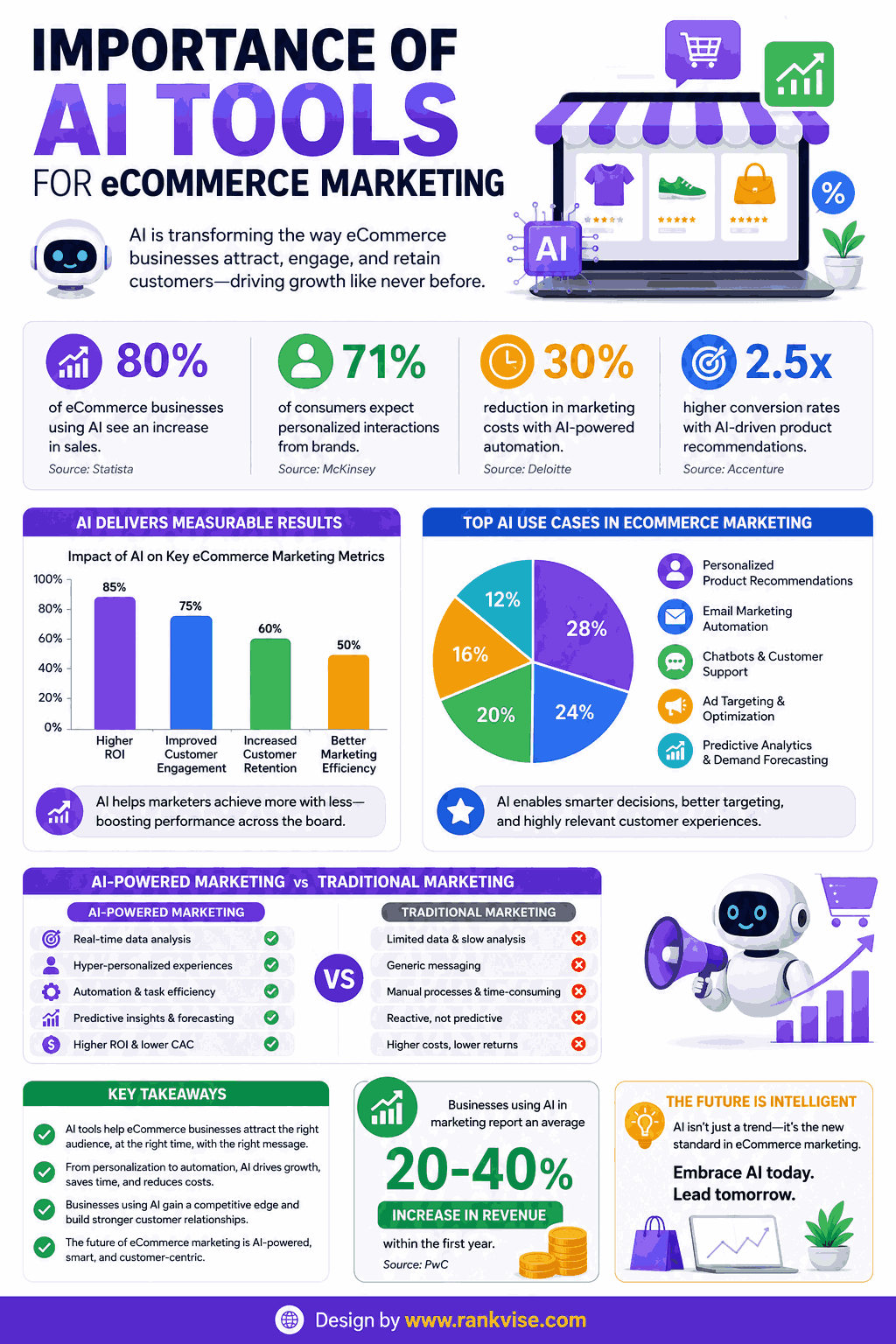
Brands using AI-driven marketing report higher conversion rates and stronger customer retention. These tools don’t replace your team. They amplify what your team can already do, freeing up hours each week for strategy and creative work.
Whether you run a Shopify store or manage a multi-channel retail operation, the right AI stack can transform how you attract, convert, and retain customers.
What Makes an AI Marketing Tool Worth Using?
Not every tool labeled “AI-powered” delivers real value. Before investing, evaluate tools based on a few essential criteria.
Look for platforms that offer:
- Actionable automation — not just dashboards, but tools that act on data in real time
- Easy integration — compatibility with your existing eCommerce platform, CRM, and ad channels
- Transparent pricing — clear costs without hidden fees as you scale
- Measurable ROI — built-in reporting that ties activity to revenue
The best AI tools for eCommerce marketing combine ease of use with genuine intelligence. They learn from your store’s data and improve performance over time without requiring a data science team.
Top 10 AI Tools for eCommerce Marketing Growth
1. Klaviyo
AI Email and SMS Marketing for Online Stores
Klaviyo dominates eCommerce email marketing for good reason. Its AI engine segments customers based on purchase behavior, predicted lifetime value, and browsing patterns. You can automate abandoned cart flows, post-purchase sequences, and win-back campaigns with precision.
The platform integrates natively with Shopify, BigCommerce, and WooCommerce. Its predictive analytics forecast when a customer will buy next, helping you time outreach perfectly.
2. Jasper
AI Content Creation for Product and Campaign Copy
Creating product descriptions, ad copy, and blog content at scale is exhausting. Jasper uses generative AI to draft high-converting marketing copy tailored to your brand voice. It supports templates for product pages, email subject lines, social posts, and landing pages.
Jasper’s brand memory feature ensures consistency across every piece of content. For eCommerce teams producing hundreds of SKU descriptions, this tool saves weeks of writing time.
3. Tidio
AI Chatbots for eCommerce Customer Engagement
Tidio combines live chat with AI-powered chatbots that handle common customer questions instantly. Its Lyro AI assistant resolves up to 70% of support queries without human intervention. It can recommend products, track orders, and guide visitors toward checkout.
For online stores, faster response times directly translate into higher conversion rates. Tidio integrates with Shopify, WordPress, and major eCommerce platforms seamlessly.
4. Dynamic Yield
AI-Powered Product Recommendations and Personalization
Dynamic Yield is an enterprise-grade personalization engine now owned by Mastercard. It delivers individualized product recommendations, personalized homepage layouts, and targeted promotions based on real-time behavior.
Retailers using this tool see measurable lifts in average order value. Its machine learning models continuously optimize which products to show each visitor, making every storefront interaction feel tailored.
5. Surfer SEO
AI-Driven Content Optimization for Organic Traffic
Organic search remains one of the most profitable channels for eCommerce. Surfer SEO analyzes top-ranking pages and provides data-backed recommendations for your product category pages, blog posts, and landing pages.
Its AI content editor scores your drafts in real time against competitors. You get clear guidance on word count, keyword usage, headings, and semantic terms. This helps online stores rank higher without guessing.
6. AdCreative.ai
AI Ad Creative Generation for Paid Campaigns
Running paid ads across Google, Meta, and TikTok requires constant creative testing. AdCreative.ai generates high-performing ad visuals and copy using AI trained on conversion data. It scores each creative before you spend a dollar.
eCommerce brands use it to produce dozens of ad variations in minutes. The platform learns which designs and messaging resonate with your audience and prioritizes winning formats automatically.
7. Omnisend
Multi-Channel Marketing Automation for eCommerce
Omnisend is purpose-built for online retail. It combines email, SMS, push notifications, and social retargeting into unified automated workflows. Its AI features include smart send-time optimization and predictive customer segmentation.
The drag-and-drop automation builder makes complex campaigns accessible. Omnisend’s pre-built eCommerce workflows for cart recovery, order confirmation, and product review requests get you running quickly.
8. Nosto
AI-Powered Commerce Experience Platform
Nosto specializes in eCommerce personalization across search, merchandising, and content. It uses behavioral AI to create individualized shopping experiences that increase engagement and revenue per visit.
Its visual merchandising tools let you control how products display dynamically. Nosto works well for mid-market and enterprise online retailers seeking deeper personalization without heavy development resources.
9. Triple Whale
AI Analytics and Attribution for eCommerce
Accurate attribution is critical for scaling paid media. Triple Whale consolidates data from Shopify, ad platforms, and analytics tools into a single AI-powered dashboard. Its AI assistant, called Moby, answers plain-language questions about your store performance.
eCommerce marketers use it to identify which campaigns actually drive profit, not just clicks. Triple Whale’s predictive models help allocate ad budgets more effectively across channels.
10. Postscript
AI SMS Marketing Built for Shopify Stores
SMS marketing delivers some of the highest engagement rates in eCommerce. Postscript focuses exclusively on this channel for Shopify merchants. Its AI tools optimize send times, segment audiences based on shopping behavior, and automate conversational flows.
The platform ensures compliance with messaging regulations while maximizing revenue per subscriber. Brands using Postscript regularly see SMS generate 20–30% of their owned-channel revenue.
How to Choose the Right AI Tools for Your Store
Selecting the right stack depends on your business size, goals, and existing tech setup. Here is a quick comparison to guide your decision.
| Business Need | Recommended Tool | Best For |
|---|---|---|
| Email and SMS automation | Klaviyo, Omnisend | Lifecycle marketing |
| Content creation at scale | Jasper | Product copy, blogs, ads |
| Customer support automation | Tidio | Real-time chat, order help |
| On-site personalization | Dynamic Yield, Nosto | Product recommendations |
| SEO and organic traffic | Surfer SEO | Content optimization |
| Paid ad creative | AdCreative.ai | Meta, Google, TikTok ads |
| Analytics and attribution | Triple Whale | Budget and ROI clarity |
| SMS-first marketing | Postscript | Shopify SMS campaigns |
Start with one or two tools that address your biggest bottleneck. Then expand your stack as your team builds confidence with AI-assisted workflows.
Common Mistakes to Avoid When Using AI in eCommerce Marketing
AI tools deliver results only when used strategically. Avoid these pitfalls:
- Over-automating without oversight — Always review AI-generated content and recommendations before they reach customers.
- Ignoring data quality — AI models are only as good as the data feeding them. Clean your customer data regularly.
- Stacking too many tools at once — Start lean. Adding five tools simultaneously creates confusion and wasted spend.
- Skipping integration planning — Ensure your tools connect smoothly with your eCommerce platform and each other.
The brands that win with AI marketing treat these tools as partners, not replacements, for human judgment.
What to Expect From AI in eCommerce Marketing Beyond Right Now
The trajectory is clear. AI will handle increasingly complex marketing decisions with less human input. Expect deeper real-time personalization, autonomous campaign management, and voice-commerce integration within the next two years.
Predictive analytics for online retail will shift from forecasting trends to prescribing specific actions. Tools will tell you not just what might happen, but exactly what to do about it. eCommerce brands that build their AI foundations now will have a significant advantage.
FAQs
Top tools include Klaviyo, Jasper, Tidio, Dynamic Yield, Surfer SEO, AdCreative.ai, Omnisend, Nosto, Triple Whale, and Postscript. Each serves a specific marketing function from email automation to ad creative generation.
AI tools personalize product recommendations, optimize send times for emails and SMS, and automate customer support. These actions reduce friction in the buying process and increase the likelihood of purchase.
Yes. Tools like Omnisend, Tidio, and Postscript offer free or affordable starter plans. Small stores can begin with one tool and scale as revenue grows.
No. AI handles data analysis, automation, and repetitive tasks efficiently. However, strategy, brand voice, and creative direction still require human expertise and decision-making.
Most leading AI marketing tools offer native integrations or plugins for Shopify and WooCommerce. Setup typically involves installing an app and connecting your store data through a guided onboarding process.