Internal links are the connective tissue of your website. They guide visitors between related pages and help search engines understand your content hierarchy. Yet most websites neglect this critical element.
- AI automates internal linking at scale, finding contextually relevant opportunities humans would miss.
- AI suggests natural, varied anchor text to improve readability while avoiding over-optimization penalties.
- Orphan page detection flags unlinked pages and recommends precise link placements to surface hidden content.
- Pick tools by need: audits, semantic linking, content optimization, or WordPress integration for an efficient workflow.
- Start with a full audit, define topic clusters, set anchor standards, and schedule regular monitoring to maintain link health.
A strong internal linking strategy distributes page authority across your entire site. It helps newer pages get indexed faster. It also keeps visitors engaged longer by surfacing relevant content at the right moment.
The problem is scale. Managing internal links manually across hundreds or thousands of pages becomes nearly impossible. Broken links pile up. New content goes unlinked. Older pages lose relevance because nobody connects them to fresh articles.
That is exactly where ai tools for internal linking deliver transformational value.
How AI Changes Internal Link Building
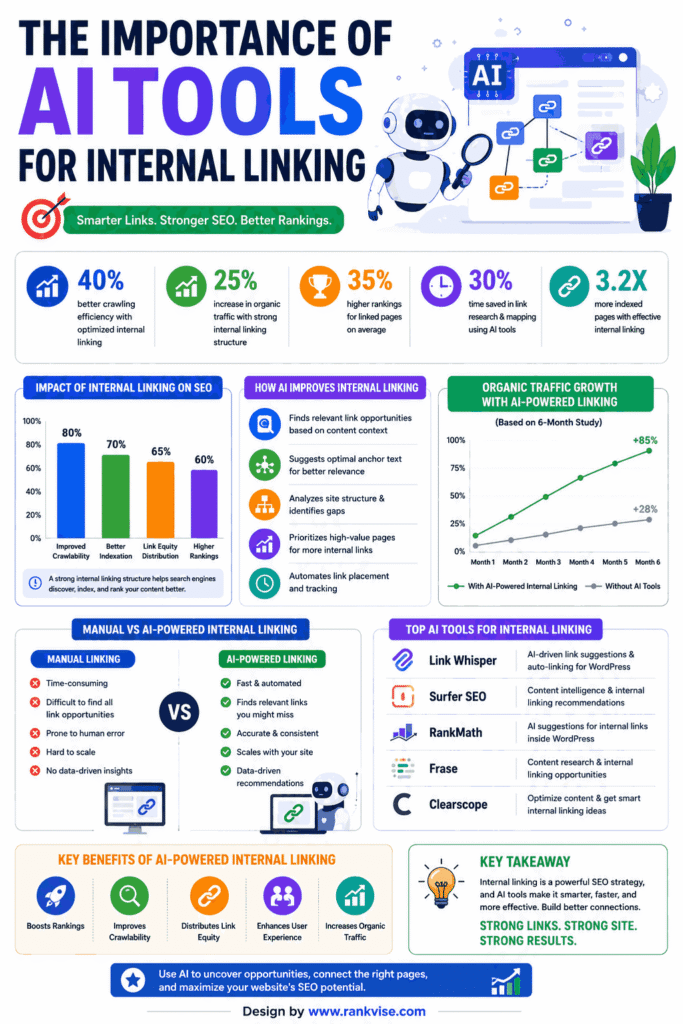
Traditional internal linking requires someone to read every page and manually decide where links belong. That approach breaks down quickly as websites grow. AI automates the entire process with precision that humans simply cannot match at scale.
Automated Link Discovery
AI crawls your entire website and maps relationships between pages. It identifies contextually relevant linking opportunities that a human editor would miss. The tool reads the actual content, not just titles or URLs.
This means every suggestion is based on topical relevance, not random guessing. A blog post about email marketing gets linked to your guide on open rates, not your unrelated product page. Context-aware linking improves both user experience and search engine optimization.
Anchor Text Optimization
Choosing the right anchor text matters for rankings and readability. AI analyzes surrounding content to suggest natural, descriptive anchor phrases. It avoids over-optimization by varying anchor text across your site.
Good anchor text tells readers and search engines what to expect on the linked page. AI ensures consistency without making every link look identical. This reduces the risk of triggering search engine penalties for manipulative linking patterns.
Orphan Page Detection
Orphan pages have no internal links pointing to them. Search engines struggle to find and rank these isolated pages. AI tools scan your entire site architecture and flag every orphan page instantly.
Once identified, the tool suggests exactly where to place links to these forgotten pages. This simple fix can rescue valuable content that was invisible to both users and crawlers.
8 Best AI Tools for Internal Linking in 2026
Here are the most effective platforms for automating and optimizing your internal link structure right now.
1. Link Whisper — WordPress-Native Linking Assistant
Link Whisper is one of the most popular automated internal linking tools for WordPress sites. It scans your content and suggests relevant internal links as you write or edit posts.
- Real-time link suggestions while editing in WordPress
- Bulk linking to add internal links across multiple posts at once
- Orphan content report to find unlinked pages
- Broken link detection and cleanup tools
- Customizable settings to exclude specific pages or categories
Link Whisper works best for bloggers and content-heavy WordPress sites that publish frequently.
2. Yoast SEO Premium — Structured Linking Within Your CRM
Yoast SEO Premium includes an internal linking suggestion feature powered by content analysis. It recommends related posts and cornerstone content links directly inside the WordPress editor.
- Suggestions based on cornerstone content strategy
- Readability and SEO analysis alongside link recommendations
- Internal link counter for every page
- Seamless integration with the broader Yoast SEO plugin
- Redirect manager to preserve link equity during URL changes
Teams already using Yoast benefit from having link suggestions within their existing workflow.
3. Screaming Frog + AI Integration — Technical SEO Powerhouse
Screaming Frog is a website crawler that provides deep insight into your site structure. Paired with AI extensions or custom scripts, it becomes a powerful internal link audit tool.
- Comprehensive site crawl with link mapping
- Identifies orphan pages, redirect chains, and broken links
- Exportable data for custom AI-driven link analysis
- Visualization of site architecture and link depth
- Integrates with Google Search Console and Analytics
SEO professionals use Screaming Frog to audit large sites before implementing AI-suggested link improvements.
4. Surfer SEO — Content Optimization With Link Guidance
Surfer SEO analyzes top-ranking pages and recommends content structure, including internal linking opportunities. Its AI content editor highlights where links should appear based on competitive analysis.
- NLP-driven content analysis with link placement cues
- Audit feature that evaluates existing internal link distribution
- Content planner that maps topic clusters for strategic linking
- SERP analyzer to benchmark against competitor link structures
- Works alongside Google Docs and WordPress
Surfer SEO suits teams that want internal linking recommendations as part of a broader content optimization workflow.
5. InLinks — Entity-Based Linking Automation
InLinks uses natural language processing to understand entities and topics across your website. It automatically inserts internal links based on semantic relationships, not just keyword matching.
- Automated link insertion using entity recognition
- Knowledge graph visualization of your site content
- Schema markup generation for enhanced search visibility
- Topic cluster mapping and content gap analysis
- Supports multiple languages for international sites
InLinks is particularly strong for websites focused on topical authority and semantic SEO strategies.
6. Linkilo — Lightweight WordPress Linking Plugin
Linkilo offers a streamlined approach to internal link management for WordPress. It provides AI-driven suggestions without the complexity of enterprise-level platforms.
- Automatic internal link suggestions based on content relevance
- Focus keyword tracking for anchor text optimization
- Outbound and inbound link reporting per page
- Easy bulk editing for link updates
- Affordable pricing for small to mid-size sites
Smaller publishers and niche site owners find Linkilo a cost-effective alternative to heavier tools.
7. Ahrefs — Site Audit With Link Opportunity Reports
Ahrefs includes powerful internal link analysis within its site audit tool. It identifies linking opportunities, orphan pages, and pages with low internal link counts.
- Site audit that flags internal linking issues automatically
- Link opportunity report showing where to add connections
- Content explorer to find related pages on your domain
- Page-level link equity analysis
- Integration with keyword tracking and backlink data
Teams using Ahrefs for backlink research gain internal linking intelligence without adding another subscription.
8. SEMrush Site Audit — Comprehensive Link Health Monitoring
SEMrush audits your site structure and highlights internal linking errors and opportunities. Its AI-assisted recommendations prioritize fixes based on potential ranking impact.
- Internal link distribution analysis across your domain
- Crawl depth optimization suggestions
- Broken link and redirect chain detection
- Page authority flow visualization
- Automated re-crawl scheduling for ongoing monitoring
Enterprise marketing teams rely on SEMrush for continuous internal link health management alongside broader SEO campaigns.
Quick Comparison: AI Internal Linking Tools
| Tool | Best For | Platform | Key Strength |
|---|---|---|---|
| Link Whisper | WordPress bloggers | WordPress plugin | Real-time link suggestions |
| Yoast SEO Premium | Cornerstone content | WordPress plugin | Integrated SEO workflow |
| Screaming Frog | Technical audits | Desktop application | Deep crawl analysis |
| Surfer SEO | Content optimization | Web-based | Competitive link benchmarking |
| InLinks | Semantic linking | Web-based | Entity-based automation |
| Linkilo | Small WordPress sites | WordPress plugin | Lightweight and affordable |
| Ahrefs | SEO professionals | Web-based | Link opportunity reports |
| SEMrush | Enterprise teams | Web-based | Comprehensive site audits |
How to Build an Effective AI-Powered Internal Linking Strategy
Buying a tool is only the first step. You need a clear process to get real results from automated linking.
Audit Your Current Link Structure First
Run a full site crawl before adding any new links. Identify broken links, orphan pages, and pages with excessive or insufficient internal links. This baseline tells you exactly where to focus.
Define Your Topic Clusters
Group related content into clusters around core themes. Each cluster needs a pillar page that connects to all supporting articles. AI tools for internal linking work best when your content architecture follows a logical hierarchy.
Set Quality Standards for Anchor Text
Let AI suggest anchor phrases, but review them for natural readability. Anchors should describe the destination page clearly. Avoid generic phrases like “click here” or “read more” that add no contextual value.
Monitor and Maintain Regularly
Internal links break when you delete or redirect pages. Schedule monthly audits using your chosen tool. Automated monitoring catches issues before they hurt your crawl efficiency or user experience.
Real Results You Can Expect From Better Internal Linking
Sites that optimize internal links consistently see measurable improvements. Crawl efficiency increases because search engines navigate your content more effectively. Page authority flows to the pages that matter most for conversions.
Most websites notice improved keyword rankings within 30 to 60 days of fixing internal link issues. Pages that previously sat on page two often jump to page one simply by receiving more contextual internal links.
Bounce rates drop when visitors find relevant content through well-placed links. Average session duration increases as people explore connected topics. These engagement signals reinforce your rankings over time, creating a positive feedback loop.
FAQs
They are software platforms that use artificial intelligence to automatically find, suggest, and manage internal links across your website. They replace manual linking with data-driven, scalable automation.
Yes. Proper internal links distribute page authority and help search engines understand your content structure. This directly supports higher rankings for target keywords.
Link Whisper and Linkilo are the most popular WordPress-specific options. Both offer real-time suggestions, orphan page detection, and bulk link management inside the WordPress editor.
Run a thorough audit at least once per month. Schedule automated crawls with tools like Screaming Frog or SEMrush to catch broken links and new opportunities regularly.
Yes. Tools like InLinks, Ahrefs, and SEMrush handle sites with thousands of pages efficiently. They are designed specifically for scale and automate tasks that would take humans weeks to complete manually.