Backlinks remain one of Google’s strongest ranking signals. Every link pointing to your site acts as a vote of confidence from another domain. But not all links carry equal weight. Some boost your rankings, while others quietly damage them.
- Prefer tools that score link quality, detect toxic links, analyze anchor text, and track new or lost backlinks.
- Use AI-driven platforms to surface competitor backlink opportunities and prioritize high-value prospects automatically.
- Integrate outreach and disavow workflows to move from analysis to action without manual gaps.
- Avoid common mistakes: prioritize relevance over quantity, audit toxicity regularly, and maintain anchor text diversity.
- Test tools with free trials, match choice to budget and team size, and enable automated monitoring for real-time alerts.
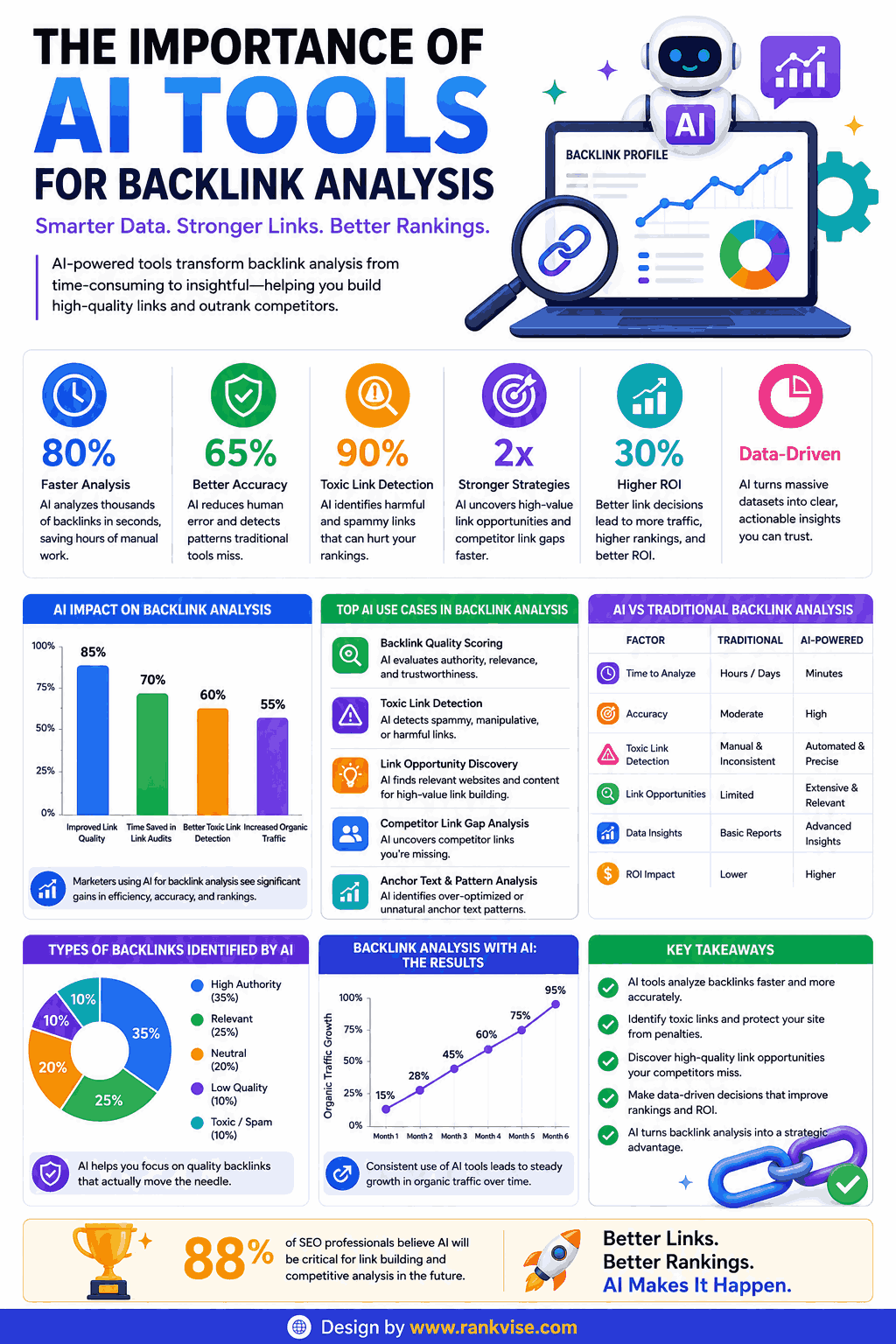
AI tools for backlink analysis help you separate valuable links from harmful ones. They reveal where your competitors earn their best links. They also surface new opportunities you would never find manually. In a landscape where link quality matters more than quantity, these tools are essential.
Without proper backlink monitoring, you risk losing rankings to negative SEO or missing high-value link prospects hiding in plain sight.
What Should a Good Backlink Analysis Tool Offer?
The right tool does more than count your backlinks. It provides context, quality signals, and actionable next steps. Here is what to look for when evaluating options.
Key capabilities include:
- Link quality scoring — Assess whether a backlink helps or hurts your site based on domain authority, relevance, and trust metrics
- Competitor backlink research — See exactly which sites link to your competitors and identify gaps in your own profile
- Toxic link detection — Flag spammy or harmful links that could trigger search engine penalties
- New and lost link tracking — Monitor your backlink profile in real time so you catch changes immediately
- Anchor text analysis — Understand the distribution of anchor text across your link profile to maintain a natural pattern
- Outreach integration — Connect link prospects directly to email outreach workflows for efficient link building
The best AI tools for backlink analysis combine these features with machine learning that improves recommendations over time.
Top 10 AI Tools for Backlink Analysis
1. Ahrefs
The Industry Standard for Backlink Research
Ahrefs maintains one of the largest live backlink indexes on the web, crawling over 8 billion pages daily. Its Site Explorer tool lets you analyze any domain’s complete backlink profile in seconds. You see referring domains, anchor text distribution, link growth trends, and domain rating all in one dashboard.
The tool excels at competitor backlink research. Enter a rival’s URL and discover every site linking to them. Ahrefs also flags potentially toxic links and tracks new and lost backlinks with daily email alerts.
2. SEMrush
All-in-One SEO Suite With Deep Link Analytics
Semrush offers a comprehensive backlink analytics module within its broader SEO platform. Its Backlink Audit tool uses AI-powered toxicity scoring to evaluate every link pointing to your domain. You can send disavow lists directly to Google from within the platform.
The Backlink Gap tool compares your link profile against up to five competitors simultaneously. This reveals exactly where your rivals earn links that you do not. Semrush also integrates link building outreach, making it a complete solution from analysis to action.
3. Moz Link Explorer
Domain Authority Pioneer With Trusted Metrics
Moz created the widely used Domain Authority metric, and its Link Explorer tool leverages that foundation. It analyzes your backlink profile using spam score detection, linking domain quality, and anchor text patterns. The interface is clean and accessible even for SEO beginners.
Moz’s spam score helps you identify risky links before they cause ranking damage. The tool tracks your domain authority over time so you can measure how your link building efforts impact overall site strength.
4. Search Atlas
AI-Powered SEO Platform With Smart Link Intelligence
Search Atlas centralizes backlink analysis alongside content optimization, keyword research, and technical audits. Its AI engine evaluates link quality beyond basic metrics, considering topical relevance and contextual placement.
The platform identifies link building opportunities by analyzing content gaps between your site and top-ranking competitors. Search Atlas suits teams that want backlink analysis integrated into a broader AI-driven SEO workflow rather than a standalone tool.
5. Majestic
Specialized Backlink Database With Unique Trust Metrics
Majestic focuses exclusively on link intelligence. It offers two proprietary metrics, Trust Flow and Citation Flow, that measure link quality and quantity independently. This dual-metric approach gives you a nuanced view of your backlink profile’s health.
The tool’s historic index stretches back years, allowing you to analyze long-term link trends. Majestic’s Topical Trust Flow feature maps links to specific industries, showing whether your backlinks come from relevant or unrelated sources. This level of detail is valuable for spotting unnatural link patterns.
6. SE Ranking
Affordable Backlink Checker With AI-Enhanced Insights
SE Ranking delivers robust backlink monitoring at a price point accessible to small businesses and freelancers. Its backlink checker evaluates referring domains, anchor texts, and link attributes like dofollow versus nofollow status.
The platform recently integrated AI-powered insights that highlight the most impactful link opportunities based on your niche. SE Ranking also provides a backlink gap analysis tool and automated alerts for new or lost links. It offers strong value for teams that need reliable data without enterprise-level pricing.
7. Linkody
Lightweight Link Monitoring and Disavow Management
Linkody focuses on real-time backlink monitoring with a simple, no-frills interface. It tracks every new and lost backlink and sends instant notifications. The tool evaluates link quality using metrics from Moz and Majestic combined.
Its built-in disavow file generator simplifies toxic link management. Linkody works well for agencies managing multiple client sites that need ongoing link surveillance without the complexity of larger platforms.
8. BuzzSumo
Content-Driven Backlink Discovery
BuzzSumo takes a content-first approach to link analysis. It shows you which pieces of content in your niche attract the most backlinks. This reveals the topics, formats, and angles that earn links organically.
By analyzing top-linked content from competitors, you can reverse-engineer a content strategy that naturally attracts referring domains. BuzzSumo bridges the gap between content marketing and link building, making it uniquely useful for teams focused on earning links through valuable content.
9. Monitor Backlinks
Simple Tracking With Competitor Intelligence
Monitor Backlinks provides straightforward link tracking combined with competitor monitoring. You add competitor domains and the tool alerts you whenever they gain new backlinks. This creates a continuous stream of link prospecting opportunities.
The platform integrates with Google Analytics and Search Console for deeper performance context. Its keyword tracking feature connects your backlink growth directly to ranking changes, helping you prove the ROI of link building campaigns.
10. Respona
AI Link Prospecting and Outreach Automation
Respona combines backlink analysis with AI-powered outreach in one platform. It identifies link building opportunities by analyzing competitor backlinks, unlinked brand mentions, and content relevant to your niche. The AI then personalizes outreach emails at scale.
For teams that want to move from analysis to action quickly, Respona eliminates the gap between finding link prospects and contacting them. Its automated follow-up sequences improve response rates significantly compared to manual outreach.
How to Choose the Right Backlink Analysis Tool
Your choice depends on budget, team size, and what stage of link building you prioritize. Use this comparison to narrow your options.
| Primary Need | Recommended Tool | Best For |
|---|---|---|
| Comprehensive backlink research | Ahrefs | Deep competitive link analysis |
| All-in-one SEO with link audits | Semrush | Teams needing a full SEO platform |
| Domain authority tracking | Moz Link Explorer | Beginners and DA-focused strategies |
| AI-integrated SEO workflow | Search Atlas | AI-first marketing teams |
| Trust-based link evaluation | Majestic | Advanced link quality assessment |
| Budget-friendly monitoring | SE Ranking, Linkody | Small businesses and freelancers |
| Content-driven link strategy | BuzzSumo | Content marketers earning organic links |
| Outreach automation | Respona | Teams scaling link building campaigns |
Start with one tool that matches your immediate priority. Most platforms offer free trials, so test before committing to an annual plan.
Common Backlink Analysis Mistakes That Hurt Your Rankings
Even experienced marketers make errors when analyzing their link profiles. Avoid these pitfalls:
- Chasing quantity over quality — One link from a high-authority, relevant site outperforms dozens of low-quality links. Focus on domain relevance and trust.
- Ignoring toxic backlinks — Spammy links accumulate over time. Audit your profile quarterly and disavow harmful links before they trigger ranking drops.
- Copying competitor strategies blindly — Competitor backlink data reveals opportunities, not a blueprint. Adapt their approach to your own content and audience.
- Neglecting anchor text diversity — An unnatural anchor text profile signals manipulation to search engines. Maintain a healthy mix of branded, generic, and keyword-rich anchors.
- Analyzing once and forgetting — Backlink profiles change constantly. Set up automated monitoring to stay informed about new links, lost links, and shifts in link quality.
Consistent analysis and proactive management keep your backlink profile healthy and your rankings stable.
Where AI Is Taking Backlink Analysis Next
AI will continue transforming how marketers approach link building and analysis. Expect tools to predict which content will earn backlinks before you publish it. Automated link quality scoring will become more sophisticated, factoring in contextual relevance, user engagement on linking pages, and real-time trust signals.
Predictive link prospecting will identify outreach targets based on publisher behavior patterns, not just static domain metrics. The tools that integrate these capabilities will save marketers hours each week while delivering stronger, more sustainable link profiles.
FAQs
Top tools include Ahrefs, Semrush, Moz Link Explorer, Search Atlas, Majestic, SE Ranking, Linkody, BuzzSumo, Monitor Backlinks, and Respona. Each specializes in different aspects of link analysis and building.
These tools evaluate links based on spam scores, domain trust metrics, link placement context, and known patterns of manipulative link schemes. They flag suspicious links and help you create disavow files for Google.
Yes. Google Search Console provides basic backlink data for free. Ahrefs offers a free backlink checker with limited results. Moz also provides free access to a simplified version of its Link Explorer tool.
Perform a full backlink audit at least once per quarter. Set up automated monitoring with tools like Linkody or Semrush to receive daily or weekly alerts about new, lost, or potentially harmful backlinks.
Absolutely. Tools like Ahrefs and Semrush let you enter any competitor domain and see their complete backlink profile. The backlink gap feature reveals sites linking to competitors but not to you, creating a ready-made list of outreach targets.