Knowing where your pages rank is the foundation of every SEO strategy. Without reliable position data, you are making decisions in the dark. You cannot improve what you cannot measure.
- AI-powered anomaly detection flags sudden ranking shifts instantly, enabling fast response to updates and optimization campaigns.
- SERP feature monitoring reveals true visibility beyond position numbers by tracking featured snippets, local packs, images, and AI overviews.
- Choose tools based on scale, reporting needs, SERP coverage, and integrations so data fits workflows from freelancers to enterprise teams.
Search results have grown increasingly complex. Featured snippets, local packs, AI overviews, and video carousels all compete for visibility. A simple “position 3” ranking no longer tells the full story. You need tools that capture the complete picture of how your pages appear in search.
Manual rank checking is unreliable and impossibly slow at scale. Search engines personalize results based on location, device, and browsing history. What you see when you Google your keyword is not what your customers see.
That is why ai tools for rank tracking have become essential for any serious SEO effort.
How AI Makes Rank Tracking Smarter
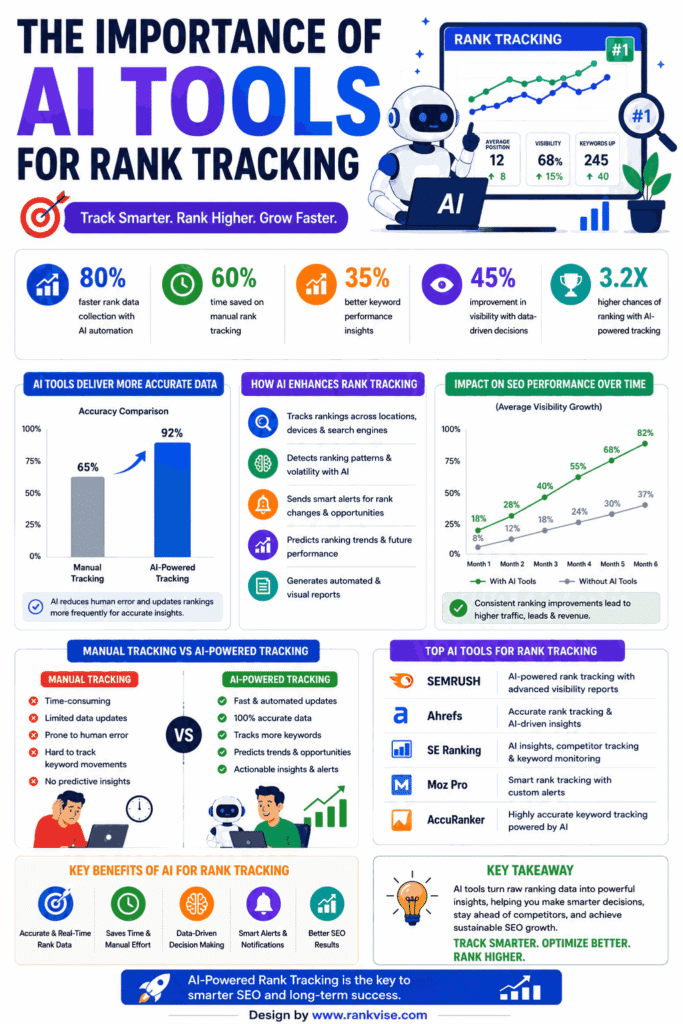
Traditional rank trackers simply check keyword positions on a schedule. AI-powered platforms go much further. They interpret data, spot patterns, and surface insights that would take analysts hours to uncover manually.
Automated Ranking Anomaly Detection
AI monitors your keyword positions continuously and flags unusual movements instantly. A sudden drop across multiple pages might signal a Google algorithm update. A sharp rise could confirm that your latest optimization effort is working.
Without AI, you would need to review hundreds of keywords individually to spot these trends. Automated anomaly detection saves time and prevents you from missing critical ranking shifts that demand immediate action.
Competitive Intelligence at Scale
AI rank tracking tools monitor your competitors alongside your own keywords. They identify when a competitor gains or loses visibility and explain the likely cause. This intelligence helps you react to market changes before they erode your traffic.
Some platforms even predict competitive threats. They analyze content freshness, backlink velocity, and technical changes across rival domains. You receive early warnings rather than discovering problems after traffic has already declined.
SERP Feature Monitoring
Rankings now extend beyond traditional blue links. AI tools track your presence across featured snippets, people also ask boxes, knowledge panels, image packs, and AI-generated overviews. This comprehensive SERP tracking reveals your true search visibility.
A page ranking in position four might actually capture more clicks than position one if it owns the featured snippet. AI tools quantify this visibility so you understand your actual performance, not just your position number.
9 Best AI Tools for Rank Tracking in 2026
Here are the most capable platforms for monitoring keyword rankings with AI-powered intelligence.
1. SE Ranking — Comprehensive Keyword Position Monitoring
SE Ranking delivers accurate daily rank tracking across Google, Bing, and Yahoo with granular location targeting. Its AI features highlight ranking trends and suggest optimization priorities.
- Daily rank updates with 100% accuracy guarantee
- Tracking across desktop, mobile, and tablet devices
- Local rank tracking down to zip code level
- SERP feature tracking including AI overviews and featured snippets
- Competitor comparison with side-by-side ranking analysis
SE Ranking suits agencies and in-house teams that need reliable, detailed position data at a competitive price.
2. Semrush Position Tracking — Enterprise-Level Rank Intelligence
Semrush offers one of the most feature-rich keyword tracking tools on the market. Its AI layers surface cannibalization issues, trending keywords, and visibility score changes automatically.
- Daily position updates across multiple search engines
- Cannibalization detection when multiple pages target the same keyword
- Visibility trend analysis with historical comparison
- Custom tagging and grouping for organized keyword management
- Landscape analysis showing your market share against competitors
Enterprise teams and agencies managing large keyword portfolios rely on Semrush for depth and scalability.
3. Ahrefs Rank Tracker — Backlink-Enriched Ranking Data
Ahrefs combines rank tracking with its industry-leading backlink database. This integration lets you correlate ranking changes directly with link profile shifts.
- Scheduled rank tracking with flexible update frequencies
- SERP overview showing all competitors for each keyword
- Traffic potential estimates beyond simple search volume
- Country, state, and city-level tracking options
- Integration with site audit and content explorer tools
SEO professionals who value backlink context alongside ranking data find Ahrefs especially useful.
4. AccuRanker — Speed-Focused Rank Tracking Platform
AccuRanker is built for speed and precision. It delivers on-demand ranking updates in seconds rather than waiting for scheduled daily checks. Its AI analyzes ranking volatility across your entire keyword set.
- On-demand rank refresh with results in under 30 seconds
- Share of voice metric showing overall search visibility
- AI-driven landing page analysis and optimization cues
- Dynamic competitor discovery based on keyword overlap
- API access for custom reporting and dashboard integration
AccuRanker works best for teams that need real-time data during active optimization campaigns.
5. SERPWatcher by Mangools — Simple, Visual Rank Monitoring
SERPWatcher offers a clean, intuitive interface that makes rank tracking accessible for beginners and small teams. Its performance index distills complex data into a single actionable metric.
- Daily rank tracking with clean visual dashboards
- Performance index that combines position and search volume impact
- Interactive charts showing ranking history over time
- Desktop and mobile tracking with location targeting
- Email alerts for significant ranking changes
Small businesses and freelance SEOs appreciate SERPWatcher for its simplicity and affordable pricing.
6. Wincher — Lightweight Daily Rank Tracking
Wincher provides straightforward daily rank monitoring with keyword suggestions and competitor tracking. Its AI features focus on identifying quick-win opportunities based on current rankings.
- Automatic daily position tracking across Google
- Keyword suggestions based on Google Search Console data
- Competitor tracking with ranking overlap analysis
- Annotation feature to mark algorithm updates and site changes
- Simple reporting with PDF and CSV export options
Content teams use Wincher to monitor publishing impact without the complexity of enterprise tools.
7. Nightwatch — Deep Local and Global Rank Intelligence
Nightwatch specializes in precise local rank tracking across thousands of locations simultaneously. Its AI identifies location-specific trends and opportunities that broader tools often miss.
- Tracking across over 100,000 locations worldwide
- Google Maps and local pack position monitoring
- Segmented views by keyword groups, locations, and devices
- Automated reporting with white-label options
- Search visibility graphs with competitor benchmarking
Local SEO agencies and multi-location businesses depend on Nightwatch for granular geographic ranking data.
8. Advanced Web Ranking — Agency-Grade Reporting Platform
Advanced Web Ranking focuses on flexible, white-label reporting alongside accurate rank tracking. Its AI features automate report generation and highlight the metrics clients care about most.
- Tracking across Google, Bing, YouTube, and Amazon
- White-label reports with custom branding and scheduling
- Unlimited on-demand ranking checks
- Market share analysis across your competitive landscape
- API integration for custom dashboard builds
Agencies that deliver regular client reports choose Advanced Web Ranking for its presentation capabilities.
9. Serpstat — All-in-One SEO Platform With Rank Monitoring
Serpstat includes rank tracking as part of its broader SEO toolkit. Its AI capabilities connect ranking data to content audits, backlink analysis, and keyword research in one unified workspace.
- Daily and on-demand position tracking
- Keyword clustering by search intent and topic
- Visibility trends with competitor comparison
- Site audit integration to connect technical issues with ranking drops
- Team collaboration features with role-based access
Teams wanting a single platform for keyword research, tracking, and site audits find Serpstat a cost-effective choice.
Quick Comparison: AI Rank Tracking Tools
| Tool | Best For | Update Frequency | Starting Price | Key Strength |
|---|---|---|---|---|
| SE Ranking | Accurate daily tracking | Daily | ~55 USD/month | Location-level precision |
| Semrush | Enterprise portfolios | Daily | ~129 USD/month | Cannibalization detection |
| Ahrefs | Backlink correlation | Varies | ~99 USD/month | Link + rank integration |
| AccuRanker | Real-time data needs | On-demand | ~129 USD/month | Instant rank refresh |
| SERPWatcher | Beginners | Daily | ~29 USD/month | Simple visual interface |
| Wincher | Lightweight monitoring | Daily | ~39 USD/month | Quick-win identification |
| Nightwatch | Local SEO tracking | Daily | ~39 USD/month | Hyper-local precision |
| Advanced Web Ranking | Agency reporting | On-demand | ~49 USD/month | White-label reports |
| Serpstat | All-in-one SEO | Daily | ~59 USD/month | Unified SEO workspace |
How to Choose the Right AI Rank Tracking Tool
Selecting the best platform depends on your specific situation. Consider these factors before committing.
Define Your Tracking Scale
Count how many keywords you need to monitor across how many locations. Small blogs tracking 100 keywords need very different tools than agencies monitoring 50,000 keywords across dozens of markets. Match the platform to your actual volume requirements.
Evaluate SERP Feature Coverage
Basic position tracking is no longer sufficient. Ensure your tool monitors featured snippets, AI overviews, local packs, and other SERP features relevant to your keywords. Missing this data means missing a significant portion of your search visibility.
Consider Your Reporting Needs
Freelancers may only need a simple dashboard. Agencies require white-label PDF reports with client branding. Enterprise teams often need API access for custom dashboards. Choose a tool that matches how you consume and share ranking data.
Check Integration With Your Existing Stack
Your rank tracking tool should connect to Google Search Console, Analytics, and your preferred SEO platforms. Isolated data creates blind spots. Native integrations reduce manual work and improve the accuracy of your analysis.
What Meaningful Improvements Can You Expect?
Teams that switch to ai tools for rank tracking typically save five to ten hours weekly on manual position checking and reporting. That time shifts directly into optimization work that actually moves rankings.
Automated anomaly alerts help teams respond to algorithm updates within hours instead of days. Faster response times minimize traffic losses during volatile ranking periods. Competitive tracking reveals content gaps you can exploit before rivals notice them.
The compounding benefit is better decision-making. When you see exactly how every keyword moves after each change you make, your optimization strategy becomes increasingly precise. Every future action is informed by reliable data rather than assumption.
FAQs
They are software platforms that use artificial intelligence to monitor keyword positions in search engines automatically. They detect ranking trends, flag anomalies, and provide actionable optimization insights.
Daily tracking is standard for active SEO campaigns. On-demand checks work best during time-sensitive optimizations. Avoid checking manually, as personalized search results skew accuracy.
Yes. Tools like Nightwatch and SE Ranking track rankings at city and zip code levels. Local rank monitoring is essential for businesses serving specific geographic areas.
Rank tracking monitors your keyword positions. SERP tracking also captures featured snippets, AI overviews, image packs, and other search result features. The best tools do both
Free tools offer limited accuracy and keyword volume. They work for basic monitoring of a few keywords. Professional campaigns need paid tools for reliable daily data across hundreds or thousands of keywords.