For about 15 years, local SEO had one scoreboard. You wanted to be in the top three of the map pack and on page one of the blue links. Everything you did (citations, reviews, the Google Business Profile, backlinks) laddered up to that one goal: rank higher, get clicked.
That scoreboard still exists. It just isn’t the only one anymore.
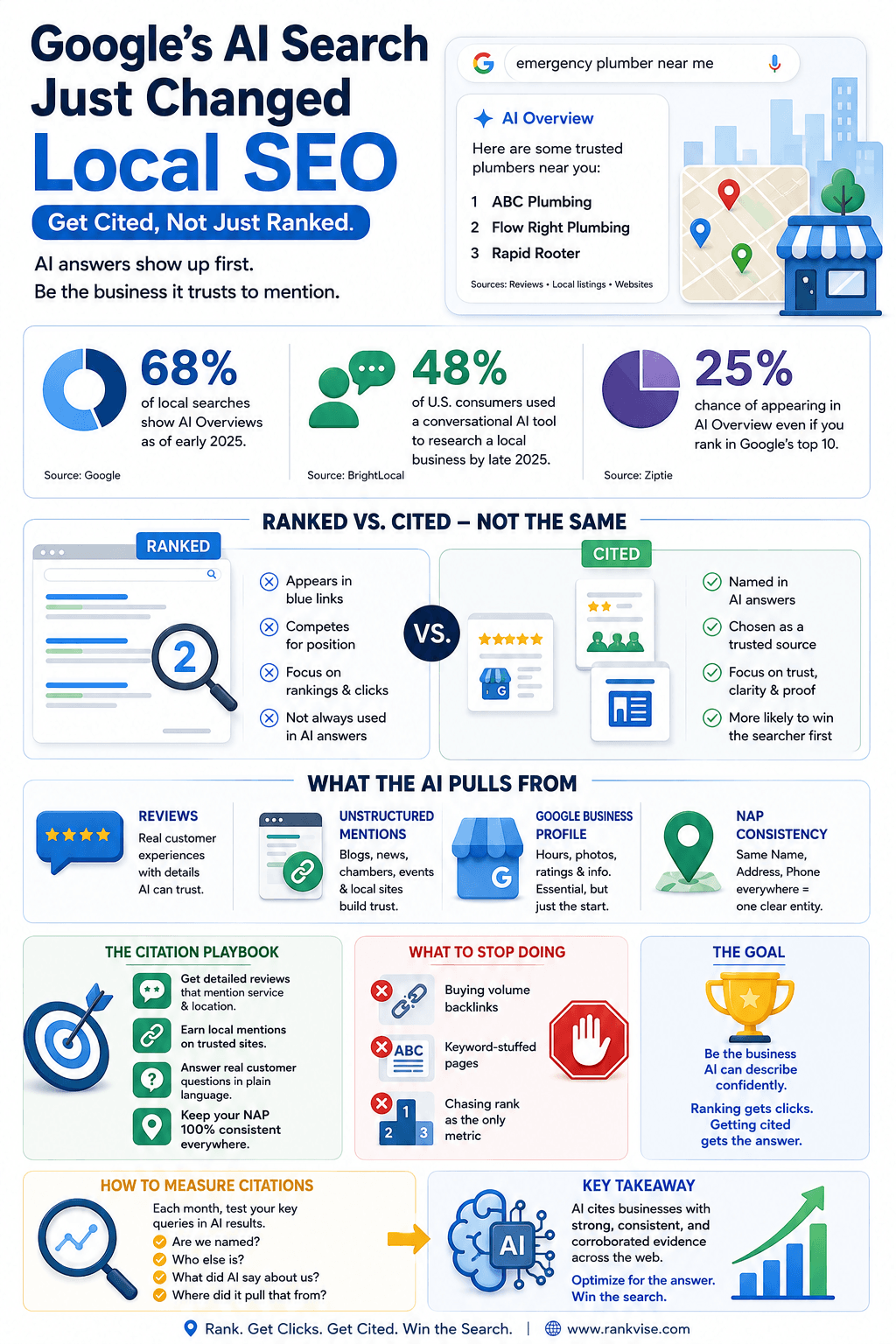
When someone searches “emergency plumber near me” or “who does commercial HVAC in Chandler” today, a large share of them see an AI-generated answer before they ever reach the map pack. Google’s own data has AI Overviews showing up on roughly 68% of local searches as of early 2025, and by late 2025 around 48% of U.S. consumers said they’d used a conversational AI tool to research a local business. The AI reads a few sources, writes a paragraph, and names two or three businesses. If you’re one of the named businesses, you win the query before the competition gets a scroll. If you’re not, your page-one ranking is now a runner-up finish that the searcher may never see.
Ranking and getting cited have become two different jobs. Here’s what changed, and what to do about it.
Being Ranked & Being Cited are Not The Same Signal
The instinct is to assume these are the same thing wearing different clothes. Rank well, get cited, done. The data says otherwise. A Ziptie study found that being in the top ten of Google’s organic results gives your business only about a 25% chance of appearing in the AI Overview for that query. Three out of four times, the pages Google ranks are not the sources Google’s AI quotes.
Think about what that means. You can do everything the old playbook rewards, land in position two, and still watch the AI answer name two competitors and leave you out. The AI isn’t ranking pages against each other. It’s assembling an answer, and it pulls the pieces of that answer from wherever the most usable, most corroborated information lives. Sometimes that’s the top-ranked page. Often it’s a review, a chamber of commerce listing, or a sentence buried in a local news write-up.
If you understand how retrieval-augmented systems work, this will sound familiar. A retrieval system doesn’t answer from memory. It searches available documents first, then writes an answer based on what it found. Google’s AI is doing a version of the same thing across the open web plus its own business data. The question you should be asking is no longer “does my page rank?” It’s “when the AI goes looking for information about my kind of business in my city, does it find enough clean, consistent, corroborated material about me to feel safe citing?”
What The AI Actually Pulls From
Based on how AI Mode and AI Overviews have behaved through 2025 and into 2026, a few sources carry outsized weight for local and service queries.
Reviews do a lot of the work. Review content has turned out to be one of the main things Google’s AI surfaces in response to local prompts, and not just the star rating. The AI reads what customers actually wrote. A review that says “they fixed our rooftop unit the same day in July” is a specific, corroborating detail the AI can lean on. There’s a wrinkle worth knowing: a GatherUp study found 67% of consumers don’t rigorously fact-check the sources an AI cites. So when the AI repeats something your reviews establish, most people take it at face value. Your reviews are writing your first impression for you, which is exactly why reviews and authority signals have become their own SEO discipline.
Unstructured mentions matter more than they used to. This is the part traditional local SEO underrated for years. Mentions of your business across blogs, community pages, sponsorship pages, industry association sites, and local news show up heavily in AI answers, sometimes more than the ranking signals we’re used to optimizing. The AI treats a mention on the Greater Phoenix Chamber site or a “preferred vendors” page on a partner’s website as a small piece of evidence that you exist, do this work, and are connected to this place. Enough of those pieces, and you become a safe entity to name.
The Google Business Profile still feeds the basics. Hours, phone, rating, photos, category. AI Mode pulls this, and it needs to be right. But a complete profile is table stakes now, not an advantage. Everyone has one. It gets you into the pool of “businesses Google knows about.” It doesn’t get you cited on its own. If the profile is your starting point, earning organic visits to your Google Business Profile is the right groundwork, but don’t mistake it for the finish line.
Name, address, and phone consistency is the quiet foundation under all of it. If your business shows up as three slightly different names across your site, your profile, and a dozen directories, you’ve made yourself harder to resolve into a single confident entity.
The AI can’t be sure the five-star reviews and the chamber listing and the website all describe the same company. Inconsistency doesn’t just cost you a ranking point. It makes you a riskier thing to cite.
The Citation Playbook For Service Businesses
None of this requires a new agency retainer. It requires pointing effort at the sources the AI actually reads.
Treat reviews as content, not a scoreboard
Star count still matters, but the text is now search fuel. Ask customers to mention the specific service and the location in their own words. “They re-piped our house in Gilbert” is worth more to an AI answer than “Great service, five stars.” Answer every review, including the good ones, in language a person would actually use. You’re not just placating the reviewer. You’re adding corroborating text the AI can read.
Go earn local mentions on purpose
This is where my local link building for Arizona businesses maps almost perfectly onto the AI-citation problem, because the same mentions that build real local authority are the ones the AI reads. Chamber of Commerce member directories. Arizona chapters of your national industry association. Local First Arizona if you qualify. Event sponsorships that put your name and a link on the organizer’s site. A guest column in a regional publication. Every one of these is both a backlink for the old scoreboard and a corroborating mention for the new one. One good local mention is worth a dozen generic directory submissions, and now it’s worth even more because the AI is reading it too.
Answer the actual questions in plain language
AI answers are built from content that reads like an answer. If a customer would ask “how much does it cost to unclog a main line” or “do you work on tankless water heaters,” have a page that answers that question directly, in conversational English, near the top. Document your real FAQs the way a person asks them, not the way a marketer phrases a service line. The AI is trying to write a helpful sentence. Make the helpful sentence easy to lift from your site.
Fix your entity before you chase anything new
Before you spend a dollar on new content, spend an afternoon making your name, address, and phone identical everywhere they appear. Website, Google Business Profile, Bing, Apple Maps, chamber listings, old directory profiles. This is boring and it’s the highest-leverage hour in the whole plan, because everything else you do only counts if the AI can attach it to one clear business.
What To Stop Doing
Some old habits are now actively wasteful.
Buying volume backlinks was always a bad idea, and it’s a worse one now. The AI isn’t impressed by a count. It’s reading for corroboration and relevance, and a hundred junk links from unrelated national sites give it nothing to corroborate. If anything they add noise that makes your entity murkier.
Keyword-stuffed service pages that no human would read out loud don’t get lifted into AI answers, because they don’t contain liftable sentences. The AI wants a clean claim it can quote. “Chandler’s trusted premier best affordable HVAC repair services company” is not a sentence it can use.
And chasing rank as the only metric will quietly mislead you. You can climb to position two and lose queries to businesses ranked below you that got cited instead. If you only watch rankings, you won’t even see it happening.
How To Actually Measure This
Rankings are easy to track, which is part of why we over-index on them, and the fundamentals there still apply: improving your average position in Search Console hasn’t stopped mattering. Citations are harder, so build a light habit instead of a dashboard obsession. Once a month, run your five or six most important queries the way a customer would, in Google’s AI results and in a couple of the big chat tools, and just read the answers. Are you named? Who else is? What did the AI say about you, and where did it clearly pull that from? One important caveat: AI results are personalized and vary per user, so treat this as directional, not a leaderboard. You’re watching a trend line, not a single number.
The businesses that win the next few years of local search won’t be the ones with the most links or the flashiest site. They’ll be the ones the AI can describe confidently because the evidence is everywhere, consistent, and written in plain language. Ranking got you clicks. Getting cited gets you the answer. Start optimizing for the answer.