Every business needs visibility. Internet advertising platforms give you direct access to billions of potential customers. They let you target specific audiences, track performance, and scale campaigns quickly.
- Choose platforms based on audience location, budget flexibility, ad format, campaign objective, and industry fit.
- Prioritize platforms offering advanced targeting, real-time analytics, A/B testing, CRM integration, and transparent pricing.
- Start with two or three platforms that match your audience, master them before expanding to new channels.
- Avoid common mistakes: missing conversion tracking, targeting too broadly, creative fatigue, skipping A/B tests, and spreading budget across platforms.
- Use cross-platform retargeting, align ad messaging with landing pages, and reallocate budget weekly based on performance.
The digital ad market continues expanding each year. Businesses that choose the right online advertising channels gain a competitive edge. But with dozens of platforms available, picking the best fit requires clarity on goals, budgets, and audiences.
This guide breaks down 25 internet advertising platforms worth considering. You will learn what each platform does best and where it fits in your marketing strategy.
What Are Internet Advertising Platforms?
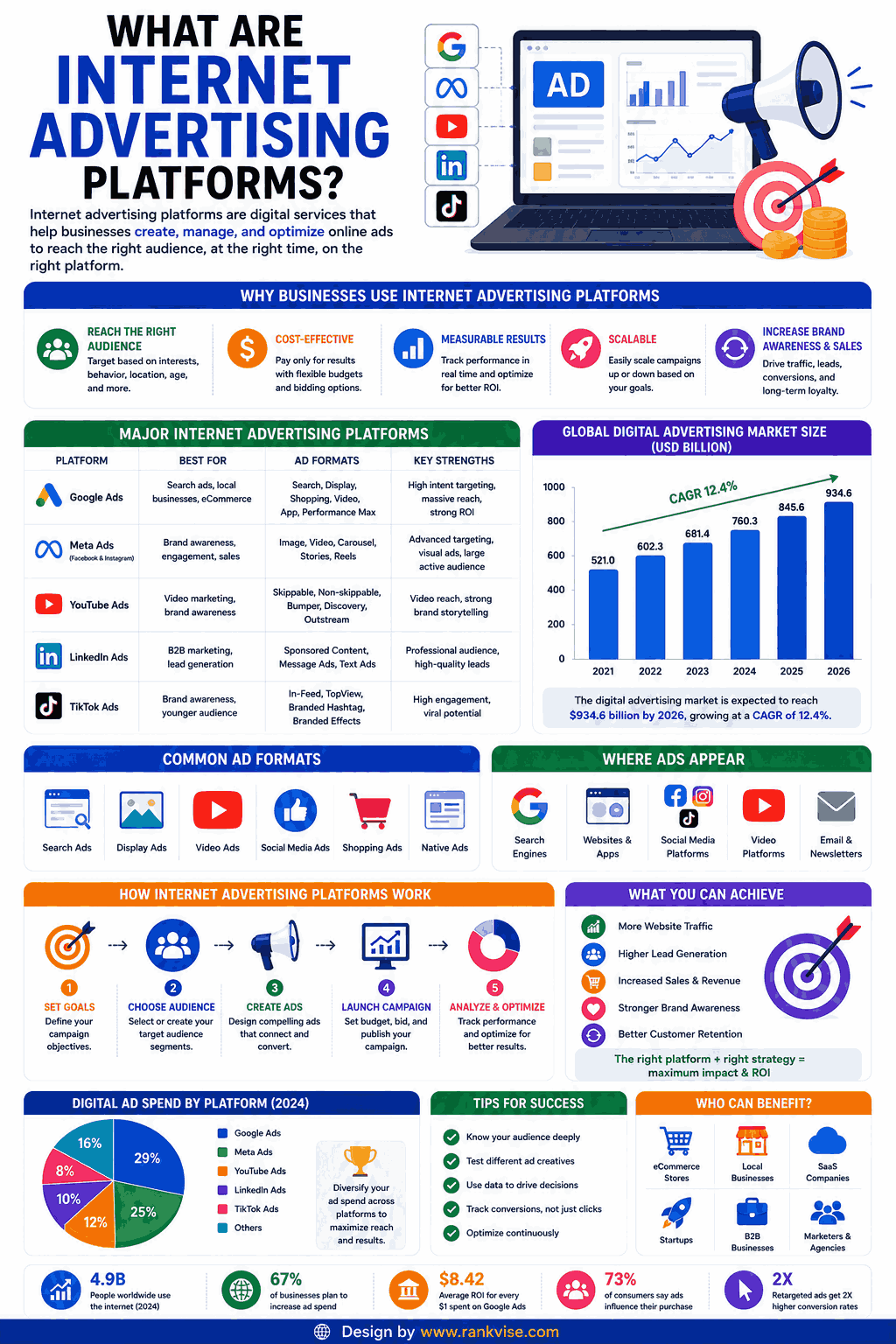
Internet advertising platforms are digital tools that let businesses display paid promotions to online audiences. These platforms connect advertisers with publishers or users across websites, apps, search engines, and social media networks.
They operate on different pricing models. Cost-per-click, cost-per-impression, and cost-per-action are the most common. Each platform offers unique targeting options based on demographics, interests, behavior, and location.
How to Choose the Right Online Advertising Channel
Before exploring the full list, consider these selection criteria:
- Audience location: Where does your ideal customer spend time online?
- Budget flexibility: Some platforms require higher minimum spends than others.
- Ad format preference: Video, display, text, or native ads each serve different goals.
- Campaign objective: Brand awareness, lead generation, or direct sales require different approaches.
- Industry fit: Certain platforms perform better for B2B, ecommerce, or local businesses.
25 Internet Advertising Platforms Compared
Below is a comprehensive breakdown of leading digital ad platforms organized by category.
Search Engine Advertising Platforms
| Platform | Best For | Pricing Model | Key Strength |
|---|---|---|---|
| Google Ads | All businesses | CPC/CPM | Largest search network globally |
| Microsoft Advertising | B2B and older demographics | CPC | Lower competition, cheaper clicks |
| Yahoo Gemini | Native + search hybrid | CPC/CPM | Access to Yahoo and AOL audiences |
Google Ads dominates paid search advertising. It reaches over 90% of internet users through Search, Display, YouTube, and Shopping campaigns. Nearly every business benefits from running Google campaigns.
Microsoft Advertising (formerly Bing Ads) serves ads on Bing, Yahoo, and DuckDuckGo. It often delivers 20–30% lower cost-per-click than Google. B2B companies find strong results here.
Yahoo Gemini combines native advertising with search placements. It suits brands wanting visibility across Yahoo’s content ecosystem.
Social Media Advertising Platforms
| Platform | Best For | Monthly Active Users | Top Ad Format |
|---|---|---|---|
| Meta Ads (Facebook & Instagram) | Ecommerce, local businesses | 3.9 billion+ | Carousel and video ads |
| TikTok Ads | Gen Z and millennials | 1.5 billion+ | Short-form video |
| LinkedIn Ads | B2B and recruiting | 1 billion+ | Sponsored content |
| Pinterest Ads | Lifestyle and retail | 480 million+ | Shopping pins |
| Snapchat Ads | Young audiences | 800 million+ | AR lenses and stories |
| X Ads (formerly Twitter) | News and tech audiences | 550 million+ | Promoted posts |
| Reddit Ads | Niche communities | 100 million+ daily | Promoted threads |
Meta Ads remains the most versatile social ad platform. Its targeting engine uses behavioral data from Facebook, Instagram, Messenger, and WhatsApp. Ecommerce brands often see strong return on ad spend here.
TikTok Ads offers unmatched engagement rates for video-first campaigns. Brands reaching younger audiences find this platform essential for awareness and viral reach.
LinkedIn Ads commands premium pricing but delivers high-quality B2B leads. Decision-makers actively use LinkedIn, making it ideal for SaaS, consulting, and professional services.
Pinterest Ads works exceptionally well for visual products. Users come with purchase intent, making conversion rates higher than many social platforms.
Programmatic and Display Advertising Platforms
| Platform | Best For | Key Feature |
|---|---|---|
| Google Display Network | Broad reach display campaigns | Access to 2 million+ websites |
| Amazon DSP | Ecommerce retargeting | Purchase behavior targeting |
| The Trade Desk | Enterprise programmatic buying | Omnichannel campaign management |
| AdRoll | Retargeting for SMBs | Cross-platform retargeting |
| Criteo | Ecommerce performance | Dynamic product retargeting |
| Taboola | Content discovery | Native ads on premium publishers |
| Outbrain | Content marketing | Native placements on news sites |
Amazon DSP gives advertisers access to Amazon’s purchase data. You can target people based on what they actually buy. This makes it powerful for ecommerce and consumer goods brands.
The Trade Desk is a demand-side platform for larger advertisers. It provides access to connected TV, audio, display, and video inventory through one dashboard.
Taboola and Outbrain specialize in native advertising. Their ads appear as recommended content on major news websites. They work well for content-driven lead generation.
Video Advertising Platforms
| Platform | Best For | Ad Placement |
|---|---|---|
| YouTube Ads | Brand awareness and tutorials | Pre-roll, mid-roll, discovery |
| Spotify Ads | Audio and podcast audiences | Audio and video between songs |
| Hulu Ads | Streaming TV audiences | Commercial breaks in content |
| Roku Ads | Connected TV viewers | Home screen and in-stream |
YouTube Ads operates within Google Ads. It offers skippable and non-skippable video formats. With over 2 billion monthly users, it reaches virtually every demographic.
Spotify Ads lets businesses target listeners by mood, genre, and activity. Audio ads feel personal and less intrusive than visual formats.
Connected TV platforms like Hulu and Roku bring traditional TV advertising precision to streaming audiences. They suit brands with bigger budgets seeking premium placements.
Ecommerce-Specific Advertising Platforms
| Platform | Best For | Key Advantage |
|---|---|---|
| Amazon Ads | Product sellers on Amazon | High purchase intent traffic |
| Walmart Connect | Walmart marketplace sellers | Growing retail media network |
| Shopify Audiences | Shopify store owners | Lookalike audience targeting |
Amazon Ads puts products in front of shoppers actively searching to buy. Sponsored Products, Brands, and Display formats cover the full purchase funnel.
Walmart Connect is expanding rapidly. Brands selling on Walmart’s marketplace gain access to in-store and online ad placements.
Key Features to Look for in Digital Ad Platforms
When evaluating any paid media platform, prioritize these capabilities:
- Advanced audience targeting and segmentation options
- Real-time campaign performance analytics
- A/B testing and creative optimization tools
- Integration with your CRM or ecommerce platform
- Transparent pricing with no hidden fees
- Retargeting and lookalike audience creation
- Multi-format ad support (video, image, text, carousel)
Common Mistakes When Using Internet Advertising Platforms
Avoid these pitfalls that drain budgets without delivering results:
- Running campaigns without clear conversion tracking
- Targeting audiences too broadly instead of testing narrow segments first
- Ignoring ad creative fatigue and running the same ads too long
- Spreading budget across too many platforms simultaneously
- Skipping A/B tests on headlines, images, and calls to action
Start with two or three platforms that align with your audience. Master those before expanding to additional channels.
How to Maximize ROI Across Multiple Ad Platforms
Successful advertisers follow a structured approach:
- Define one primary campaign objective per platform.
- Allocate 70% of budget to proven channels and 30% to testing new ones.
- Review performance data weekly and reallocate spend accordingly.
- Use retargeting across platforms to capture users who did not convert initially.
- Align ad messaging with landing page content for consistency.
Cross-platform strategies compound results. A user might discover your brand on TikTok, research on Google, and convert through a retargeting ad on Meta.
FAQs
Google Ads and Meta Ads offer the best combination of reach, targeting, and budget flexibility for small businesses starting with paid advertising.
Most small businesses start with 500–2,000 USD monthly per platform. Scale spending based on measured return on ad spend and conversion data.
LinkedIn Ads and Google Search Ads deliver the strongest B2B results. Both platforms reach decision-makers actively searching for solutions
Yes. Running campaigns on two or three platforms simultaneously lets you reach audiences at different stages of the buying journey.
Use UTM parameters and a centralized analytics tool like Google Analytics. This lets you compare results from each platform in one dashboard.