Eight million dollars. That is what a single 30-second commercial during Super Bowl LX cost advertisers in 2026. That figure makes the Super Bowl the most expensive advertising slot on television by a wide margin.
- Full Super Bowl campaigns cost far more than airtime, often totaling between 15 million and 50 million USD due to production and amplification.
- The game delivers unmatched live reach and attention, regularly attracting over 110 million US viewers and high social media amplification.
- Limited commercial inventory and huge demand make slots scarce; networks prioritize returning advertisers and premium placements cost more.
- Production budgets range widely, typically one million to ten million USD, with celebrity fees adding from 500,000 to several million.
- Effectiveness varies: about one third of advertisers see measurable sales lift; others gain awareness but struggle to convert without follow-up.
But the cost of an ad at the Super Bowl goes far beyond that media buy. Production budgets, celebrity endorsements, and digital campaign extensions push total spending well past the airtime price alone. Understanding the full picture helps you see why brands still line up to pay it.
This guide breaks down exactly what Super Bowl advertising costs, how pricing has evolved over decades, and whether the investment actually delivers results.
How Much Does a Super Bowl Ad Cost in 2026?
A 30-second Super Bowl commercial in 2026 cost an average of 8 million USD. That price covers only the airtime — the right to broadcast your ad during the game on the host network. It does not include creating the commercial itself.
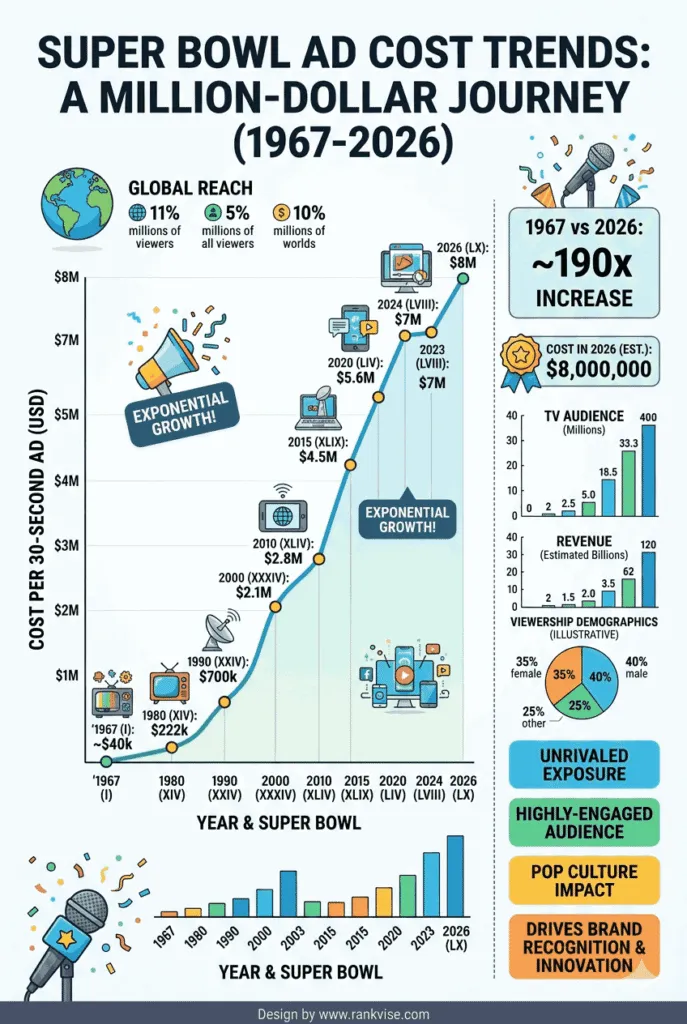
This represents a significant jump from recent years. In 2024, the same 30-second slot cost around 7 million USD. In 2020, it was approximately 5.6 million USD. The price has climbed steadily every year, driven by massive live viewership and cultural relevance that no other broadcast can match.
For context, the very first Super Bowl in 1967 charged roughly 37,500 USD for a 30-second ad on NBC. Adjusted for inflation, that translates to about 369,000 USD in today’s dollars. The leap from 369,000 USD to 8 million USD shows just how dominant the Super Bowl has become as an advertising platform.
Super Bowl Ad Cost History — From 1967 to 2026
The price trajectory of Super Bowl commercials tells a clear story of growing demand and cultural influence. Here is how the cost of a 30-second ad has changed across key years.
| Year | Super Bowl | Cost of 30-Second Ad (USD) |
|---|---|---|
| 1967 | I | 37,500 – 42,500 |
| 1980 | XIV | 222,000 |
| 1990 | XXIV | 700,000 |
| 2000 | XXXIV | 2.1 million |
| 2010 | XLIV | 2.8 million |
| 2015 | XLIX | 4.5 million |
| 2020 | LIV | 5.6 million |
| 2023 | LVII | 7 million |
| 2024 | LVIII | 7 million |
| 2026 | LX | 8 million |
The pattern is unmistakable. Prices roughly doubled every decade from the 1990s onward. The acceleration from 5.6 million USD in 2020 to 8 million USD in 2026 reflects the growing scarcity of live mass-audience television moments.
Networks can command these prices because demand consistently exceeds supply. The Super Bowl typically sells out its ad inventory months before the game. Some brands secure multi-year deals to guarantee their slot, which further tightens availability for newcomers.
What Drives the High Cost of Super Bowl Advertising
The sticker price seems staggering. But several factors explain why advertisers willingly pay it year after year.
Unmatched Live Viewership
The Super Bowl regularly attracts over 110 million viewers in the United States alone. No other single broadcast comes close to that number. In a media landscape increasingly fragmented by streaming, the Super Bowl remains one of the few guaranteed mass-audience events.
Audience Attention Is Uniquely High
Unlike regular television, viewers actively watch Super Bowl commercials. Many tune in specifically for the ads. Social media conversations before and after the game amplify each commercial’s reach well beyond the live broadcast window.
Cultural Relevance and Brand Prestige
Appearing during the Super Bowl signals that a brand has arrived. It is a statement of scale, confidence, and ambition. For newer companies, a Super Bowl debut can generate awareness that would take months of traditional advertising to achieve.
Scarcity of Available Slots
The game broadcast only has a limited number of commercial breaks. With roughly 50 to 60 available ad slots and hundreds of brands competing, demand far outstrips supply. That scarcity is the engine behind price increases every year.
The True Total Cost of a Super Bowl Campaign
The 8 million USD airtime fee is just the starting point. The total cost of a Super Bowl advertising campaign is significantly higher when you factor in production and amplification.
Production Budgets
Creating a Super Bowl-quality commercial typically costs between 1 million and 10 million USD. Brands hire top directors, A-list celebrities, and large production crews to ensure their 30 seconds stand out. Some ads involve elaborate special effects, original music, or cinematic-level storytelling.
Celebrity Endorsement Fees
Many Super Bowl ads feature famous actors, musicians, or athletes. Celebrity fees alone can range from 500,000 USD to several million, depending on the star’s profile. These fees come on top of the production and airtime costs.
Digital and Social Media Extension
Modern Super Bowl campaigns do not end when the ad airs. Brands invest heavily in teaser campaigns, social media promotion, YouTube pre-releases, and post-game digital content. This extended campaign often doubles the total investment, pushing comprehensive Super Bowl campaign costs to between 15 million and 50 million USD or more.
Agency and Creative Fees
The advertising agencies behind Super Bowl campaigns charge premium rates for concept development, scripting, and strategic planning. These fees typically add another 500,000 to 2 million USD to the overall budget.
Is a Super Bowl Ad Worth the Investment
This is the question every CMO asks before signing the cheque. The answer depends on the brand’s goals, category, and ability to maximise the moment.
When It Works
Super Bowl ads deliver the strongest return when brands pair massive awareness with a clear call to action. Companies launching new products, entering new markets, or repositioning their brand find the Super Bowl especially powerful. The 2024 game saw several newer brands — particularly in fintech and AI — use their spots to establish instant credibility.
The earned media value adds enormous leverage. A memorable Super Bowl ad generates millions of dollars in free media coverage, social sharing, and YouTube views. Some ads accumulate over 100 million online views within days of airing.
When It Falls Flat
Not every Super Bowl ad delivers. Forgettable spots that blend into the noise waste their massive investment. Brands without a follow-up strategy often see a brief spike in awareness that fades quickly. The ad itself must be exceptional to justify the cost.
Research from marketing analytics firms shows that roughly one-third of Super Bowl advertisers see measurable sales lift in the weeks following the game. The remaining two-thirds see awareness gains but struggle to convert attention into revenue directly.
The Verdict
For large brands with sufficient budgets and strong creative, the Super Bowl remains one of the most efficient ways to reach a massive audience simultaneously. For smaller brands, the total campaign cost of 15 million to 50 million USD makes it a high-risk proposition that requires careful strategic planning.
How Brands Secure a Super Bowl Ad Slot
Buying Super Bowl airtime is not as simple as placing an order. The process involves relationship-building, negotiation, and long-term commitments.
Networks typically begin selling Super Bowl ad inventory nine to twelve months before the game. Returning advertisers get priority access, which means first-time buyers often face limited availability and premium pricing. Some brands sign multi-year contracts to lock in pricing and guarantee placement in specific commercial breaks.
Placement within the broadcast also affects cost. Ads airing during the first and fourth quarters, or immediately after the halftime show, command higher prices due to peak viewership during those moments.
FAQs
A 30-second commercial during Super Bowl LX in 2026 cost an average of 8 million USD. This covers airtime only, not production or campaign expenses.
Super Bowl ads cost a premium because the game attracts over 110 million live viewers. High demand, limited inventory, and unmatched audience attention drive prices up every year.
Including production, celebrity fees, and digital amplification, a full Super Bowl campaign typically costs between 15 million and 50 million USD or more beyond the airtime fee alone.
The first Super Bowl in 1967 charged between 37,500 and 42,500 USD for a 30-second spot. Adjusted for inflation, that equals roughly 369,000 USD in 2026 dollars.
Research shows about one-third of Super Bowl advertisers see direct sales lift after the game. Most brands gain significant awareness and earned media value, but conversion depends on creative quality and follow-up strategy.