Timing matters more than most marketers realise. You can create the perfect Facebook post, but if you publish it when your audience is asleep or busy, it disappears into the feed without a trace.
Finding the best time to post on Facebook gives your content a head start. It increases the chance that real people see, react to, and share what you publish. The Facebook algorithm favours early engagement. Posts that gain traction quickly get pushed to more feeds. Posts that land flat get buried.
This guide breaks down the latest data on optimal posting times, explains why those windows work, and shows you how to find the schedule that fits your specific audience.
What the Latest Data Says About Optimal Facebook Posting Times
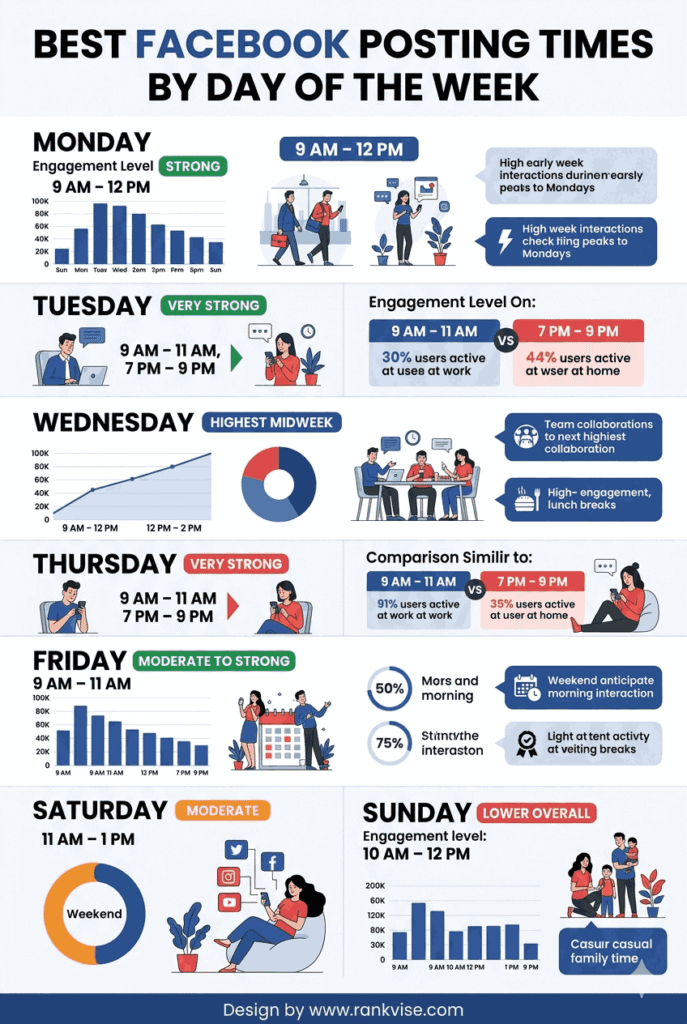
Multiple studies analysed millions of posts across industries to identify patterns. The data from Hootsuite, Sprout Social, and other platforms paints a consistent picture for 2026 and into 2026.
The strongest engagement windows on Facebook fall between 8 AM and 12 PM on weekdays. Midday posts, especially between 9 AM and 11 AM, consistently outperform content published in the early morning or late afternoon. Tuesday, Wednesday, and Thursday tend to generate the highest interaction rates across most industries.
Weekend posting also shows promise, particularly between 11 AM and 1 PM on Saturdays. Sunday engagement dips compared to other days, though niche audiences like hobbyists and lifestyle followers remain active.
A secondary peak appears in the evening hours. Posts published around 7 PM to 9 PM on Tuesdays and Thursdays capture audiences scrolling after dinner. This window works especially well for B2C brands and entertainment-focused pages.
Best Facebook Posting Times by Day of the Week
Not every day delivers equal results. Here is a breakdown of peak Facebook hours based on aggregated engagement data.
| Day | Best Posting Window | Engagement Level |
|---|---|---|
| Monday | 9 AM – 12 PM | Strong |
| Tuesday | 9 AM – 11 AM, 7 PM – 9 PM | Very strong |
| Wednesday | 9 AM – 12 PM, 12 PM – 2 PM | Highest midweek |
| Thursday | 9 AM – 11 AM, 7 PM – 9 PM | Very strong |
| Friday | 9 AM – 11 AM | Moderate to strong |
| Saturday | 11 AM – 1 PM | Moderate |
| Sunday | 10 AM – 12 PM | Lower overall |
Wednesday consistently ranks as the single best day for Facebook engagement. Midweek content benefits from established routines. People are settled into their work week and take regular scroll breaks. Friday and weekend performance varies more by industry and audience type.
Why These Time Slots Drive Higher Engagement
The patterns above are not random. They reflect real human behaviour and the way the Facebook algorithm rewards content.
Morning Commute and Break Scrolling
Most people check their phones during the morning commute or in the first hour at work. Posts published between 8 AM and 10 AM catch this early wave of attention. The algorithm registers that initial engagement and amplifies the post to more users throughout the morning.
The Lunchtime Window
The midday spike between 11 AM and 1 PM aligns with lunch breaks. People step away from work tasks and open social media. This window works across nearly every audience demographic. It is the single most reliable posting slot for brands that can only publish once per day.
The Evening Scroll
After dinner, many users settle into a longer browsing session. The 7 PM to 9 PM window captures this relaxed attention. Content published here competes with less volume than midday posts, which can actually boost visibility for pages with smaller followings.
Does the Best Posting Time Change by Industry?
Yes. General benchmarks provide a useful starting point, but your specific industry influences which windows perform best.
- Retail and ecommerce — Midday posts on Wednesday and Friday drive the strongest click-through rates. Weekend mornings also perform well for product-focused content.
- B2B and professional services — Tuesday through Thursday mornings between 9 AM and 11 AM deliver the most engagement. Business audiences scroll during work hours, not evenings.
- Healthcare and education — Early mornings between 8 AM and 9 AM and early evenings around 6 PM work well. These audiences often check social media before and after structured schedules.
- Food and hospitality — Late morning posts around 11 AM and early evening posts around 5 PM align with meal planning behaviour.
- Entertainment and media — Evening hours between 7 PM and 10 PM generate the highest engagement. Audiences consume entertainment content during leisure time.
These patterns reinforce why a one-size-fits-all Facebook posting schedule rarely works. Use industry benchmarks as a starting point, then refine based on your own performance data.
How to Find Your Own Best Posting Times
General data gives you a foundation. Your own audience data gives you precision. Facebook provides built-in tools that reveal exactly when your followers are most active.
Use Facebook Insights
Navigate to your Facebook Page, open the Meta Business Suite, and check the Insights section. Look for the “Active Times” report. It shows a heatmap of when your followers are online, broken down by day and hour. This data reflects your actual audience, not a global average.
Test and Measure
Run a simple experiment over four to six weeks. Post the same type of content at different times across different days. Track reach, engagement rate, and click-throughs for each post. Patterns will emerge quickly. The times that consistently deliver higher numbers become your optimal Facebook posting times.
Adjust for Time Zones
If your audience spans multiple regions, you may need to post more than once per day. A post timed for 10 AM Eastern misses your West Coast audience during their commute. Use scheduling tools like Meta Business Suite, Hootsuite, or Buffer to stagger posts across key time zones without manual effort.
How the Facebook Algorithm Affects Post Timing
The Facebook algorithm does not simply show posts in chronological order. It prioritises content based on predicted engagement. Timing plays a role because posts that gain quick initial reactions signal quality to the algorithm.
When you publish during peak Facebook hours, more of your followers see the post immediately. If they like, comment, or share it within the first 30 to 60 minutes, the algorithm treats the post as high value. It then pushes it to additional users who did not see it initially.
Publishing during low-activity hours means fewer people see the post at launch. Fewer initial reactions tell the algorithm the content is less interesting. Even a great post can underperform simply because it launched at the wrong time.
Common Mistakes That Hurt Your Facebook Posting Schedule
Even experienced social media managers fall into timing traps. Avoid these errors to protect your engagement rates.
- Posting at the same time every day regardless of data — Consistency matters, but rigid schedules ignore day-to-day behaviour differences. Adapt your timing to match daily audience patterns.
- Ignoring weekends entirely — Saturday mornings deliver solid engagement for many B2C brands. Skipping weekends means missing an audience that is relaxed and ready to engage.
- Publishing too frequently in a short window — Posting three times within two hours cannibalises your own reach. Space your posts at least three to four hours apart.
- Relying only on global benchmarks — Your audience is unique. Use general data to start, but always validate with your own Insights data.
- Forgetting to account for seasonal shifts — Audience behaviour changes during holidays, summer months, and major events. Review your timing strategy quarterly.
Quick Tips to Boost Facebook Engagement Beyond Timing
Timing gets your content seen. Quality keeps people engaged. Pair your optimised posting schedule with these practices.
- Use native video and Reels — Facebook prioritises video content in the feed. Short-form Reels currently receive the strongest organic push from the algorithm.
- Ask questions in your captions — Posts that invite comments generate more interaction, which triggers further algorithmic distribution.
- Reply to comments quickly — Engaging with your audience within the first hour signals active community management. The algorithm rewards responsive pages.
- Test different content formats — Rotate between images, carousels, videos, polls, and text posts. Diverse formats keep your audience interested and help you identify what performs best.
FAQs
Weekdays between 9 AM and 12 PM deliver the strongest results for most business pages. Wednesday and Thursday mornings consistently show the highest engagement rates.
Yes. Posts published during peak audience activity hours gain faster initial engagement, which signals the algorithm to push the content to more users organically.
Most brands see strong results posting three to five times per week. Quality and timing matter more than volume. Posting too often can dilute your per-post engagement.
Morning posts between 9 AM and 11 AM perform best for most audiences. However, evening posts between 7 PM and 9 PM on Tuesdays and Thursdays also perform well for B2C brands.
Yes. Scheduling tools like Meta Business Suite, Hootsuite, or Buffer let you publish at optimal times consistently, even when you are not online. They also help manage content across multiple time zones.