A customer engagement centre is a centralized hub where businesses manage all customer interactions across multiple channels. It goes beyond answering calls. It connects conversations from email, chat, social media, phone, and self-service into one unified experience.
- Move from reactive issue resolution to proactive relationship building using data and outreach to prevent churn and drive loyalty.
- Unify customer data with CRM integration so agents have full history and personalize interactions across touchpoints.
- Leverage AI automation and self-service to handle routine queries, suggest responses, and free agents for complex conversations.
- Prioritize workforce management, training, and agent empowerment to maintain quality, reduce turnover, and improve customer interactions.
- Measure engagement-focused metrics, iterate continuously, and expect higher retention, increased revenue, lower support costs, and actionable insights.
Unlike traditional call centres that focus on resolving issues, a customer engagement centre prioritizes building relationships. It uses data, automation, and human expertise to deliver proactive, personalized communication at every touchpoint.
Businesses adopt this model to increase retention, reduce churn, and turn one-time buyers into long-term advocates.
How Does a Customer Engagement Centre Differ From a Call Centre?
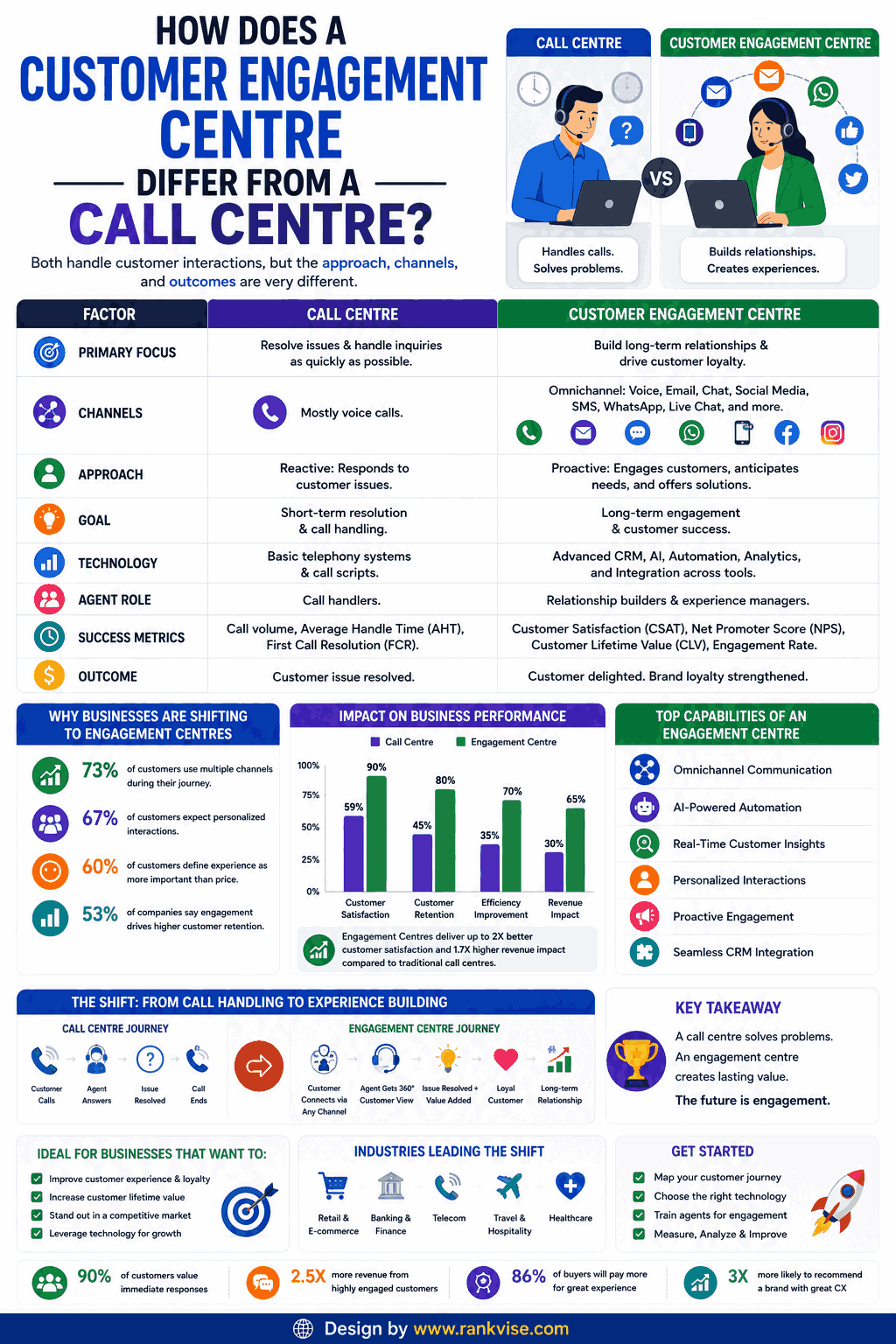
Many people confuse these two models. The differences are significant and impact customer experience directly.
| Feature | Traditional Call Centre | Customer Engagement Centre |
|---|---|---|
| Channels | Phone only or phone-primary | Omnichannel (phone, email, chat, social, SMS) |
| Approach | Reactive problem-solving | Proactive relationship building |
| Data usage | Basic call logs | Unified customer profiles with history |
| Agent role | Issue resolution | Personalized engagement and retention |
| Metrics | Call volume and handle time | Customer satisfaction and lifetime value |
| Technology | Phone systems and ticketing | CRM integration, AI, and analytics |
A call centre waits for problems. A customer engagement centre anticipates needs and reaches customers before issues escalate. This shift from reactive to proactive changes how customers perceive your brand.
Why Businesses Are Investing in Customer Engagement Centres
Customer expectations have changed permanently. People want fast responses across their preferred channels. They expect companies to remember previous interactions. They leave brands that make them repeat information.
Here is what drives adoption:
- Customers use an average of 3–5 channels when interacting with brands
- 73% of buyers say experience influences their purchasing decisions
- Retaining existing customers costs 5–7 times less than acquiring new ones
- Companies with strong omnichannel engagement retain 89% of their customers versus 33% for those with weak engagement
A customer engagement centre addresses all these realities. It centralizes data, empowers agents, and creates seamless experiences regardless of how customers reach you.
Core Components of an Effective Customer Engagement Centre
Building a high-performing engagement centre requires several interconnected elements working together.
Omnichannel Communication Platform
Customers should move between channels without losing context. If someone starts a conversation on live chat and follows up by phone, the agent must see the full history instantly.
An omnichannel platform unifies all touchpoints into one interface. Agents handle interactions from any channel without switching between tools. This eliminates information gaps and reduces customer frustration.
Unified Customer Data and CRM Integration
Every interaction generates data. A customer engagement centre collects and organizes this data into comprehensive profiles. Purchase history, support tickets, preferences, and communication history all live in one place.
CRM integration ensures agents see the complete picture before responding. They know what customers bought, what issues they reported, and what solutions worked previously. This context transforms generic support into personalized engagement.
AI-Powered Automation and Self-Service
Not every interaction requires a human agent. Chatbots, knowledge bases, and automated workflows handle routine queries efficiently. They provide instant answers while freeing agents for complex conversations.
Smart routing directs customers to the right agent based on issue type, language, or priority level. AI tools suggest responses, surface relevant knowledge articles, and predict customer intent in real time.
Workforce Management and Agent Empowerment
Engaged agents deliver better customer experiences. Workforce management tools forecast demand, schedule staff appropriately, and prevent burnout. They balance workloads so agents maintain quality throughout their shifts.
Training programs, performance dashboards, and career development paths keep agents motivated. When agents feel supported, customers notice the difference in every interaction.
Key Benefits of Running a Customer Engagement Centre
Organizations that transition from basic support to full engagement centres see measurable results across multiple business areas.
- Higher customer retention: Proactive outreach and personalized service reduce churn by 15–25%
- Increased revenue per customer: Engaged customers spend 20–40% more over their lifetime
- Lower support costs: Self-service and automation deflect 30–50% of routine inquiries
- Faster resolution times: Unified data eliminates repetitive troubleshooting steps
- Better agent satisfaction: Purpose-driven roles and proper tools reduce turnover
- Actionable insights: Centralized data reveals patterns that inform product and marketing decisions
These benefits compound over time. Each positive interaction strengthens the customer relationship and increases future revenue potential.
How to Build a Customer Engagement Centre Strategy
Transitioning to an engagement model requires planning. Follow these steps to build a strategy that delivers results.
Step 1: Audit Current Customer Touchpoints
Map every channel where customers interact with your business. Identify gaps, friction points, and disconnected systems. Note where customers drop off or express frustration.
Step 2: Define Engagement Goals and Metrics
Move beyond traditional call centre metrics. Track customer satisfaction scores, net promoter scores, first-contact resolution, customer effort scores, and lifetime value. Align agent incentives with these engagement-focused measures.
Step 3: Select the Right Technology Stack
Choose platforms that integrate seamlessly with your existing tools. Prioritize solutions offering omnichannel support, CRM connectivity, AI capabilities, and robust analytics.
Leading customer engagement platforms include:
| Platform | Best For | Key Capability |
|---|---|---|
| Salesforce Service Cloud | Enterprise businesses | Deep CRM integration |
| Genesys Cloud | Mid-to-large organizations | AI-driven omnichannel routing |
| Zendesk | Growing businesses | Ease of use and scalability |
| NICE CXone | Contact centre transformation | Workforce optimization |
| HubSpot Service Hub | SMBs with HubSpot ecosystem | Unified marketing and service data |
| Freshdesk | Budget-conscious teams | Affordable multichannel support |
Step 4: Train Teams for Engagement, Not Just Resolution
Agents need different skills in an engagement centre. Train them on active listening, empathy, personalization techniques, and proactive communication. Equip them to identify upsell opportunities and anticipate needs.
Step 5: Measure, Iterate, and Improve
Launch with clear baselines. Monitor key metrics weekly. Gather agent feedback on tools and processes. Refine workflows based on data rather than assumptions. Continuous improvement separates good engagement centres from exceptional ones.
Real-World Customer Engagement Centre Examples
Retail example: A fashion brand notices a loyal customer has not purchased in 90 days. The engagement centre triggers a personalized outreach with curated recommendations based on past purchases. The customer returns and completes a purchase within a week.
SaaS example: A software company detects declining product usage from a mid-tier account. An engagement specialist reaches out proactively, offers training resources, and schedules a success review. The account renews instead of churning.
Banking example: A customer messages about a declined transaction via mobile chat. The agent sees their full profile, identifies the fraud alert trigger, resolves it instantly, and proactively adjusts alert settings for future travel.
Common Mistakes When Setting Up a Customer Engagement Centre
Avoid these pitfalls that undermine engagement efforts:
- Implementing technology without redesigning processes around customer needs
- Measuring agents on speed alone rather than quality and relationship outcomes
- Treating channels as separate silos instead of a unified conversation
- Ignoring agent experience while focusing exclusively on customer experience
- Collecting data without acting on insights or personalizing interactions
Success requires commitment to cultural change, not just software purchases. Technology enables engagement, but people and processes deliver it.
The Future of Customer Engagement Centres in 2026 and Beyond
Several trends are reshaping how engagement centres operate:
- Generative AI handles increasingly complex conversations while maintaining natural tone
- Predictive analytics identify at-risk customers before they show obvious churn signals
- Video support becomes standard for high-value interactions and complex troubleshooting
- Hyper-personalization uses real-time behavioral data to tailor every response
- Employee experience platforms ensure agent wellbeing matches customer experience investments
Businesses that invest early in these capabilities build competitive advantages their competitors struggle to replicate.
Start Building Deeper Customer Relationships Today
A customer engagement centre transforms how your business connects with customers. It replaces transactional support with meaningful relationships that drive loyalty and revenue. Start by auditing your current experience, selecting the right tools, and training teams to engage rather than simply respond.
The businesses that thrive invest in customer relationships before competitors force them to react.
FAQs
A contact centre handles inbound and outbound communications. A customer engagement centre adds proactive outreach, personalization, and data-driven relationship building across all channels.
Costs range from 50 to 300 USD per agent monthly for cloud platforms. Total investment depends on team size, technology choices, and integration complexity.
They use omnichannel platforms like Genesys, Salesforce Service Cloud, or Zendesk combined with CRM systems, AI tools, and workforce management solutions.
Yes. Small businesses use affordable tools like Freshdesk or HubSpot to centralize interactions and personalize communication without enterprise-level budgets.
Focus on customer satisfaction, net promoter score, first-contact resolution, customer lifetime value, and customer effort score rather than call volume alone.