B2B prospecting evolved a lot over the last decade. Today’s practices are driven by data availability and automation. Modern businesses don’t have to rely on a single approach when they want to generate leads. They have two main methods to choose from: email lookup tools or manual prospecting. Both strategies can identify potential clients for businesses to connect with. However, they are very different.
The competition across all industries is massive. A brand that wants to succeed has to reach the right decision-makers ASAP. In 2026, sales teams are expected to deliver fast results, but personalization in outreach is still important. These demands drive brands towards B2B prospecting software, but they haven’t abandoned manual prospecting altogether. Many professionals still rely on hands-on methods, since they lead to more meaningful connections.
What’s the right approach? As with every other decision that marketing teams have to make, the strengths and limitations of both approaches will make a difference.
What Is Email Lookup in B2B Prospecting?
Email lookup is the process of finding verified business email addresses with specialized tools. In the B2B environment, email lookup is supported by automation systems that collect publicly available data and company records. They also refer to user behavior to deliver relevant contact information. Many email lookup tools integrate with CRM platforms and broader lead prospecting software. The point of using such tools is that sales teams don’t have to search for contact details manually. They use automated solutions to get accurate email addresses at scale.
The right platform provides usable data, which supports outreach and reduces the time that teams spend on repeated tasks. In practice, these tools use data aggregation and predictive AI software to match professionals with their most likely business email formats. Not everything has to be automated, though. The team can (and should) validate each selection before use.
Email lookup is great for fast identification of decision-makers. It also carries lower risk of outdated or incorrect data. By automating the repetitive research task, these tools allow the brand to focus on the more important details of its outreach strategy.
What Is Manual Prospecting?
Manual prospecting is the traditional approach for identifying potential leads, without heavily automating any step of the process. It requires an active search for prospects through company websites, professional networks, and social media (mostly LinkedIn). Sales professionals who choose this approach don’t get their data from large databases. They gather information step by step, and manually verify most of the details.
This way of prospecting starts with defining the ideal customer, and then manually identifying companies or individuals that fit that profile. From there, the process may continue like this:
- checking LinkedIn profiles
- exploring company “About” pages
- going through press releases
- locating contact information through publicly available sources
Manual prospecting is, without any doubt, more time-consuming. However, it also gives deeper context. Sales teams can understand the exact prospect’s role and business needs before they initiate contact. They also get informed about the brand’s recent activity, which leads to personalized outreach. That alone can improve the response rates when targeting high-value accounts.
However, the process requires a lot of time and significant effort. Automated systems have a big advantage: they are integrated into lead prospecting software. Manual methods limit the number of prospects that can be reached within a given period of time. The accuracy of data also depends on the researcher’s skill, as well as the availability of current information.
Manual prospecting has obvious limitations, but is still relevant in 2026, especially for niche markets. Some situations prioritize personalization over scale, and that’s when manual prospecting shines.
Main Differences Between Email Lookup and Manual Prospecting
Both manual prospecting and email lookup have the same goal: connect with potential leads. But they are very different in many aspects:
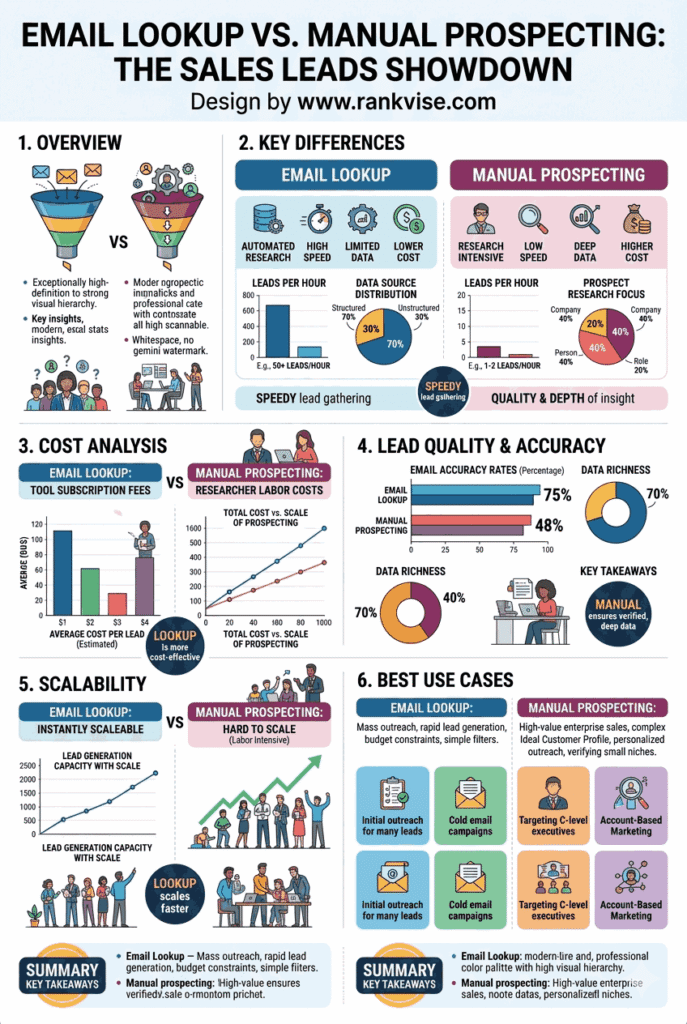
Speed and Efficiency
Email lookup tools are FAST. Thanks to automation and integration, lead prospecting software can deliver large volumes of contact data in minutes. Modern platforms deliver almost instant results, so they are perfect for high-volume outreach campaigns.
Manual prospecting is much slower. Each lead requires individual research, which must identify the right contact, verify their role, and get company details. That’s a lot of work that leads to thoughtful targeting, but reduces the number of prospects that can be reached within a given time.
Data Accuracy
Email lookup tools use aggregated databases and validation mechanisms to deliver accurate data. Many of them rely on predictive AI to improve the match. However, the accuracy depends on how frequently the data is updated.
Manual prospecting can be very accurate when it’s done properly. The sales team individually verifies every detail. However, that also leaves space for human error, especially when the marketing team works under deadlines or with incomplete data sources.
Scalability
This is the greatest advantage of email lookup. Businesses using lead prospecting software can easily expand their outreach without the need to increase their workload proportionally. Automation allows teams to handle thousands of leads with minimal manual intervention.
Manual prospecting doesn’t scale efficiently. As the number of target leads grows, so does the workload. This requires hiring additional team members or significantly extending the time needed to complete prospecting tasks.
Cost
Email lookup tools do require a financial investment, which may be through subscriptions or usage-based pricing. However, they reduce labor costs because they minimize the time spent on repetitive tasks. Many companies, especially those focused on growth, find this trade-off cost-effective.
Manual prospecting may seem less expensive at first. After all, it doesn’t require specialized tools. However, there’s a hidden cost in time and human resources. Spending hours researching individual leads quickly becomes inefficient, especially for teams that want to scale their outreach.
In practice, the choice between email lookup and manual prospecting depends on the team’s size and its business goals. The required personalization is another decisive factor. Each method has its strength, but the differences are more pronounced as the company grows and its prospecting needs evolve.
When Should You Use Email Lookup vs Manual Prospecting?
The choice mainly depends on your business goals, outreach volume, and the level of needed personalization. Most teams today aren’t asking which method is better, but which one works in the specific context.
Best Use Cases for Email Lookup
Email lookup is most effective when the team prioritizes speed and scale. It works well when you need to quickly build large prospect lists and maintain consistent outreach across multiple campaigns. The method is very useful in the following situations:
- Launching large-scale email campaigns
- Expanding into new markets or industries
- Building initial lead lists for sales teams
- Running time-sensitive outreach initiatives
- Supporting automated workflows through an email lookup API
In these cases, the speed in processing large volumes of data makes email lookup a more efficient option when compared to manual research.
Best Use Cases for Manual Prospecting
Manual prospecting is more suitable when quality and context are more important than volume. It gives space for deeper research and a better understanding of each prospect. That can improve the effectiveness of a personalized outreach.
B2B marketing teams prefer manual prospecting in these situations:
- Targeting high-value or enterprise clients
- Account-based marketing strategies
- Niche industries with limited available data
- Building long-term relationships with major decision-makers
- Early-stage outreach, when relevance is critical
Manual prospecting demands much more time, but it can lead to stronger engagement when precision is indisputable.
Hybrid Prospecting: Why Most Teams Combine Both
Many businesses don’t have to rely on a single prospecting method. They adopt a hybrid model, which combines the speed of email lookup with the precision of manual research. This allows them to balance efficiency and personalization.
The idea behind hybrid processing is simple: use automation to handle large-scale data collection, and apply manual effort where it matters the most. For example, a sales team may use B2B prospecting software to generate an initial list of potential leads. Then, they will refine the list through manual research before reaching out. This ensures that the outreach will be relevant, but the team will still benefit from a faster workflow.
The hybrid approach is very effective for companies that manage high-volume campaigns, but still want targeted outreach. By integrating tools powered by predictive AI software with manual validation, they can prioritize the most promising leads and personalize their messaging.
This is what simple hybrid prospecting looks like:
- Use lead prospecting software to identify a broad set of potential contacts.
- Apply automation to gather and verify contact information.
- Manually review selected prospects to make sure they match the ideal customer profile.
- Customize the message, based on insights gathered through manual research.
- Use structured workflows to manage outreach at scale with consistency.
When manual prospecting is combined with email lookup, businesses can create a more flexible prospecting strategy. Automation handles repetitive tasks, and the manual input adds context and relevance. The result is a more balanced and scalable approach to lead generation.