Email marketing remains a dominant force for generating revenue, particularly since the average email marketing ROI is $36–$42 for every $1 spent across the industry.
While many brands gravitate toward Klaviyo as a default choice, the platform often presents a steep learning curve and a high price point. Also, you may end up paying for enterprise features you don’t yet need.
Finding a solution that balances high performance with a thoughtfully designed interface is essential for brands that want to scale without unnecessary friction.
1. Omnisend
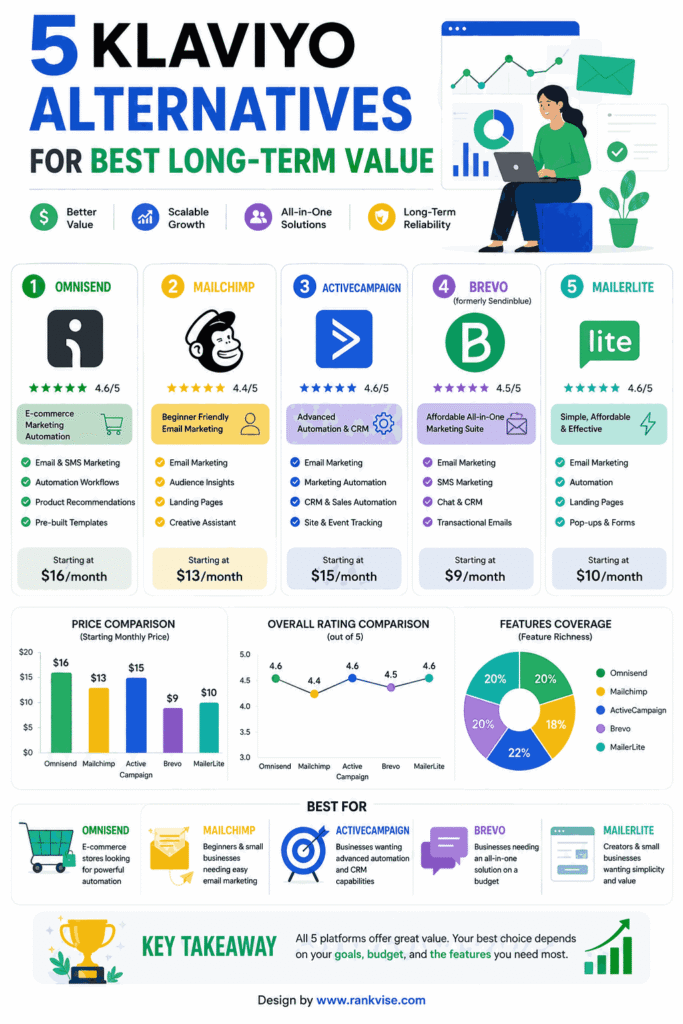
Omnisend is a dedicated platform for ecommerce brands that focuses on delivering high value through an intuitive interface. It centers on the idea that sophisticated marketing should not be tedious or overly complex.
The platform is used by over 150,000 customers and maintains a 4.8 average rating for its performance and support. The tool is built specifically for mid-size ecommerce merchants who require powerful tools without an excessive complexity trade-off.
Key features
- Predictive AI: This stack includes segments, RFM analysis, and Customer Lifetime Value (CLV) forecasting to help you anticipate customer behavior.
- Generative AI: The platform offers tools for copywriting and maintaining a consistent brand voice across all your email and SMS campaigns.
- Forms AI: This feature builds and reviews signup forms to ensure they are optimized for conversion from the moment a visitor lands on your site.
- MCP integration: Through the Model Context Protocol, you can use Omnisend directly inside ChatGPT or Claude to create campaigns and check performance.
Pros
- Strong ROI of $79 for every $1 spent: This performance metric is backed by data from a global user base of 150,000 merchants.
- Five-day free migration: For users on qualifying plans, Omnisend’s team will entirely rebuild your current workflows and templates within five days, saving you the hassle of a manual transition.
- Award winning 24/7 customer support: The platform has received best customer service awards for five years running, starting in 2022.
- Unified email and SMS workflows: You can combine global SMS reach and email sequences within a single, thoughtfully designed automation.
Cons
- Ecommerce specific focus: The platform is primarily designed for online stores and is less suitable for B2B or service based businesses.
- No native sales CRM: There is no built in CRM for managing complex sales pipelines or manual lead tracking for sales teams.
Pricing
- Free plan available.
- Paid plans start at $16/month.
2. Mailchimp
Mailchimp is one of the most recognizable names in the marketing world. It has moved beyond simple email to become a full marketing platform for various business types.
Despite its extensive toolkit, recent price hikes and strict contact limits make scaling expensive for growing brands. It remains a solid choice for those who need a general purpose tool that integrates with almost everything.
Key features
- Creative assistant: This AI-driven tool pulls assets directly from your website to automatically generate beautiful, on-brand designs.
- Customer journey builder: The visual interface allows you to map out automated paths for customers based on their interactions with your brand.
- Content optimizer: Benchmarks your emails against millions of top-performing campaigns to offer data-backed suggestions for improving copy and imagery.
- Predictive demographics: The platform uses data to predict the age and gender of your subscribers so you can target them more effectively.
Pros
- Extensive integration library: The platform connects with hundreds of third party apps, making it a highly flexible hub for your data.
- All-in-one marketing suite: It consolidates multiple channels, offering social media posting, digital ads, and landing pages all within a single dashboard.
- Mobile app: You can manage campaigns, view reports, and edit your emails while you are away from your desk.
- Global brand recognition: The massive user base means there are endless tutorials and third-party experts available to help you troubleshoot.
Cons
- Complexity in pricing: The cost can scale quickly as your list grows, and the distinction between audiences can lead to paying for the same subscriber twice.
- Support limitations: Direct human support is often restricted on lower tier plans, which can be difficult when you face technical issues.
Pricing
- Free plan available.
- Paid plans start from $13/month.
3. ActiveCampaign
ActiveCampaign positions itself as a leader in marketing automation and customer experience. It is designed for businesses that want to go beyond basic newsletters and create highly personalized, data-driven journeys.
The platform includes a strong CRM component, which makes it a favorite for businesses with a longer sales cycle. It provides deep insights into how users interact with your website and your emails.
Key features
- Site tracking: This tool allows you to see what products or pages your subscribers visit on your site to trigger specific follow-up emails.
- Advanced automation map: You can view how all your different automations interact with each other in a single high-level view.
- Integrated sales CRM: The platform manages your deals and leads alongside your marketing emails to keep your sales team aligned.
- Predictive sending: The system analyzes when individual subscribers are most likely to open an email and sends it at that specific time.
Pros
- Superior automation capabilities: The logic and branching options for workflows are among the most detailed in the industry.
- Comprehensive lead scoring: You can assign points to subscribers based on their actions to identify your most engaged potential customers.
- Highly customizable reporting: The platform offers deep dives into campaign performance and revenue attribution for your marketing efforts.
- Excellent deliverability: It is widely respected for having strong relationships with internet service providers to keep your emails out of the spam folder.
Cons
- Steep learning curve: The interface can be overwhelming because of the sheer number of features and settings available to the user.
- Price point: The professional and enterprise tiers are a significant investment and may be more than a small brand needs.
Pricing
- No free plan (14-day free trial).
- Paid plans start from $15month (billed annually).
4. Brevo
Brevo, formerly known as Sendinblue, has evolved into a versatile marketing and sales platform. It is particularly well-known for its transactional email capabilities and its unique pricing model.
Instead of charging based on the number of contacts you have, it charges based on the number of emails you send. This makes it a compelling choice for businesses with large lists that do not send messages frequently.
Key features
- Transactional email engine: The platform is a top choice for sending order confirmations, password resets, and other automated system messages.
- WhatsApp campaigns: You can send marketing messages directly to customers on WhatsApp, which is a key channel in many global markets.
- Shared inbox: The team can manage customer emails from a centralized location to ensure no inquiry goes unanswered.
- Heatmap reporting: For higher-tier plans, you can see exactly where subscribers are clicking within your email layouts.
Pros
- List size independence: You can store an unlimited number of contacts on any plan without increasing your monthly subscription cost.
- Built-in SMS and WhatsApp: The multichannel approach is integrated directly into the core platform for easy access.
- Clean and functional interface: The design is straightforward and avoids the clutter found in more complex enterprise tools.
- Strong security and compliance: It is a European company with a heavy focus on GDPR compliance and data privacy.
Cons
- Basic automation logic: While it handles standard workflows well, it lacks some of the deeper branching logic found in specialized ecommerce tools.
- Limited template variety: The library of pre-designed email templates is smaller than those offered by some major competitors.
Pricing
- Free plan available.
- Paid plans start from $9/month.
5. MailerLite
MailerLite is built on the philosophy that professional marketing should be accessible and clean. It avoids the bloat of many larger platforms while still providing the essential tools needed for growth.
It is often favored by creators, small businesses, and those who value a minimalist aesthetic. The interface is thoughtfully designed to ensure that users can find what they need without searching through endless menus.
Key features
- Drag-and-drop editor: The email builder is one of the smoothest in the category and makes creating responsive designs a quick process.
- Website builder: You can create full websites or landing pages with the same intuitive interface used for your emails.
- Monetization tools: The platform integrates with Stripe to allow you to sell digital products or subscriptions directly through your emails.
- A/B split testing: You can test different subject lines, content, and even sender names to see what resonates best with your audience.
Pros
- Accessible interface: The dashboard is uncluttered and focuses on the most important tasks for your daily marketing.
- Strong value for small lists: It is one of the most cost-effective options for brands that are just beginning to build their subscriber base.
- Excellent landing page builder: The quality of the landing pages you can build often rivals dedicated standalone software.
- Fast and helpful support: The support team is known for being responsive and providing clear solutions to technical questions.
Cons
- Lacks advanced ecommerce features: It does not offer the same level of deep product data integration as platforms built specifically for online stores.
- Strict approval process: To protect sender deliverability, new accounts undergo a manual review, which can be time-consuming if you need to launch campaigns immediately.
Pricing
- Free plan available.
- Paid plans start from $10/month.
Conclusion
Choosing the right email marketing platform is a decision that impacts your long-term growth and your daily peace of mind. While some tools come with a high price and excessive complexity, several alternatives provide a more intuitive experience.
There is a tool that fits your specific needs regardless of what you prioritize: deep sales CRM integration, transactional emails, ecommerce focus, or anything else. Put some time and effort into making the decision, as selecting a platform with a strong ROI and accessible support ensures that your marketing efforts remain productive and sustainable.