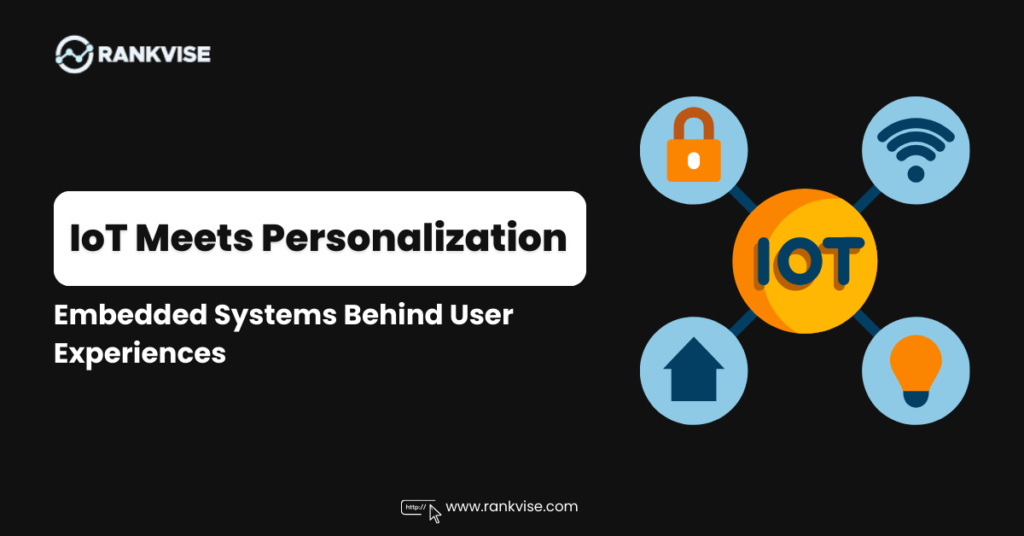
Most technological shifts arrive with considerable noise. IoT did not. It crept in quietly — through thermostats, hospital monitors, and warehouse logistics systems — and began transforming operations long before most people had a word for what was happening.
The data has since caught up. The global IoT market is valued at roughly $175 billion in 2026 and is projected to hit $344 billion by 2035. Some 21.1 billion connected devices are active today, a number expected to climb to 39 billion by 2030. This is no longer an emerging trend. IoT has become foundational infrastructure — as essential to modern operations as electricity or broadband connectivity.
So what does that mean in practice, for companies and the people running them?
When Technology Works Best, You Don’t Notice It
The invisibility is by design. A sensor tracking a shipping container across time zones, a beacon reporting equipment idle time from a factory floor — when IoT is functioning well, none of it demands your attention. What you notice instead is that things run more smoothly than they did before.
Asset tracking offers one of the clearest illustrations. Businesses managing physical inventory — machinery, vehicles, tools, containers — once depended on spreadsheets, manual audits, and a fair amount of guesswork. Objects went missing. Processes stalled. Inefficiency quietly eroded margins.
IoT shifted that equation. Real-time location data, automated alerts, and interactive dashboards showing exactly where each asset sits at any given moment are no longer futuristic concepts — they’re operational tools that mid-sized companies are deploying today.
A concrete example: a platform built for Keg Speed to manage beer kegs across multiple locations. Each keg received a Bluetooth beacon. A React Native mobile app pulled live location data from those beacons and rendered it on an interactive map — displaying not just current location, but how long each keg had been sitting idle. The results were measurable: a 35% reduction in asset loss and a 40% improvement in operational efficiency. That’s the kind of outcome that becomes possible when physical objects start communicating with software.
Why Over 80% of Executives Now Consider IoT Essential
More than 80% of executives say IoT is critical to their operations. That figure doesn’t reflect marketing enthusiasm — it reflects a genuine, accelerating shift in how organizations run.
Development teams like those at Lampa.dev building targeted, high-impact IoT solutions consistently find that starting focused and expanding from there is the approach that actually works.
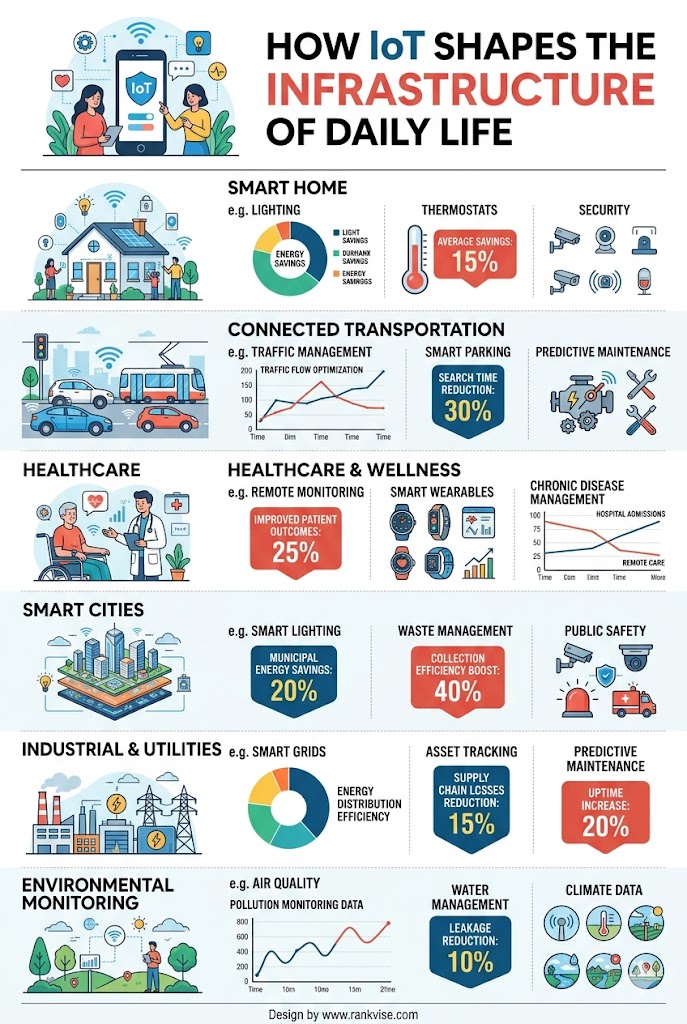
The industries leading adoption tell an interesting story. Manufacturing is applying IoT to predictive maintenance and production line monitoring. Logistics operations are using it for asset tracking and route optimization. Healthcare is deploying connected devices for remote patient monitoring. Retail is leveraging IoT to manage inventory and analyze customer behavior. Smart cities are applying it to traffic systems and energy management.
What these sectors have in common is that they all involve physical assets generating data that was previously invisible. IoT makes that data accessible — and, more importantly, actionable, which is central to how IoT is shaping the future of business and daily life.
For smaller businesses, the starting point is often more accessible than expected. A full infrastructure overhaul isn’t necessary to see results. A focused solution — tracking one category of assets, monitoring one segment of a production line — can produce measurable returns within months. The key is identifying a specific operational problem and solving it precisely, rather than attempting to transform everything simultaneously. Development teams building targeted, high-impact IoT solutions consistently find that starting focused and expanding from there is the approach that actually works.
From Smart Homes to Connected Health: IoT’s Consumer Footprint
On the consumer side, IoT has already reshaped daily life in ways most people barely register. Smart home devices, wearables, connected vehicles — 57% of U.S. households are expected to own at least one IoT device, with adoption continuing to rise.
But the more compelling consumer story isn’t about convenience. It’s about health. Devices monitoring cardiac conditions, tools pulling glucose data for diabetes management, fitness trackers that go well beyond step counts — these products are producing genuinely better health outcomes. The boundary between consumer technology and healthcare is blurring, and the results are substantive.
AI, Edge Computing, and Security: What’s Shaping the Next Phase of IoT
Several forces are determining how IoT continues to mature, and each deserves attention.
The convergence of AI and IoT is enabling faster, smarter decision-making. When connected devices feed data directly into AI systems, that information doesn’t merely get collected — it gets interpreted in real time. Anomalies get flagged before they escalate. Maintenance gets scheduled before breakdowns occur. The AIoT market alone is projected to reach $102 billion by 2026, reflecting how central this combination has become.
Edge computing is solving the latency problem. Processing data closer to where it’s generated — rather than routing everything through centralized cloud infrastructure — makes real-time responses genuinely instantaneous. In manufacturing, autonomous vehicles, and any environment where split-second timing matters, this distinction is operationally significant.
Security remains the most significant unresolved challenge. Nearly half of all organizations — 47% — have reported vulnerabilities in connected devices. Every additional device expands the potential attack surface. Serious IoT implementations treat security as a foundational design requirement, not an afterthought bolted on once deployment is complete.
The Pattern Behind Every IoT Success Story
IoT’s real power doesn’t live in any single device or application. It lives in a repeating cycle: physical world meets digital world, previously invisible data becomes visible, and decisions improve as a result. That loop — sense, transmit, analyze, act — is running in the background of far more industries than most people realize.
The businesses doing this well aren’t necessarily the largest or most technically sophisticated. They’re the ones that identified a specific problem, built a focused solution around it, and scaled outward from there. A company managing physical assets across multiple locations isn’t trying to reinvent its industry. It’s simply making sure it knows where its inventory is.
Simple problem. Real solution. Measurable outcome. That’s how most IoT success stories begin.