AI governance tools help organizations manage, monitor, and control their artificial intelligence systems responsibly. They ensure AI models operate fairly, transparently, and within regulatory boundaries. As businesses deploy more AI, the risk of bias, compliance violations, and reputational damage grows.
- Regulators demand accountability; EU AI Act and NIST impose requirements, or organizations risk fines, lawsuits, and loss of customer trust.
- Platforms automate risk assessments, track model performance, and produce audit trails to convert complex compliance into manageable workflows.
- They translate technical model behavior into business-friendly dashboards showing risk scores, fairness metrics, and compliance status for executives.
- Continuous oversight and automated bias detection are critical in regulated use cases like lending to ensure nondiscriminatory decisions.
- Choose tools based on regulatory mapping, infrastructure compatibility, and budget; evaluate with free tiers before committing to enterprise licensing.
Governments worldwide now enforce AI regulations. The EU AI Act, NIST AI Framework, and similar policies demand accountability. Without proper ai governance tools, companies face fines, lawsuits, and lost customer trust.
These platforms automate risk assessments, track model performance, and generate audit trails. They turn complex compliance requirements into manageable workflows. Every organization using AI at scale needs them.
How AI Governance Platforms Help Businesses Stay Compliant
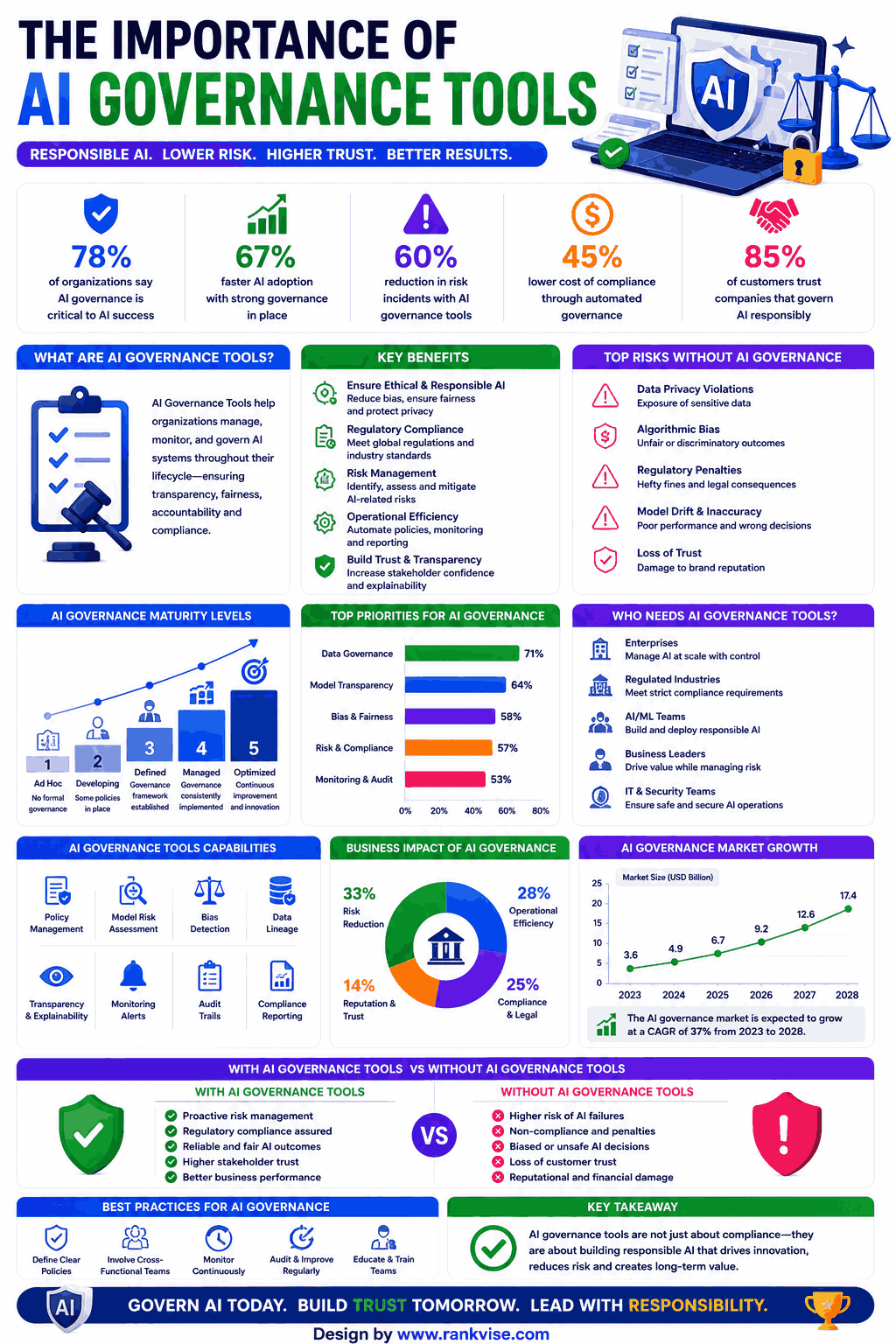
Compliance teams struggle to keep pace with evolving AI regulations. AI governance tools solve this by automating documentation and monitoring. They flag issues before regulators or customers notice them.
These tools also bridge the gap between technical teams and leadership. They translate model behavior into business-friendly dashboards. Executives see risk scores, fairness metrics, and compliance status without reading code.
Real-world scenarios make this clear. A bank using AI for loan approvals must prove the model does not discriminate. An ai governance platform continuously monitors decisions and alerts teams when bias thresholds are crossed.
Top 10 AI Governance Tools for 2026
1. IBM OpenScale (Watson OpenScale)
IBM offers one of the most mature ai governance tools on the market. It provides end-to-end lifecycle governance for AI models across any environment.
Developer: IBM Deployment: Cloud, on-premise, hybrid Industry Focus: Financial services, healthcare, government
Key Features:
- Automated bias detection across protected attributes
- Model drift monitoring in real time
- Explainability reports for individual predictions
- Regulatory compliance documentation
- Multi-cloud model tracking
Quality: Enterprise-grade reliability with deep integration into IBM’s ecosystem. Handles thousands of models simultaneously. Bias detection is among the most accurate available.
Pricing:
- Lite: Free (limited models)
- Standard: Custom enterprise pricing
- Typically starts around 30,000 USD/year for mid-size deployments
Best For: Large enterprises in regulated industries that need proven, scalable AI governance across hybrid cloud environments.
2. Google Model Cards & Vertex AI Model Governance
Google provides built-in governance capabilities within its Vertex AI platform. Model Cards offer standardized documentation for transparency.
Developer: Google Cloud Deployment: Cloud-native (GCP) Industry Focus: Technology, retail, healthcare
Key Features:
- Automated Model Cards for documentation
- Feature attribution and explainability
- Continuous model monitoring
- Data lineage tracking
- Integration with Google’s Responsible AI toolkit
Quality: Seamless for teams already on GCP. Monitoring is robust and real-time. Limited flexibility if your models run outside Google’s ecosystem.
Pricing:
- Pay-as-you-go based on predictions monitored
- Model monitoring starts at approximately 0.01 USD per prediction
- Enterprise agreements available
Best For: Organizations running AI workloads on Google Cloud that want native governance without third-party integrations.
3. Microsoft Azure Responsible AI Dashboard
Microsoft integrates responsible AI tools directly into Azure Machine Learning. The dashboard consolidates fairness, explainability, and error analysis.
Developer: Microsoft Deployment: Cloud (Azure) Industry Focus: Cross-industry
Key Features:
- Fairness assessment across demographic groups
- Error analysis to identify failure patterns
- Counterfactual explanations for decisions
- Causal inference capabilities
- Integration with Azure ML pipelines
Quality: Strong integration with the Microsoft ecosystem. Visualization tools are excellent for non-technical stakeholders. Works best with models trained in Azure ML.
Pricing:
- Included with Azure Machine Learning workspace
- Azure ML pricing starts at pay-as-you-go compute costs
- No separate governance license fee
Best For: Teams using Microsoft Azure for machine learning who want built-in responsible AI capabilities at no additional licensing cost.
4. Credo AI
Credo AI focuses specifically on AI governance, risk, and compliance. It is purpose-built rather than being an add-on to a cloud platform.
Developer: Credo AI Deployment: Cloud (SaaS) Industry Focus: Financial services, healthcare, technology, government
Key Features:
- AI risk register with automated assessments
- Regulatory mapping to EU AI Act, NIST, and ISO standards
- Policy pack templates for quick compliance setup
- Stakeholder collaboration workflows
- Continuous monitoring with governance scorecards
Quality: Purpose-built governance means deeper compliance features than cloud-native alternatives. Regulatory mapping is best-in-class. Dashboard clarity impresses compliance teams.
Pricing:
- Custom enterprise pricing
- Typically starts around 50,000 USD/year
- Pilot programs available for mid-market companies
Best For: Organizations that need dedicated AI governance software focused entirely on compliance, risk management, and regulatory readiness.
5. Arthur AI
Arthur AI specializes in model monitoring and explainability. It helps teams detect performance issues, bias, and data drift after deployment.
Developer: Arthur AI Deployment: Cloud, on-premise Industry Focus: Financial services, insurance, healthcare
Key Features:
- Real-time model performance monitoring
- Bias and fairness metrics across all model types
- Explainability for black-box models
- Alerting and anomaly detection
- Support for NLP, computer vision, and tabular models
Quality: Monitoring capabilities are highly granular. Supports more model types than most competitors. Alert customization allows teams to set precise thresholds.
Pricing:
- Free tier for small-scale monitoring
- Enterprise: Custom pricing based on prediction volume
- Mid-market plans start around 35,000 USD/year
Best For: Data science teams that need deep post-deployment monitoring with real-time alerts for bias, drift, and performance degradation.
6. Fiddler AI
Fiddler provides an AI observability platform that combines monitoring, explainability, and governance into one interface.
Developer: Fiddler AI Deployment: Cloud (SaaS), on-premise Industry Focus: Fintech, e-commerce, insurance
Key Features:
- Unified observability for all ML models
- Natural language explanations for predictions
- Data integrity monitoring
- Custom metric tracking
- Pre-production validation checks
Quality: Excellent user interface that non-technical teams appreciate. Explanation quality is high. Pre-production validation prevents problematic models from going live.
Pricing:
- Free community edition
- Team: Custom pricing
- Enterprise: Starts around 40,000 USD/year
Best For: Organizations wanting a single platform combining model observability with governance capabilities and human-readable explanations.
7. Holistic AI
Holistic AI offers an end-to-end ai governance platform with strong emphasis on auditing and risk quantification.
Developer: Holistic AI Deployment: Cloud (SaaS) Industry Focus: HR tech, finance, public sector
Key Features:
- AI risk management dashboard
- Automated bias audits for hiring algorithms
- Compliance mapping for NYC Local Law 144 and EU AI Act
- Third-party AI vendor assessments
- Quantified risk scoring
Quality: Particularly strong in HR and recruitment AI auditing. Regulatory mapping covers emerging legislation comprehensively. Vendor assessment features are unique.
Pricing:
- Custom pricing based on scope
- Audit engagements start around 20,000 USD
- Platform licensing varies by organization size
Best For: Companies using AI in hiring that must comply with bias audit regulations like NYC Local Law 144 or similar legislation.
8. Monitaur
Monitaur delivers model governance through auditable documentation and performance tracking designed for regulated industries.
Developer: Monitaur Deployment: Cloud (SaaS) Industry Focus: Insurance, banking, healthcare
Key Features:
- Automated model documentation
- Version control for model governance
- Audit-ready compliance reports
- Performance tracking over time
- Role-based access for governance workflows
Quality: Documentation automation saves significant time. Audit trail is comprehensive and regulator-friendly. Interface is straightforward for compliance officers.
Pricing:
- Custom enterprise pricing
- Typically starts at 25,000 USD/year
- Scales based on number of models governed
Best For: Compliance teams in insurance and banking that need audit-ready documentation and clear governance trails for regulatory examinations.
9. TruEra
TruEra provides AI quality management with a focus on model intelligence, testing, and diagnostics.
Developer: TruEra Deployment: Cloud, on-premise Industry Focus: Financial services, technology, healthcare
Key Features:
- AI quality scores for model evaluation
- Root cause analysis for model failures
- Pre-deployment testing suites
- Fairness and bias diagnostics
- Integration with MLOps pipelines
Quality: Diagnostics depth exceeds most competitors. Root cause analysis pinpoints exactly why models fail. Testing suites prevent bad models from reaching production.
Pricing:
- Free tier (TruLens open-source)
- Enterprise: Custom pricing
- Starts around 30,000 USD/year for enterprise features
Best For: ML engineering teams focused on model quality assurance who want deep diagnostics before and after deployment.
10. Weights & Biases (W&B) Model Registry
Weights & Biases extends beyond experiment tracking into governance with model registry and lineage capabilities.
Developer: Weights & Biases Deployment: Cloud (SaaS), self-hosted Industry Focus: Technology, research, cross-industry
Key Features:
- Full model lineage and versioning
- Experiment tracking with governance metadata
- Automated documentation of training runs
- Team collaboration on model approval workflows
- Integration with all major ML frameworks
Quality: Best-in-class experiment tracking that doubles as governance documentation. Developer experience is excellent. Approval workflows add governance structure without slowing teams down.
Pricing:
- Free for individuals
- Teams: 50 USD/user/month
- Enterprise: Custom pricing
Best For: ML teams that want governance baked into their existing experiment tracking workflow without adopting a completely separate platform.
AI Governance Tools Comparison Table
| Tool | Deployment | Free Tier | Bias Detection | Regulatory Mapping | Best For |
|---|---|---|---|---|---|
| IBM OpenScale | Hybrid | Yes (limited) | Yes | Yes | Large enterprises |
| Google Vertex AI | Cloud (GCP) | Pay-as-you-go | Yes | Partial | GCP-native teams |
| Microsoft Responsible AI | Cloud (Azure) | Included | Yes | Partial | Azure ML users |
| Credo AI | SaaS | No | Yes | Yes (best-in-class) | Compliance-first orgs |
| Arthur AI | Hybrid | Yes | Yes | Partial | Post-deployment monitoring |
| Fiddler AI | Hybrid | Yes | Yes | Partial | Observability focus |
| Holistic AI | SaaS | No | Yes | Yes | HR/recruitment AI |
| Monitaur | SaaS | No | Partial | Yes | Audit documentation |
| TruEra | Hybrid | Yes (open-source) | Yes | Partial | Model quality testing |
| W&B | Hybrid | Yes | Partial | No | MLOps governance |
How to Choose the Right AI Governance Platform
Start with your regulatory requirements. If you face EU AI Act or specific local laws, choose tools with direct regulatory mapping like Credo AI or Holistic AI. Generic monitoring tools may not satisfy auditors.
Consider your existing infrastructure next. Teams on Azure benefit from Microsoft’s built-in tools. GCP users should explore Vertex AI governance features. Multi-cloud organizations need platform-agnostic options.
Budget also matters. Cloud-native tools reduce costs since governance comes bundled. Dedicated platforms cost more but offer deeper capabilities. Start with free tiers to evaluate fit before committing.
FAQs
AI governance tools monitor AI models for bias, ensure regulatory compliance, generate audit documentation, and help organizations manage AI-related risks across their operations.
Credo AI, Holistic AI, and IBM OpenScale offer direct regulatory mapping to the EU AI Act, with automated risk assessments aligned to its classification requirements.
Yes, TruEra offers TruLens as open-source, Weights & Biases has a free individual tier, and Arthur AI provides limited free monitoring for small-scale deployments.
Any business deploying AI that affects customers should consider governance. Free and low-cost options like W&B or Google’s native tools work well for smaller teams.
They analyze model outputs across demographic groups, measure statistical fairness metrics, and flag disparities that exceed predefined thresholds for protected attributes like race or gender.