As a rule, AI agent projects fail because the team failed to identify the challenge they are going to solve. Wrong workflow, on top of messy data, with no clear owner when things go sideways. By the time any of the issues pop up, the budget is spent and the timeline is shot.
So, before you write a single line of code, here’s what to lock down before you commit budget, time, and a team to it. This guide is based on what we’ve learned through Altamira AI agent development services.
Which workflow is suitable for an AI agent?
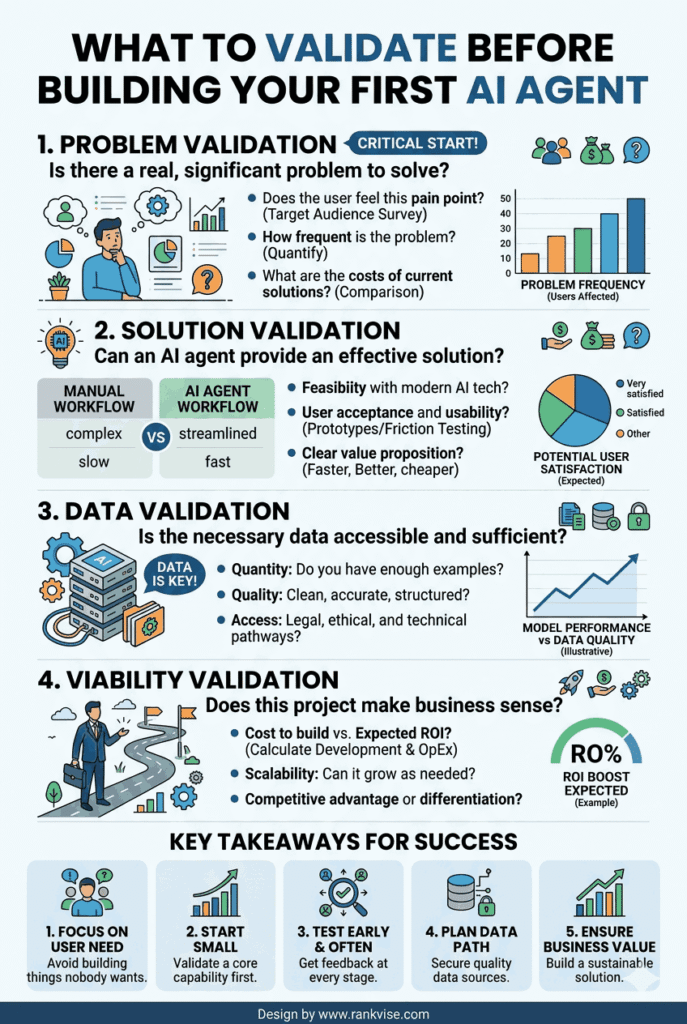
Of course, not every single manual process is worth automating with an agent. The ones that work share two qualities: you can predict the decision logic and measure the output.
Repetitive decisions
Good automation candidates are tasks your team does dozens or hundreds of times a week, where the decision follows a repetitive pattern.
Ask yourself: can I write down the rules for this decision? Can I look at 10 outputs and say which ones are right and which are wrong? If yes, you have a good starting point. If the answer depends on who’sasking, the workflow isn’t ready.
Clear human escalation
Your agent will get things wrong. Before you build, define the handoff: what triggers escalation, who receives it, through what channel, and how fast they need to respond. If the path doesn’t exist as an real operational process today, build it first. An agent without a clear escalation path is just a faster way to make unreviewed mistakes.
What data must be ready before development starts?
“We have the data” is almost always true. “The data is ready” is a much harder thing to confirm.
Source Quality
Before any development starts, it’s reasonable to audit your data against three questions:
- Is it complete? Gaps in records, missing fields, and inconsistent formats will degrade performance in ways that are difficult to separate from model issues.
- Is it consistent? Data entered across different systems and teams over time develops structural drift. The agent will inherit a drift and behave inconsistently as a result.
- Is it up-to-date? Historical data from a period when your business looked different: different products, different volumes, different processes will mislead your agent in production. Make sure the data reflects how things actually work today.
So, pass a simple reality check: could your new employee use this data to learn about the job? If not, your agent can’t either.
Permissions and audit trail
Pay some time to defining access requirements before development.
Remember, every agent action requires a log: input received, decision made, action taken, timestamp. If you feel difficulties in reconstructing a chain after the fact, you don’t have an audit trail. You have an unaccountable process running at scale.
Which technical choices affect risk and cost?
Your decisions made too early tend to drive cost and operational problems later.
Model choice
When choosing a model, capability is not the only dimension which is worth your attention. Keep in mind the cost per call, latency under load, and how failure modes behave at scale all affect whether the agent is viable in production.
| Dimension | Smaller / Faster Models | Larger / More Capable Models |
| Cost per call | Low | High |
| Latency | Low | Higher |
| Complex taskperformance | Limited | Strong |
| Hallucination risk | Present | Present, harder to detect |
| Best fit | High-volume, structuredtasks | Nuanced reasoning, open-endedoutput |
Also, note that many production agents use a tiered setup: a smaller model handles the standard case, a more capable model handles edge cases or escalations. Decide this architecture before you build around a single model because retrofitting it later costs real time and money.
Tool access and integrations
For every integration, stop and answer a few questions before development kick-off:
- What’s the blast radius if this tool call goes wrong?
- Is there a rate limit which could affect performance under production load?
- Does this action need human approval before it executes, or is it fully autonomous?
How Altamira reduces delivery risk in early AI agent projects?
The failure modes above are predictable. They show up in most first agent projects. So, it’s very important to run the validation work before committing to a development.
Discovery-first approach
Altamira runs a structured discovery phase before any development starts. The goal is to map the workflow as it actually operates and identify data gaps, missing escalation paths, and integration constraints before they become mid-sprint blockers.
Discovery isn’t extra time added to the project. It prevents at least two months of rework at the end.
KPI and guardrail setup
Altamira defines success metrics and output guardrails at the start of every project. It means agreeing on what the agent is supposed to move: resolution time, processing accuracy, escalation rate, and what outputs it should never produce.
Both need to be embedded before production. Deploying an agent without monitoring is a process running without oversight.
A simple pre-build checklist for enterprise teams
If you can’t answer a question clearly, that’s the first thing to resolve.
Workflow
- The decision logic is describable and consistent
- A rubric exists for evaluating correct vs. incorrect output
- Escalation paths are defined: triggers, owners, channels, and response times
- The workflow has enough volume to justify agent investment
Data
- Source data has been audited for completeness, consistency, and recency
- Access permissions are documented and approved
- An audit trail is designed for all agent reads and writes
- Compliance and retention requirements are confirmed
Technical architecture
- Model selection is matched to task complexity and production volume
- All integrations are scoped with blast radius and rate limit analysis
- A cost estimate exists for expected production call volume
- Human-in-the-loop checkpoints are defined for high-risk actions
Measurement
- KPIs are defined with available baselines
- Output guardrails are specified
- A monitoring plan is in place before go-live
- A process exists for handling errors discovered after launch
The final word
The most successful teams spend enough dedicated time to validation. Moreover, they treat data readiness as a hard dependency and define success before the first sprint.
It’s the difference between an agent still running six months after launch and the one that got shut down quietly after the pilot.