The difference between trademark and copyright comes down to what each one protects. A trademark protects brand identifiers like names, logos, and slogans. A copyright protects original creative works like books, music, and artwork. Both fall under intellectual property law, but they serve very different purposes.
Many business owners confuse these two protections. That confusion can leave valuable assets unprotected. Understanding trademark vs copyright helps you make smarter legal decisions from day one. It also prevents costly mistakes when launching products, building brands, or creating content.
This guide breaks down each form of protection in plain language. You will learn what qualifies, how registration works, and when your business needs one or both.
What Does a Trademark Protect?
Brand Identity and Market Recognition
A trademark protects the elements that identify your business in the marketplace. This includes your business name, logo, tagline, and even distinctive packaging. Think of the Nike swoosh or McDonald’s golden arches. Those symbols instantly connect consumers to a specific brand experience.
Trademarks exist to prevent consumer confusion. If two companies in the same industry used identical names, buyers could not tell them apart. Trademark law stops competitors from copying your brand identifiers. It gives you exclusive rights to use those identifiers in your specific market category.
What Qualifies for Trademark Protection?
Not every word or symbol qualifies for trademark registration. The mark must be distinctive enough to identify your brand uniquely. Generic terms like “coffee shop” cannot be trademarked on their own. However, a creative name like “Starbucks” for a coffee company qualifies easily.
Here are common elements that businesses trademark:
- Business names – the legal or trade name customers recognize
- Logos and symbols – visual marks that represent the brand
- Slogans and taglines – memorable phrases tied to the brand identity
- Product names – specific names for individual products or services
- Trade dress – distinctive packaging, color schemes, or store layouts
Trademark protection lasts as long as you actively use the mark in commerce. You must also renew the registration periodically. In the United States, trademark renewals happen between the fifth and sixth year, then every ten years after that.
What Does a Copyright Protect?
Original Creative Works and Expression
A copyright protects original works of authorship fixed in a tangible form. This covers a wide range of creative output. Books, songs, photographs, films, software code, and architectural designs all qualify. Copyright protects the specific expression of an idea, not the idea itself.
This distinction matters greatly. You cannot copyright the idea of a love story. But you can copyright the specific novel you wrote about one. Two authors can write books on the same topic without infringing each other’s copyright. The protection applies to how each author expressed the idea uniquely.
What Qualifies for Copyright Protection?
Copyright protection applies automatically the moment you create an original work and fix it in a tangible medium. Writing a poem on paper gives it copyright protection immediately. Recording a song onto a device does the same. You do not need to register to own the copyright.
However, registration strengthens your legal position significantly. Here are works that copyright commonly protects:
- Literary works – books, articles, blog posts, and written content
- Musical compositions – songs, lyrics, and recorded performances
- Visual art – paintings, photographs, illustrations, and graphic designs
- Film and video – movies, documentaries, and online video content
- Software – source code and program architecture
- Architectural works – building designs and blueprints
Copyright protection in the United States typically lasts for the creator’s lifetime plus 70 years. For works made for hire, protection lasts 95 years from publication or 120 years from creation, whichever comes first.
Trademark vs Copyright: A Side-by-Side Comparison
Understanding the practical differences helps you decide which protection your business needs. This comparison table highlights the key distinctions between trademark and copyright.
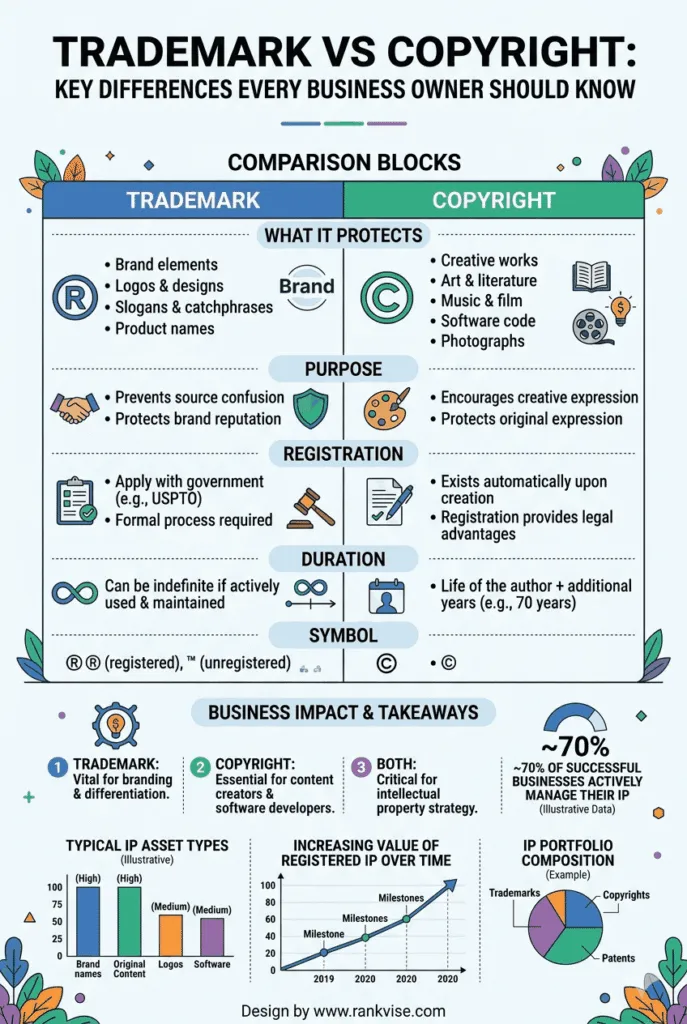
| Feature | Trademark | Copyright |
|---|---|---|
| What it protects | Brand names, logos, slogans | Creative works like books, music, art |
| Purpose | Prevents consumer confusion | Protects original creative expression |
| Registration required? | Not required but strongly recommended | Not required but recommended for enforcement |
| When protection begins | Upon use in commerce | Upon creation and fixation in tangible form |
| Duration | Indefinite with renewals and continued use | Creator’s life plus 70 years (generally) |
| Governing body (US) | United States Patent and Trademark Office | United States Copyright Office |
| Symbol used | ™ (unregistered) or ® (registered) | © |
| Infringement example | A competitor copies your brand logo | Someone republishes your article without permission |
This table clarifies why businesses often need both protections. Your logo needs a trademark. Your website content needs a copyright. Each safeguards a different type of business asset.
When Does Your Business Need a Trademark
You need a trademark when you want to protect your brand identity from competitors. Any business that operates under a unique name or logo should consider trademark registration. This is especially important if you plan to expand into new markets or sell products online.
Trademark registration gives you nationwide priority in your product or service category. Without it, another business could legally use a similar name in a different region. Early registration prevents these conflicts and saves expensive legal battles down the road.
Consider trademarking if you are launching a new brand, product line, or franchise. The investment is modest compared to the cost of rebranding if someone else claims your name later.
When Does Your Business Need a Copyright?
You need copyright protection whenever your business creates original content. This includes website copy, marketing materials, training videos, software, and product photography. Most businesses generate copyrightable content daily without realizing it.
While copyright exists automatically upon creation, formal registration provides critical benefits. It creates a public record of your ownership. It also allows you to sue for statutory damages and attorney fees in infringement cases. Without registration, your enforcement options are limited.
Businesses that produce large volumes of content should prioritize copyright registration for their most valuable works. This includes flagship products, proprietary training materials, and signature marketing campaigns.
Can You Trademark and Copyright the Same Thing?
Yes, in some cases, a single asset can receive both trademark and copyright protection. A logo is the most common example. The artistic design of a logo qualifies for copyright protection as a visual work. The same logo qualifies for trademark protection as a brand identifier.
However, each protection covers a different aspect. Copyright protects the artistic expression in the logo design. Trademark protects its function as a source identifier in commerce. These two protections work together to give your logo comprehensive legal coverage.
Not every item qualifies for dual protection. A business name is trademarkable but not copyrightable because names are too short for copyright. A novel is copyrightable but not trademarkable because it is a creative work, not a brand identifier. Understanding where these protections overlap and diverge helps you build a stronger intellectual property strategy.
Common Mistakes Businesses Make With Intellectual Property
Many businesses lose valuable rights through simple oversights. Avoid these common mistakes when managing your intellectual property.
- Waiting too long to register – delays give competitors time to claim similar marks or copy your work
- Assuming a business name registration equals a trademark – registering a business name with your state does not grant trademark rights
- Ignoring international protection – trademarks and copyrights are territorial; US protection does not cover foreign markets
- Failing to monitor for infringement – protection is only valuable if you enforce it against violators
- Not documenting creation dates – clear records of when you created a work strengthen your copyright claims
Proactive intellectual property management protects your revenue, reputation, and competitive position. Treat it as a core business function, not an afterthought.
How to Register a Trademark or Copyright in the United States
Trademark Registration Process
- Search the USPTO database to confirm your mark is available
- Identify the correct filing class for your products or services
- Submit your application through the USPTO’s Trademark Electronic Application System
- Respond to any office actions or examiner objections during review
- Receive approval and maintain the registration through timely renewals
Copyright Registration Process
- Create your original work and fix it in a tangible format
- Visit the US Copyright Office’s online registration portal
- Complete the application form and pay the filing fee
- Upload a copy of your work as a deposit
- Receive your registration certificate, typically within several months
Both processes are straightforward enough for small business owners to handle independently. However, complex cases involving multiple classes or international filings may benefit from professional legal guidance.
FAQs
A trademark protects brand identifiers like names and logos. A copyright protects original creative works like books, music, art, and software.
Individual book titles generally cannot be trademarked. However, a book series title like “Harry Potter” can qualify for trademark protection as a recognizable brand.
No, copyright protection begins automatically when you create and fix an original work. However, registration is necessary to file a lawsuit for infringement in the US.
USPTO trademark filing fees range from 250 USD to 350 USD per class of goods or services. Attorney fees, if used, are additional.
Yes, a logo can receive both protections. Copyright covers its artistic design, while trademark covers its use as a brand identifier in commerce.