Demographics tell you who your customers are. Behavioral segmentation tells you what they do. And what people do reveals far more about their buying intent than age or zip code ever will.
- Collect behavioral data from analytics, purchase history, email engagement, app usage, and support logs to build precise customer segments.
- Define three to five meaningful segments with concrete criteria that your team can act on.
- Map each segment to specific messages, channels, offers, and timing to increase conversion and retention.
- Continuously test, measure, and refine segments; refresh data regularly and prioritize privacy compliance to avoid wasted effort.
Behavioral segmentation divides your audience based on their actions, habits, and decision patterns. It looks at how people interact with your product, website, or brand. Then it uses those insights to deliver the right message at the right time.
This guide covers the core types of behavioral segmentation, real-world examples, and practical strategies you can apply immediately. Whether you run an ecommerce store or manage a SaaS platform, this approach sharpens every marketing dollar you spend.
What Is Behavioral Segmentation?
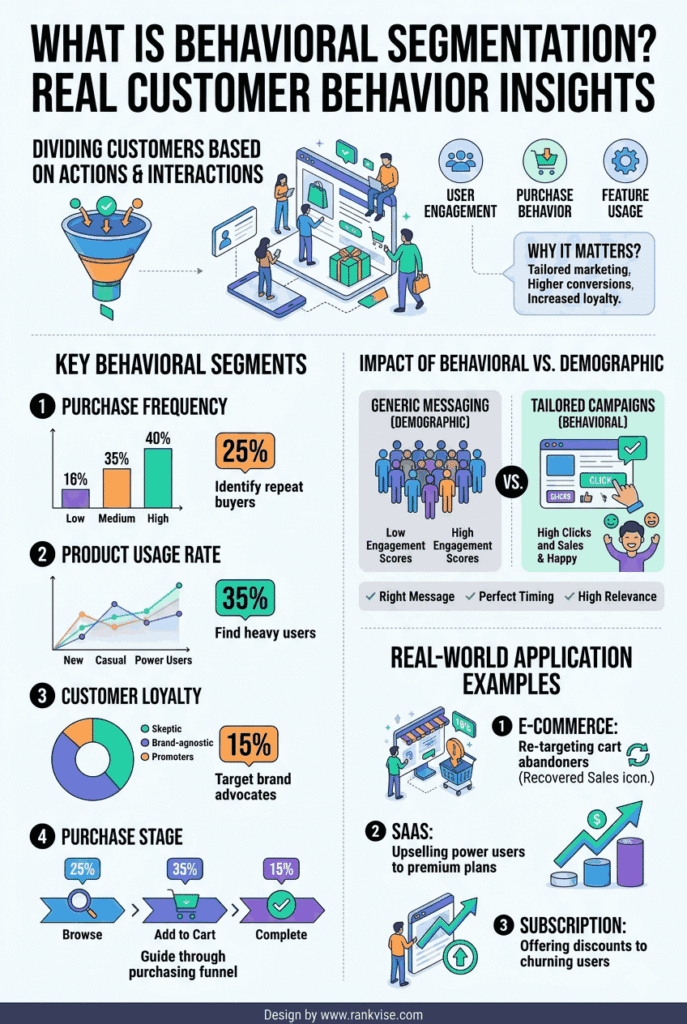
Behavioral segmentation is a marketing strategy that groups customers based on their observed behaviors. These behaviors include purchasing habits, product usage, brand interactions, and decision-making patterns.
Unlike demographic or geographic segmentation, this method focuses on actions rather than characteristics. Two customers might share the same age, income, and location but behave completely differently when shopping online.
One might browse for weeks before buying. The other might purchase impulsively within minutes. Treating them the same wastes your marketing budget. Behavioral segmentation lets you recognize these differences and respond accordingly.
Businesses collect behavioral data from multiple sources. Website analytics, purchase histories, email engagement, app usage, and customer support interactions all feed into this segmentation model. The richer your data, the more precise your customer segments become.
Why Does Behavioral Segmentation Matter?
Traditional segmentation methods rely on assumptions. You assume a 35-year-old professional wants certain products. Behavioral segmentation removes that guesswork by working with evidence.
Here is why this matters for your bottom line. Customers who receive relevant, behavior-based messaging convert at significantly higher rates. They also stay loyal longer because your communication feels personal, not generic.
The core benefits include:
- Higher conversion rates from personalized campaigns
- Reduced customer acquisition costs through precise targeting
- Improved customer retention by anticipating needs
- Better product development based on actual usage data
- Stronger email and ad performance with behavior-triggered messaging
- Clearer understanding of the customer journey
Companies like Amazon, Netflix, and Spotify built their competitive advantage on behavioral data. They track what users do, learn from those patterns, and serve recommendations that feel almost intuitive. You do not need their budget to apply the same principles.
Types of Behavioral Segmentation With Real Examples
Behavioral segmentation takes several forms. Each type captures a different dimension of customer behavior. Understanding these categories helps you choose the right approach for your business goals.
Purchase Behavior Segmentation
Purchase behavior segmentation groups customers by how they buy. It examines patterns like impulse buying, research-heavy purchasing, brand loyalty, and deal-seeking.
A clothing retailer might identify four distinct buyer types. Bargain hunters only purchase during sales. Loyal customers buy consistently at full price. Seasonal shoppers appear during holidays. First-time buyers need extra nurturing before they convert again.
Each group requires a different marketing approach. Sending a full-price promotion to a bargain hunter wastes your effort. Offering a loyalty reward to a first-time buyer feels premature.
Occasion-Based Segmentation
Occasion-based segmentation targets customers based on when they buy. Some purchases happen on predictable schedules. Others are triggered by life events or seasonal needs.
Common occasion types include:
- Universal occasions like holidays, back-to-school, or tax season
- Personal occasions like birthdays, anniversaries, or graduations
- Recurring occasions like weekly grocery runs or monthly subscriptions
- Rare occasions like weddings, home purchases, or retirement
A florist sees massive spikes around Valentine’s Day and Mother’s Day. But behavioral data might reveal a segment of customers who order flowers monthly for no specific occasion. That segment deserves its own subscription offer and messaging strategy.
Usage Rate Segmentation
Usage rate segmentation divides customers by how frequently they use your product or service. The standard categories are heavy users, moderate users, light users, and non-users.
This approach reveals where your revenue actually comes from. In many businesses, a small percentage of heavy users generates the majority of revenue. Identifying and retaining these power users becomes a critical priority.
| Segment | Behavior | Strategy |
|---|---|---|
| Heavy users | Use product daily or multiple times per week | Reward loyalty, offer premium tiers |
| Moderate users | Engage regularly but not consistently | Increase engagement with targeted content |
| Light users | Use occasionally or minimally | Re-engage with onboarding support or incentives |
| Non-users | Signed up but never activated | Trigger activation campaigns with clear value |
SaaS companies use this segmentation constantly. A project management tool might notice that teams using fewer than three features have higher churn rates. That insight triggers onboarding emails highlighting underused features.
Benefit-Sought Segmentation
Benefit-sought segmentation groups customers by the primary value they seek from your product. Different people buy the same product for entirely different reasons.
Consider toothpaste. One customer buys it for whitening. Another wants cavity protection. A third cares about fresh breath. A fourth chooses based on natural ingredients. Same product category, four distinct segments.
Understanding what benefit drives each customer lets you tailor your messaging with precision. Your product page, ad copy, and email campaigns can all speak directly to what each segment values most.
Customer Loyalty Segmentation
Loyalty-based segmentation separates customers by their commitment to your brand. Not all repeat customers are equally loyal. Some return out of habit. Others genuinely advocate for your brand.
A practical loyalty framework looks like this:
- Advocates actively recommend your brand to others
- Loyal customers buy consistently and resist competitor offers
- Habitual buyers return out of convenience, not attachment
- Switchers move between brands based on price or promotions
- Detractors had negative experiences and may discourage others
Each group needs a tailored retention strategy. Advocates deserve referral programs and early access. Switchers need competitive pricing or exclusive offers. Detractors require immediate service recovery.
How to Implement Behavioral Segmentation in Your Business
Knowing the types is useful. Applying them is where the value lives. Follow this process to build behavioral segments that drive measurable results.
Step 1: Collect the Right Behavioral Data
Start by identifying which behaviors matter most for your business. An ecommerce company might prioritize purchase frequency and cart abandonment. A SaaS business might focus on feature adoption and login frequency.
Key data sources include:
- Website and app analytics (page views, session duration, click paths)
- Purchase and transaction history
- Email engagement metrics (opens, clicks, unsubscribes)
- Customer support interactions
- Social media engagement
- Product usage logs
Your CRM, analytics platform, and marketing automation tools already capture most of this data. The challenge is organizing it into actionable segments, not collecting it.
Step 2: Define Meaningful Segments
Avoid creating too many segments. Start with three to five groups that represent distinct behavioral patterns. Each segment should be large enough to justify dedicated marketing efforts.
Use clear criteria for each segment. “Engaged users” is too vague. “Users who logged in at least 10 times in the past 30 days and used three or more features” gives your team something concrete to work with.
Step 3: Map Segments to Marketing Actions
Every segment needs a corresponding strategy. Define what message, channel, offer, and timing works best for each group.
A practical mapping might look like this:
| Segment | Action | Channel |
|---|---|---|
| Cart abandoners | Send reminder with limited-time discount | Email and retargeting ads |
| Heavy users | Offer annual plan upgrade | In-app notification |
| Inactive subscribers | Re-engagement series with new features | Email drip campaign |
| First-time buyers | Welcome sequence with product education | Email and SMS |
| Loyal customers | Exclusive early access to new products | Email and loyalty app |
Step 4: Test, Measure, and Refine
Behavioral segments are not static. Customer behavior evolves, and your segments should evolve with it. Review segment performance monthly. Test different messages, offers, and timing for each group.
Track metrics that matter for each segment. Conversion rate, retention rate, average order value, and customer lifetime value give you a complete picture. Drop segments that underperform and double down on those that drive results.
Behavioral Segmentation vs Other Segmentation Methods
Behavioral segmentation works alongside other methods, not as a replacement. Understanding how it compares helps you build a well-rounded strategy.
| Method | Basis | Strength | Limitation |
|---|---|---|---|
| Demographic | Age, gender, income | Easy to collect | Assumes similar behavior |
| Geographic | Location, climate, region | Useful for local targeting | Ignores individual preferences |
| Psychographic | Values, interests, lifestyle | Captures motivation | Hard to measure accurately |
| Behavioral | Actions, habits, usage | Based on real evidence | Requires robust data collection |
The strongest marketing strategies layer multiple segmentation types together. You might target high-income professionals in urban areas who also happen to be heavy users of your mobile app. That combination of demographic, geographic, and behavioral data creates a powerful, precise audience.
Common Pitfalls When Using Behavioral Segmentation
Even smart teams make mistakes when implementing behavior-based segments. Watch out for these common errors.
Over-segmenting your audience creates too many small groups. Each segment needs its own content, offers, and campaigns. If you cannot resource that, consolidate into fewer, broader segments.
Ignoring data privacy damages trust and invites legal risk. Always collect behavioral data transparently. Comply with regulations like GDPR and CCPA. Let customers know how you use their information.
Relying on outdated data leads to irrelevant messaging. A customer who bought winter gear six months ago may not want snow boots in July. Refresh your segments regularly to reflect current behavior.
Focusing only on buyers leaves money on the table. Non-buyers and inactive users represent untapped potential. Build segments for people who almost converted, and create campaigns that address their hesitation.
FAQs
An ecommerce store sending cart abandonment emails with a discount code is a classic example. It targets customers based on a specific action they took.
Behavioral segmentation uses observable actions like purchases and website visits. Psychographic segmentation relies on attitudes, values, and lifestyle preferences that are harder to measure.
You need purchase history, website analytics, email engagement metrics, product usage data, and customer interaction logs. Most CRM and analytics tools already collect this.
Yes. Even basic email tools let you segment by purchase history or engagement level. Start with two or three segments and expand as your data and resources grow.
Review and refresh segments at least quarterly. Customer behavior shifts with seasons, trends, and life changes, so static segments lose accuracy over time.