Marketing fundamentals are the core principles that guide how businesses attract, engage, and retain customers. They form the foundation of every successful campaign, product launch, and brand strategy. Without them, even the most creative ideas fall flat.
- Apply the marketing mix: align product, price, place, and promotion to deliver distinct customer value.
- Define and update clear target audiences and buyer personas using research, analytics, and customer interviews.
- Prioritize content and SEO, choose channels where your audience engages, and focus deeply on two platforms rather than many.
- Measure performance with CAC, CLV, conversion rates, and ROMI; review results regularly and optimize campaigns quarterly.
Think of marketing fundamentals as the rulebook for connecting your product to the right audience. They help you understand buyer behavior, craft compelling messages, and choose the right channels. Whether you run a startup or manage a Fortune 500 brand, these principles remain constant.
Businesses that ignore these basics often waste budgets chasing trends. Those that master them build sustainable, scalable growth engines. The difference between the two comes down to discipline and clarity.
The Marketing Mix: Understanding the 4 Ps
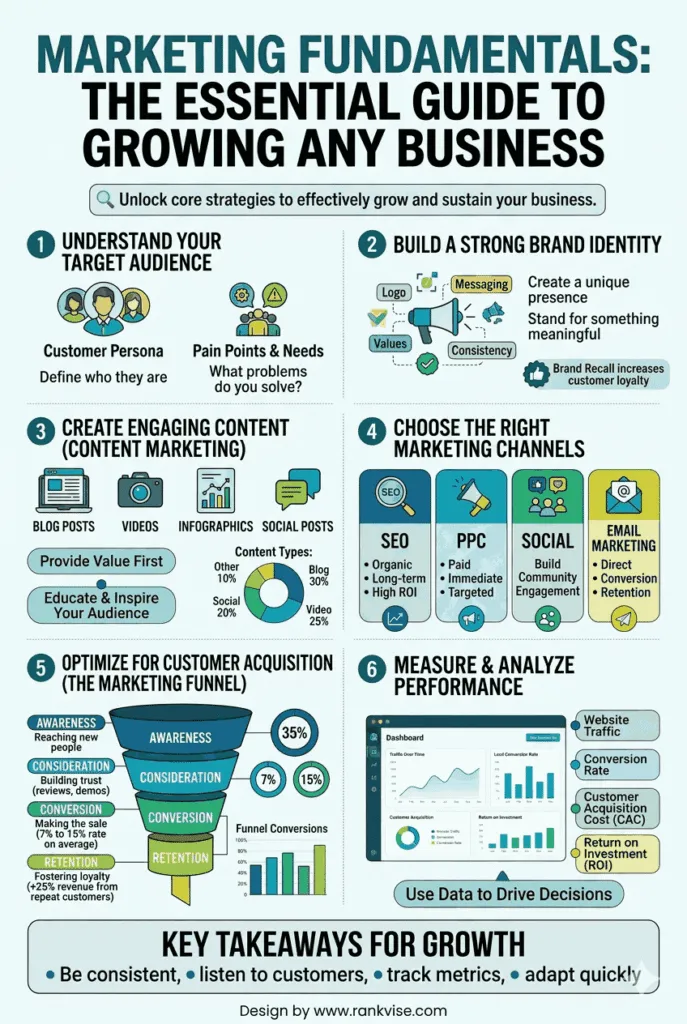
The marketing mix is the backbone of any marketing strategy. It consists of four interconnected elements that shape how you deliver value.
Product
Your product is the solution you offer to a specific problem. It must align with what your target audience actually needs — not what you assume they want. Successful businesses validate their product through research, testing, and customer feedback before scaling.
A strong product strategy also considers packaging, features, quality, and differentiation. Ask yourself: what makes my offering distinct from competitors? If you cannot answer that in one sentence, your positioning needs work.
Price
Pricing directly affects perception, demand, and profitability. Set your price too high, and you limit your market. Set it too low, and you erode trust and margins.
Effective pricing strategies include value-based pricing, competitive pricing, and penetration pricing. Each serves a different business goal. The best approach depends on your market position, cost structure, and customer expectations.
Place
Place refers to the distribution channels where customers find and purchase your product. This includes physical retail, e-commerce platforms, direct sales, and third-party marketplaces.
Choosing the right channels requires understanding where your audience already spends time and money. A luxury skincare brand might thrive on its own website. A budget snack brand might need shelf space in grocery stores nationwide.
Promotion
Promotion covers every tactic you use to communicate your value to potential buyers. This includes advertising, content marketing, social media, email campaigns, and public relations.
The goal of promotion is not just visibility. It is about delivering the right message to the right person at the right time. Great promotion educates, builds trust, and motivates action.
Identifying and Understanding Your Target Audience
Every effective marketing strategy starts with a clear picture of who you serve. Your target audience is the specific group most likely to buy your product or service.
How to Define Your Ideal Customer
Start by analyzing demographics like age, income, location, and occupation. Then go deeper into psychographics — values, interests, pain points, and buying motivations. Combine both for a complete customer profile.
Use tools like surveys, interviews, analytics platforms, and CRM data. Real insights always outperform assumptions. The brands that win are the ones that listen more than they broadcast.
Building Buyer Personas
A buyer persona is a semi-fictional representation of your ideal customer. It gives your team a shared reference point for every marketing decision.
| Persona Element | Example |
|---|---|
| Name | “Marketing Manager Maria” |
| Age Range | 30–42 |
| Pain Point | Limited budget, needs measurable ROI |
| Preferred Channel | LinkedIn, industry blogs |
| Buying Trigger | Case studies with proven results |
Create two to three personas for your primary segments. Update them quarterly as your audience evolves.
Digital Marketing Strategy: Channels That Drive Results
A strong digital marketing strategy connects your fundamentals to the platforms where modern buyers make decisions. Choosing the right mix of channels determines your reach and return on investment.
Content Marketing
Content marketing attracts and educates potential customers through valuable, relevant information. Blog posts, videos, podcasts, and guides build authority over time. This approach earns trust before you ever ask for a sale.
Consistency matters more than volume. One well-researched article per week outperforms five shallow posts. Focus on answering real questions your audience asks.
Search Engine Optimization
SEO ensures your content appears when people search for solutions you provide. It involves optimizing on-page elements, building quality backlinks, and creating content aligned with search intent.
Technical SEO — site speed, mobile usability, structured data — also plays a critical role. Search engines reward websites that deliver fast, accessible, and relevant experiences.
Social Media Marketing
Social media marketing builds community and amplifies your brand voice. Each platform serves a different purpose and audience. LinkedIn works for B2B thought leadership. Instagram excels at visual storytelling. TikTok captures younger demographics with short-form video.
Choose platforms based on where your audience engages, not where every competitor posts. Depth on two channels beats shallow presence on six.
Email Marketing
Email remains one of the highest-ROI marketing channels available. It lets you nurture leads, retain customers, and drive repeat purchases — all without depending on algorithms.
Segment your lists based on behavior and preferences. Personalized emails generate significantly higher open and conversion rates than generic blasts.
Brand Positioning: Standing Out in a Crowded Market
Brand positioning defines how your audience perceives you relative to competitors. It answers one critical question: why should someone choose you?
Crafting a Unique Value Proposition
Your value proposition is a clear statement of the benefit you deliver and why you deliver it better. It should be specific, measurable, and customer-focused.
Avoid vague claims like “we provide excellent service.” Instead, try: “We help e-commerce brands reduce cart abandonment by 30% in 90 days.” Specificity builds credibility.
Consistency Across Every Touchpoint
Your brand must feel cohesive everywhere — website, social media, packaging, customer support, and advertising. Inconsistency confuses buyers and weakens trust.
Create brand guidelines that cover voice, tone, visual identity, and messaging frameworks. Share them with every team member and external partner.
Measuring Marketing Performance
You cannot improve what you do not measure. Marketing analytics turn guesswork into informed decisions.
Key Metrics Every Marketer Should Track
- Customer Acquisition Cost (CAC): Total spend divided by new customers acquired. Lower is better, but not at the expense of quality.
- Customer Lifetime Value (CLV): The total revenue a customer generates over their relationship with your brand. High CLV justifies higher acquisition costs.
- Conversion Rate: The percentage of visitors who take a desired action. Track this across every funnel stage.
- Return on Marketing Investment (ROMI): Revenue generated per dollar spent on marketing. This metric keeps your budget accountable.
- Engagement Rate: Measures how actively your audience interacts with content. High engagement signals relevance and resonance.
Tools for Marketing Measurement
Google Analytics, HubSpot, SEMrush, and platform-native dashboards provide the data you need. Set up dashboards that align with your specific business goals. Review performance weekly and adjust tactics monthly.
Common Marketing Mistakes to Avoid
Even experienced teams fall into predictable traps. Awareness is the first step toward avoiding them.
- Skipping market research: Launching without understanding demand leads to wasted resources and missed opportunities.
- Targeting everyone: Broad targeting dilutes your message. Narrow focus drives stronger results and lower costs.
- Ignoring retention: Acquiring new customers costs five to seven times more than keeping existing ones. Invest in loyalty programs and post-purchase communication.
- Chasing vanity metrics: Likes and followers feel rewarding but rarely correlate with revenue. Focus on metrics tied to business outcomes.
- Inconsistent execution: Marketing compounds over time. Stopping and starting campaigns destroys momentum and wastes prior investment.
Building a Marketing Plan That Actually Works
A marketing plan translates your strategy into actionable steps with clear deadlines and ownership.
Start with your business objectives. Define your target audience segments. Select your primary channels. Set measurable KPIs for each campaign. Allocate budget based on expected ROI, not habit.
Review your plan quarterly. Markets shift, competitors adapt, and customer preferences evolve. The best marketing plans are living documents, not static PDFs collecting dust.
FAQs
Beginners should master the marketing mix (4 Ps), target audience identification, brand positioning, digital marketing channels, and performance measurement.
B2B marketing focuses on longer sales cycles, relationship building, and ROI-driven messaging. B2C marketing emphasizes emotion, convenience, and faster purchase decisions.
Knowing your target audience lets you create relevant messages, choose effective channels, and allocate budget efficiently — leading to higher conversion rates and lower acquisition costs.
Content marketing and SEO form the foundation because they generate long-term organic traffic. Paid channels amplify results but depend on strong fundamentals to convert effectively.
Review your marketing strategy quarterly and make major updates annually. Market conditions, customer behavior, and competitive landscapes change constantly and require ongoing adaptation.