RFP stands for request for proposal. It is a formal document that organizations use to invite vendors or service providers to submit bids for a specific project. The RFP outlines the project requirements, evaluation criteria, and submission guidelines. Vendors then respond with detailed proposals explaining how they would deliver the work.
Think of an RFP as a structured job posting for companies instead of individuals. Rather than hiring an employee, you are hiring an external business to complete a defined scope of work. The RFP process ensures that multiple qualified vendors compete for the opportunity. This competition drives better pricing, higher quality, and greater accountability.
Businesses of all sizes use request for proposal documents. Government agencies, corporations, nonprofits, and educational institutions rely on them regularly. Any project that involves significant spending or complexity benefits from a well-crafted RFP.
How Does the RFP Process Work?
The Step-by-Step RFP Workflow
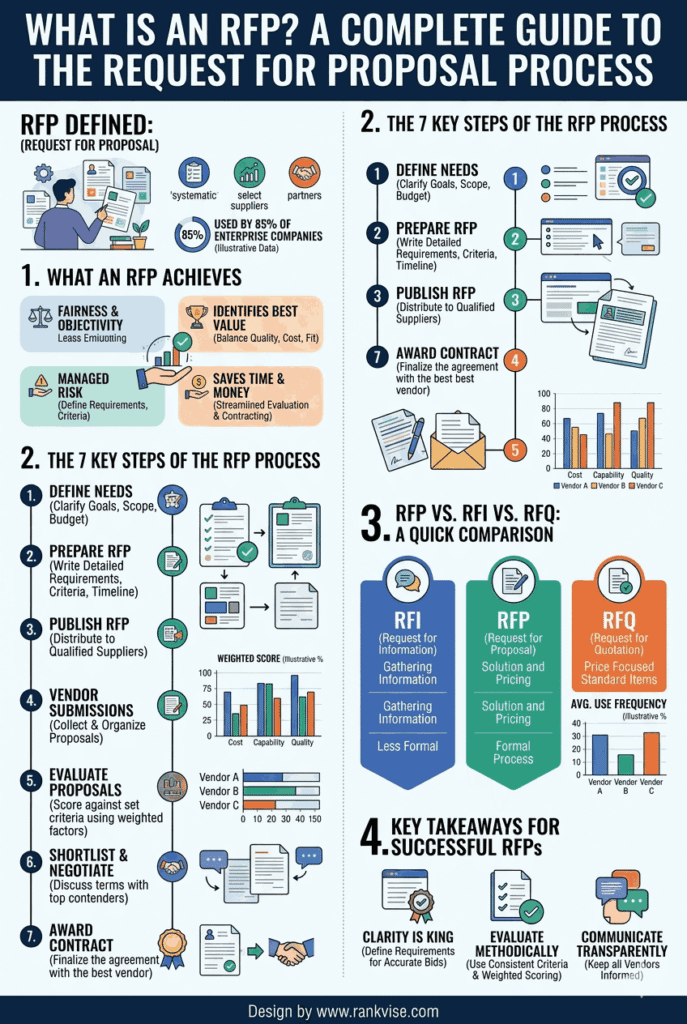
The request for proposal process follows a predictable sequence. Understanding each step helps both buyers and vendors navigate it successfully.
- Identify the need – the organization defines a project or service requirement that external help can fulfill
- Draft the RFP document – the buying team writes detailed requirements, timelines, budget expectations, and evaluation criteria
- Distribute to vendors – the organization sends the RFP to pre-qualified vendors or publishes it on procurement platforms
- Vendors submit proposals – interested vendors respond with their approach, pricing, team qualifications, and relevant experience
- Evaluate and shortlist – the buying team scores each proposal against the stated criteria
- Conduct presentations or interviews – shortlisted vendors present their proposals in person or virtually
- Select and negotiate – the organization chooses the best vendor and finalizes contract terms
This structured approach eliminates guesswork from major purchasing decisions. It creates a documented, defensible selection process that stakeholders can review and audit.
Who Typically Issues an RFP?
Organizations issue request for proposal documents when they need outside expertise or resources. Procurement teams, project managers, or department heads usually lead the process. Government agencies issue RFPs for nearly all major contracts due to legal transparency requirements.
Private companies use RFPs when projects exceed a certain budget threshold. Many organizations set internal policies requiring an RFP for any engagement above 25,000 USD or 50,000 USD. This threshold varies by company size and industry. The goal is ensuring fair competition and fiscal responsibility.
What Should an RFP Include?
Essential Sections of a Request for Proposal
A well-structured RFP gives vendors everything they need to submit a competitive, accurate proposal. Missing information leads to vague responses and wasted time on both sides. Include these core sections in every request for proposal document.
- Company overview – a brief description of your organization, mission, and relevant background
- Project scope – a clear explanation of what you need, including deliverables, objectives, and success metrics
- Timeline – key milestones, deadlines for submissions, and the expected project start and end dates
- Budget range – a realistic budget range or ceiling so vendors can tailor their proposals appropriately
- Evaluation criteria – the specific factors you will use to score proposals, such as experience, price, and methodology
- Submission requirements – formatting guidelines, page limits, required documents, and the submission deadline
- Terms and conditions – legal requirements, confidentiality expectations, and contract terms
Each section should be clear and specific. Ambiguity in an RFP produces ambiguous proposals. The more precise your requirements, the more useful the vendor responses will be.
How Detailed Should the Project Scope Be?
The project scope is the most critical section of any RFP. It defines exactly what you expect the vendor to deliver. Write it from the vendor’s perspective. Ask yourself what a qualified outsider would need to know to estimate effort, cost, and timeline accurately.
Include measurable outcomes wherever possible. Instead of saying “improve our website,” specify “redesign the homepage and five landing pages to increase conversion rates by 15 percent within six months.” Specific goals attract serious vendors. Vague descriptions attract guesswork.
RFP vs RFQ vs RFI: What Is the Difference?
Businesses use several types of solicitation documents beyond the request for proposal. Each serves a distinct purpose in the procurement process. Understanding the differences prevents you from using the wrong tool for the job.
| Document | Full Name | Purpose | When to Use |
|---|---|---|---|
| RFP | Request for Proposal | Solicits detailed proposals including approach and pricing | Complex projects where methodology matters as much as cost |
| RFQ | Request for Quotation | Solicits price quotes for clearly defined products or services | Straightforward purchases where specifications are already fixed |
| RFI | Request for Information | Gathers general information about vendor capabilities | Early research stages before defining exact project requirements |
An RFQ works when you know exactly what you want and just need pricing. An RFI works when you are still exploring options and need market insight. An RFP works when you need vendors to propose creative solutions, not just quote a price. Most large projects begin with an RFI, narrow down candidates, and then issue a formal RFP.
How to Write an Effective RFP
Focus on Outcomes, Not Just Tasks
The best request for proposal documents describe desired outcomes rather than prescribing exact methods. Tell vendors what success looks like. Let them propose how to achieve it. This approach attracts innovative solutions that you might not have considered internally.
For example, do not write “build a mobile app using React Native.” Instead, write “develop a cross-platform mobile application that supports 10,000 concurrent users and loads within two seconds.” The first version limits your options. The second invites creative problem-solving from experienced vendors.
Set Realistic Timelines
Give vendors enough time to prepare thoughtful proposals. Rushing the process produces shallow responses and discourages top-tier vendors from participating. Most RFPs allow three to four weeks for vendor responses. Complex projects may require six weeks or more.
Your internal evaluation timeline also matters. Plan at least two weeks for scoring proposals and one week for vendor presentations. Shortcutting the evaluation phase leads to poor vendor selection. And poor vendor selection creates problems that far outlast the time you saved.
Be Transparent About Budget
Many organizations hesitate to share budget information in their RFP. This hesitation usually backfires. Without a budget range, vendors either overshoot your expectations or underbid to win the work. Neither outcome serves your project well.
Sharing a budget range signals professionalism and seriousness. It tells vendors that you understand the market and have secured internal funding. Qualified vendors will focus their proposals on maximizing value within your stated range rather than guessing at what you can afford.
Common Mistakes to Avoid When Creating an RFP
Even experienced procurement teams make avoidable errors during the RFP process. These mistakes waste time, discourage strong vendors, and produce weaker outcomes.
- Writing vague requirements – unclear scope statements generate proposals that miss the mark entirely
- Including too many evaluation criteria – more than seven or eight criteria dilute focus and complicate scoring
- Ignoring vendor questions – a Q&A period builds trust and improves proposal quality for everyone involved
- Choosing solely on price – the cheapest vendor often delivers the most expensive problems later
- Skipping the debrief – not telling losing vendors why they lost damages your reputation and future vendor pool
A well-managed RFP process builds strong vendor relationships even with companies you do not select. Those vendors may be perfect for your next project. Treat every participant with respect and transparency.
Real-World RFP Examples Across Industries
Request for proposal documents appear in nearly every industry. Here are practical examples showing how different organizations use them.
- Technology – a retail company issues an RFP for a new e-commerce platform that integrates with existing inventory systems
- Marketing – a university sends an RFP to creative agencies seeking a full campus rebranding including logo, messaging, and website
- Construction – a city government publishes an RFP for a new community center requiring architectural design and project management
- Healthcare – a hospital network distributes an RFP for an electronic health records system serving 15 regional facilities
- Consulting – a nonprofit releases an RFP for a strategic planning consultant to facilitate a three-year organizational roadmap
Each of these examples involves complexity, significant budget, and the need for expert external support. These are the conditions where the RFP process delivers the greatest value.
FAQs
An RFP invites qualified vendors to submit detailed proposals for a specific project. It creates a fair, competitive process that helps organizations select the best vendor based on defined criteria.
The entire RFP process typically takes six to twelve weeks from drafting to vendor selection. Complex projects involving government agencies or large enterprises may take longer.
An RFP requests a detailed proposal including methodology, timeline, and pricing. An RFQ only requests a price quote for a clearly defined product or service with fixed specifications.
Yes, small businesses can issue RFPs for any project where competitive vendor selection adds value. Even simplified RFPs help small companies compare options and negotiate better terms.
A strong RFP response directly addresses every requirement in the document, demonstrates relevant experience, provides clear pricing, and shows a deep understanding of the issuing organization’s goals.