A vision statement describes the future your organization wants to create. It captures where your company is heading, not where it stands today. A strong vision statement inspires employees, attracts customers, and guides strategic decisions over the long term.
- Be future focused, concise, inspiring, specific, and aligned with your company's core values.
- Keep it concise and ambitious; fewer words often create greater emotional impact and memorability.
- Center the vision on customer and human outcomes rather than products, metrics, or internal operations.
- Draft freely, then edit ruthlessly: remove jargon, buzzwords, and generic phrasing for clarity.
- Test the statement with someone outside your organization and refine until it is clear and motivating.
Think of it as a North Star for your business. Every major decision should move the company closer to that vision. Unlike a mission statement, which explains what you do now, a vision statement paints a picture of what success looks like in the future.
The best vision statement examples are concise, ambitious, and easy to remember. They motivate teams without being vague or generic. Let us explore 50 real-world examples and break down what makes each one effective.
What Makes a Great Vision Statement?
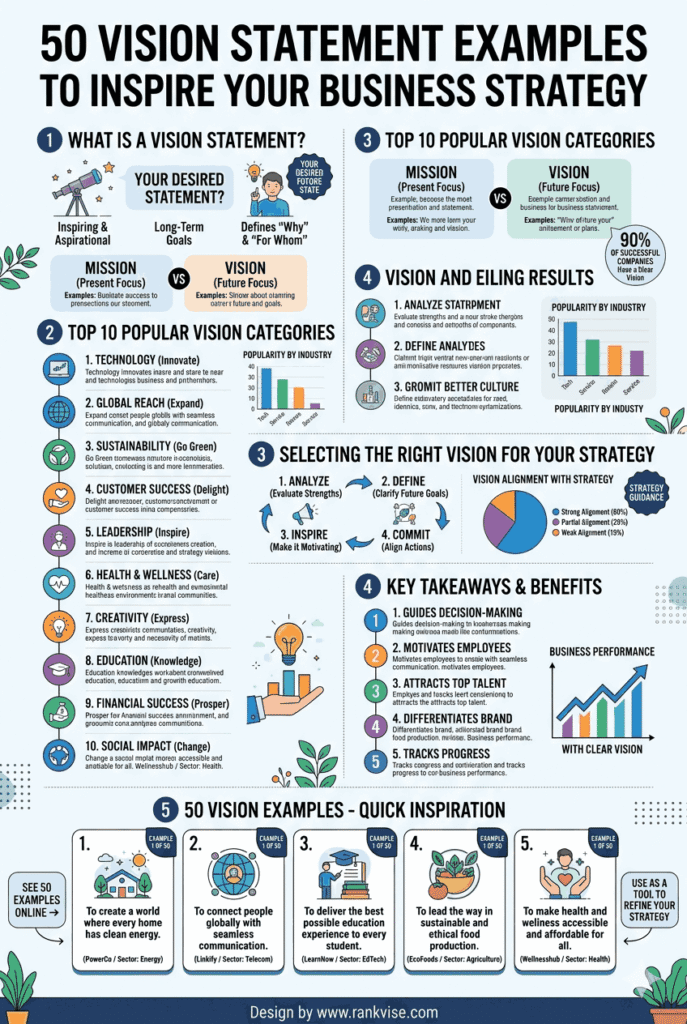
Before diving into examples, it helps to understand the qualities that separate powerful vision statements from forgettable ones. A great company vision statement shares these characteristics.
- Future-focused – describes an aspirational destination, not current operations
- Concise – typically one to two sentences that anyone can remember
- Inspiring – motivates employees and stakeholders to work toward something meaningful
- Specific enough – gives clear direction without being overly narrow
- Aligned with values – reflects the company’s core beliefs and culture
A vision statement should feel ambitious yet achievable. If it sounds like every other company in your industry, it needs more specificity. If nobody can remember it, it needs fewer words.
50 Vision Statement Examples by Industry
Technology Company Vision Statements
Technology companies often craft vision statements around innovation, access, and global impact. These examples show how leading tech brands define their future ambitions.
- Microsoft – “To empower every person and every organization on the planet to achieve more.”
- Google – “To provide access to the world’s information in one click.”
- Samsung – “Inspire the world, create the future.”
- Tesla – “To create the most compelling car company of the 21st century by driving the world’s transition to electric vehicles.”
- Intel – “If it is smart and connected, it is best with Intel.”
- Salesforce – “To be the platform for customer success, helping companies connect with their customers in entirely new ways.”
- IBM – “To be the world’s most essential technology company.”
- Spotify – “To unlock the potential of human creativity by giving a million creative artists the opportunity to live off their art.”
These vision statement examples share a pattern. Each one identifies a bold future state while staying connected to the company’s core business.
Retail and Consumer Brand Vision Statements
Retail companies use vision statements to communicate customer-centric ambitions. These brands focus on experience, accessibility, and lifestyle aspirations.
- Amazon – “To be earth’s most customer-centric company, where customers can find and discover anything they might want to buy online.”
- IKEA – “To create a better everyday life for the many people.”
- Nike – “To bring inspiration and innovation to every athlete in the world.”
- Walmart – “To make every day easier for busy families.”
- Patagonia – “To save our home planet.”
- Warby Parker – “To offer designer eyewear at a revolutionary price while leading the way for socially conscious businesses.”
- Target – “To help all families discover the joy of everyday life.”
- Lululemon – “To be the experiential brand that ignites a community of people living the sweat life through sweat, grow, and connect.”
Notice how the strongest examples focus on the customer’s life, not the company’s products. This outward focus makes vision statements more inspiring and memorable.
Food and Beverage Vision Statements
Food and beverage brands often emphasize nourishment, sustainability, or shared experiences in their vision statements.
- Coca-Cola – “To craft the brands and choice of drinks that people love, to refresh them in body and spirit.”
- PepsiCo – “To be the global leader in beverages and convenient foods by winning with pep+.”
- Starbucks – “To establish Starbucks as the premier purveyor of the finest coffee in the world while maintaining our uncompromising principles.”
- McDonald’s – “To move with velocity to drive profitable growth and become an even better McDonald’s serving more customers delicious food each day around the world.”
- Nestlé – “To be a leading, competitive, nutrition, health and wellness company delivering improved shareholder value by being a preferred corporate citizen.”
- Whole Foods – “To nourish people and the planet.”
- Ben & Jerry’s – “Making the best possible ice cream, in the nicest possible way.”
- Danone – “One planet. One health.”
Short vision statements like those from Whole Foods and Danone prove that brevity can be incredibly powerful. Fewer words often create greater emotional impact.
Healthcare and Pharmaceutical Vision Statements
Healthcare companies build vision statements around patient outcomes, innovation, and global health improvement.
- Johnson & Johnson – “For every person to use their lifelong potential to create a healthier, more equitable world.”
- Pfizer – “Breakthroughs that change patients’ lives.”
- Mayo Clinic – “To provide an unparalleled experience as the most trusted partner for health care.”
- UnitedHealth Group – “To help people live healthier lives and help make the health system work better for everyone.”
- Abbott – “To help people live fuller lives through better health.”
- CVS Health – “To help people on their path to better health.”
- Roche – “Doing now what patients need next.”
These vision statement examples prioritize human outcomes over financial goals. This patient-first approach builds trust and attracts purpose-driven talent.
Financial Services Vision Statements
Banks and financial institutions focus their vision statements on empowerment, trust, and financial well-being.
- JPMorgan Chase – “To be the best financial services company in the world.”
- PayPal – “To democratize financial services to ensure that everyone, regardless of background or economic standing, has access to affordable, convenient, and secure products and services.”
- Visa – “To be the best way to pay and be paid, for everyone, everywhere.”
- Goldman Sachs – “To advance sustainable economic growth and financial opportunity across the globe.”
- Charles Schwab – “A world where everyone has access to the investing tools and guidance they need.”
- Mastercard – “A world beyond cash.”
PayPal’s vision statement stands out because it identifies a specific problem — financial exclusion — and commits to solving it. Problem-oriented vision statements feel more authentic and actionable.
Nonprofit and Social Enterprise Vision Statements
Nonprofits and social enterprises craft vision statements around the change they want to see in the world. These tend to be the most emotionally compelling.
- Habitat for Humanity – “A world where everyone has a decent place to live.”
- World Wildlife Fund – “To build a future in which people live in harmony with nature.”
- Teach For America – “One day, all children in this nation will have the opportunity to attain an excellent education.”
- Doctors Without Borders – “To provide independent, impartial medical humanitarian assistance to people affected by conflict, epidemics, disasters, or exclusion from healthcare.”
- charity: water – “A world where everyone has clean water.”
- Khan Academy – “A free, world-class education for anyone, anywhere.”
These organizations prove that vision statements do not require corporate language. Simple, human declarations often resonate more deeply than polished corporate phrasing.
Automotive and Manufacturing Vision Statements
Manufacturing and automotive companies express their vision through innovation, sustainability, and engineering excellence.
- Toyota – “To be the most respected and admired car company in America.”
- BMW – “To be the most successful premium manufacturer in the industry.”
- Ford – “To become the world’s most trusted company, designing smart vehicles for a smart world.”
- General Electric – “To build, power, move and cure the world.”
- 3M – “To be the most innovative enterprise and the preferred partner.”
- Caterpillar – “A world in which all people’s basic needs are fulfilled.”
- Volvo – “To be the world’s most progressive and desired luxury car brand by simplifying people’s lives.”
General Electric’s four-word vision statement demonstrates how extreme brevity can capture massive ambition. Every word carries significant weight.
How to Write Your Own Vision Statement
Start With the Right Questions
Writing a company vision statement begins with honest reflection. Ask your leadership team these questions before drafting anything.
- What impact do we want to have on our customers’ lives in ten years?
- What would the world look like if our company fully succeeded?
- What makes our ambition different from every other company in our space?
- What future state would make every employee proud to be part of this organization?
These questions shift the focus from daily operations to long-term purpose. The answers form the raw material for a compelling vision statement.
Draft, Edit, and Simplify
Write your first draft without worrying about length or perfection. Capture every ambitious idea your team generates. Then edit ruthlessly. Remove industry jargon, corporate buzzwords, and anything that could apply to any company in any industry.
Test your final draft with this simple exercise. Read it to someone outside your organization. If they understand it immediately and find it inspiring, you have a strong vision statement. If they look confused or unimpressed, keep simplifying.
| Vision Statement Quality | Weak Example | Strong Example |
|---|---|---|
| Too vague | “To be the best” | “To give everyone access to affordable legal services” |
| Too long | Three paragraphs of aspirations | One clear, memorable sentence |
| Too generic | “To deliver value to stakeholders” | “A world where no child goes hungry” |
| Too narrow | “To sell 10 million units by 2030” | “To make sustainable fashion the norm” |
The best vision statements balance ambition with clarity. They should stretch your organization without confusing your audience.
FAQs
A mission statement explains what your company does today and for whom. A vision statement describes the future state your organization wants to create over the long term.
A strong vision statement is typically one to two sentences long. The most memorable examples use fewer than 20 words to convey a powerful aspiration.
Yes, every business benefits from a vision statement regardless of size. It aligns your team, guides decisions, and communicates your purpose to customers and partners.
Tesla, Warby Parker, and charity: water offer excellent models for startups. Each one is bold, specific, and clearly communicates the impact the company aims to achieve.
Most companies revisit their vision statement every five to ten years. Update it when your market shifts significantly or when your organization has achieved its original vision and needs a new aspiration.