Entrepreneurial skills are the practical abilities that help you start, run, and grow a business. They go far beyond writing a business plan or pitching investors. These skills shape how you think, lead, and respond when things break down.
- Master sales and customer acquisition: build trust, solve customer problems, and create repeatable revenue processes.
- Develop financial literacy and money management: track cash flow, read statements, set pricing that covers costs and supports growth.
- Hone problem solving and critical thinking: diagnose root causes, prioritize solutions, and turn setbacks into actionable learning.
Every successful founder shares a core set of capabilities. Some are learned in classrooms. Most are built through real-world pressure, failure, and repetition. The good news is that none of them require a special degree or background.
Whether you run a solo freelance operation or lead a funded startup, these abilities determine how fast you grow. They separate people who talk about business from people who actually build one.
The Core Entrepreneurial Skills Every Founder Needs
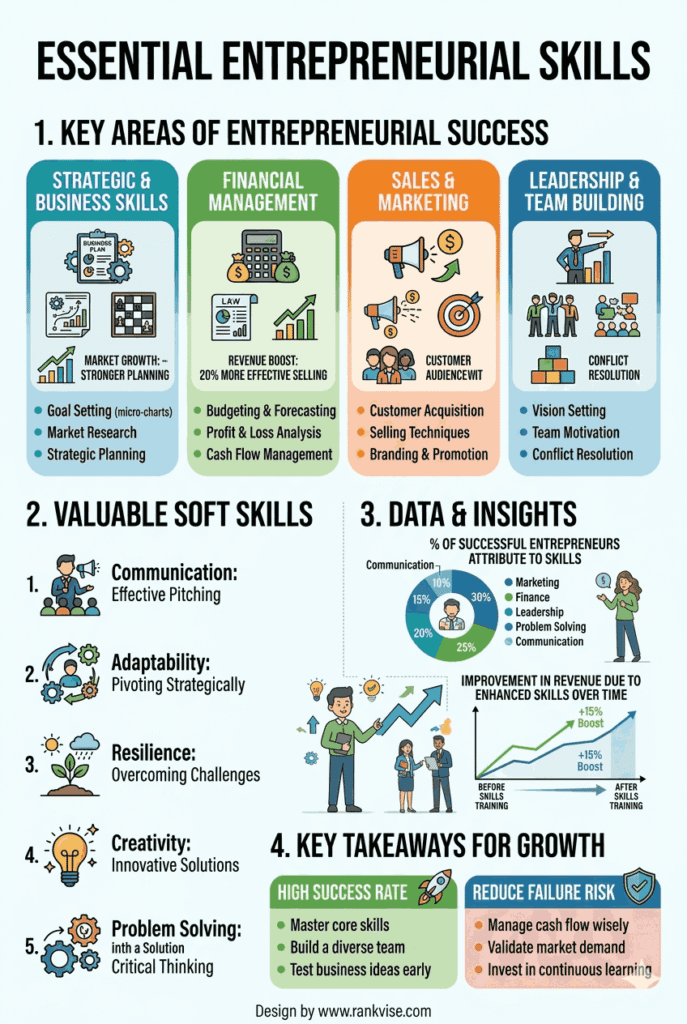
Not all business skills carry equal weight. Some directly impact revenue. Others protect you from costly mistakes. The following abilities form the foundation of every sustainable business.
1. Problem-Solving and Critical Thinking
Entrepreneurs face new problems daily. Supply chain delays, customer complaints, hiring mistakes, and cash flow gaps all demand fast solutions. You cannot wait for someone else to fix these issues.
Strong problem-solving means breaking down complex situations into manageable parts. It means asking the right questions before jumping to conclusions. Founders who master critical thinking spot root causes instead of treating symptoms.
Real-world example: When a product launch underperforms, average founders blame marketing. Skilled entrepreneurs investigate pricing, positioning, audience fit, and timing before making changes.
2. Financial Literacy and Money Management
You do not need an accounting degree. But you absolutely must understand how money moves through your business. Financial literacy means reading a profit and loss statement, tracking cash flow, and knowing your margins.
Many startups fail not from bad ideas but from poor financial decisions. Overspending on office space, underpricing services, or ignoring tax obligations can sink a profitable business within months.
Key financial skills every entrepreneur should develop:
- Reading and interpreting basic financial statements
- Forecasting revenue and expenses for the next 90 days
- Understanding gross margin versus net profit
- Managing accounts receivable and payable cycles
- Setting pricing that covers costs and supports growth
Founders who track their numbers weekly make better decisions than those who check quarterly.
3. Communication and Persuasion
Business runs on communication. You pitch to investors. You negotiate with vendors. You explain your vision to employees. You write emails that close deals. Every interaction either builds trust or erodes it.
Communication skills for entrepreneurs extend beyond public speaking. They include active listening, written clarity, and the ability to simplify complex ideas. Great communicators adjust their message based on who they are speaking with.
A founder explaining a product to a developer uses different language than when speaking with a customer. This adaptability is what makes communication a true entrepreneurial skill rather than a soft skill.
4. Leadership and Team Building
Solopreneurs eventually need help. When that moment arrives, leadership skills determine whether you build a team that thrives or one that constantly turns over. Leadership is not about authority. It is about direction, trust, and accountability.
Strong entrepreneurial leaders share several traits:
- They hire for attitude and train for skill
- They set clear expectations and follow through
- They give feedback frequently, not just during reviews
- They take responsibility when things go wrong
- They celebrate wins publicly and address failures privately
The best founders build cultures where people want to stay. Retention saves more money than most marketing campaigns.
5. Sales and Customer Acquisition
Every entrepreneur is a salesperson. Even if you hate the word, selling is how businesses survive. You sell your idea to co-founders. You sell your product to customers. You sell your vision to investors.
Sales skills include understanding buyer psychology, handling objections, and creating urgency without pressure. Modern sales relies heavily on trust, education, and relationship building rather than aggressive tactics.
Founders who learn consultative selling outperform those who rely on scripts. When you genuinely solve a customer’s problem, the sale becomes a natural outcome of the conversation.
6. Time Management and Prioritization
Entrepreneurs wear many hats. Without strong time management, you spend hours on tasks that generate no revenue. The startup mindset requires ruthless prioritization of activities that move the needle.
Effective time management looks like this in practice:
| High-Value Activities | Low-Value Activities |
|---|---|
| Closing sales calls | Redesigning your logo for the third time |
| Building strategic partnerships | Attending networking events with no clear purpose |
| Creating systems that scale | Manually doing tasks you could automate |
| Developing your core product | Checking email every 15 minutes |
| Talking to customers directly | Writing social media posts with no strategy |
The Pareto principle applies to entrepreneurship. Roughly 20 percent of your activities produce 80 percent of your results. Identify those activities and protect that time.
7. Adaptability and Resilience
Markets shift. Competitors emerge. Customers change preferences. The ability to adapt quickly is one of the most valuable decision-making skills a founder can develop.
Resilience does not mean ignoring pain or pretending failure does not hurt. It means processing setbacks quickly and adjusting your approach. Resilient entrepreneurs treat failure as data, not as identity.
Consider how many successful companies pivoted from their original idea. Slack started as a gaming company. YouTube began as a video dating site. Instagram launched as a check-in app called Burbn. Adaptability turned potential failures into billion-dollar businesses.
How to Develop Entrepreneurial Skills Without a Business Degree
Formal education helps, but it is not required. Most entrepreneurial skills develop faster through action than through theory. Here are proven methods to build these abilities.
Start a side project before quitting your job. Even a small venture teaches you sales, budgeting, and time management simultaneously. You learn faster when your own money and reputation are on the line.
Read case studies instead of generic business books. Study how specific founders solved specific problems. This builds pattern recognition that classroom theory cannot replicate.
Find a mentor who has built what you want to build. One hour with an experienced entrepreneur saves months of trial and error. Mentors provide context that books and courses miss.
Join a mastermind group or founder community. Surround yourself with people who face similar challenges. Peer accountability accelerates skill development faster than solo study.
Common Mistakes Entrepreneurs Make When Building Skills
Many aspiring founders focus on the wrong abilities at the wrong time. A pre-revenue startup does not need advanced HR skills. A solo consultant does not need supply chain expertise yet.
Avoid these common traps:
- Spending months perfecting a business plan instead of talking to customers
- Learning advanced marketing tactics before validating product-market fit
- Attending endless workshops without applying what you learn
- Trying to master everything simultaneously instead of focusing on revenue-generating skills first
- Comparing your year one to someone else’s year ten
The most successful entrepreneurs develop skills in direct response to real business challenges. They learn what they need when they need it, then move on to the next bottleneck.
How Entrepreneurial Skills Create Long-Term Business Value
Skills compound over time. A founder who masters sales in year one and adds leadership in year two builds a business that grows faster than competitors who stall on fundamentals.
Financial literacy prevents costly mistakes. Communication skills attract better partners and talent. Problem-solving ability reduces the time between setback and recovery. Each skill reinforces the others.
The entrepreneurs who dominate their industries are not necessarily the smartest people in the room. They are the most skilled operators. They have developed practical abilities through years of deliberate practice and real business experience.
Investing in your own skill development delivers the highest return of any business investment you will ever make.
FAQs
Start with sales, financial literacy, and communication. These three skills directly generate revenue and prevent the most common early-stage business failures.
Yes, through side projects, freelancing, volunteering for leadership roles, and studying real business case studies. Practical experience accelerates learning faster than theory alone.
Entrepreneurial skills focus on creating value from scratch under uncertainty. Management skills focus on optimizing existing systems, processes, and teams within established structures.
Sales and customer acquisition consistently drives the most direct revenue impact. Every other skill supports growth, but sales generates the cash that keeps a business alive.
Most founders develop core competency within 12 to 24 months of active business building. Mastery takes longer, but functional skills develop quickly through consistent real-world application.