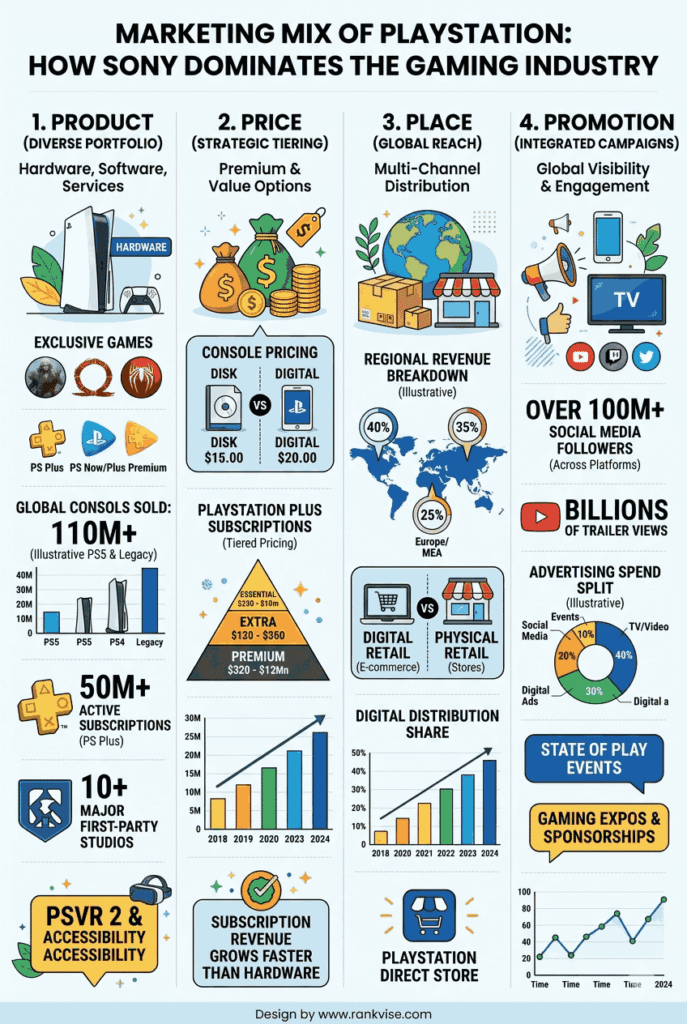
The marketing mix of PlayStation refers to the strategic combination of product, price, place, and promotion that Sony uses to market its gaming brand. These four pillars shape how PlayStation reaches millions of gamers worldwide. Understanding this framework reveals why PlayStation consistently outperforms competitors in the console market.
Sony launched the original PlayStation in 1994. Since then, the brand has evolved into a global entertainment powerhouse. Each generation of consoles has refined Sony’s approach to the 4Ps. The marketing mix of PlayStation today reflects decades of strategic learning and consumer insight.
This framework matters for marketers and business students alike. It shows how a single brand can balance innovation, affordability, global reach, and emotional storytelling. Let us break down each element in detail.
Product Strategy of PlayStation
Console Hardware That Defines Generations
PlayStation’s product strategy centers on delivering cutting-edge gaming hardware. The PS5, launched in 2020, features a custom SSD, ray tracing, and haptic feedback controllers. Sony designs each console to push technical boundaries while remaining accessible to mainstream gamers.
Hardware design plays a crucial role in brand identity. The PS5’s futuristic white-and-black design sparked global conversation at launch. Sony treats its consoles as lifestyle products, not just gaming machines. This elevates the perceived value of every PlayStation product.
Exclusive Games as a Core Differentiator
Exclusive titles form the backbone of PlayStation’s product ecosystem. Franchises like God of War, Spider-Man, and The Last of Us drive console sales directly. Sony invests heavily in first-party studios to maintain a steady pipeline of blockbuster exclusives.
These games create emotional connections that competitors struggle to replicate. A gamer who loves Horizon Forbidden West has a strong reason to stay within the PlayStation ecosystem. This exclusivity strategy locks in long-term brand loyalty.
Services and Digital Ecosystem
PlayStation Plus and PlayStation Now (now merged into tiered PS Plus plans) expand the product offering beyond hardware. These subscription services provide access to hundreds of games, cloud streaming, and online multiplayer. Sony positions these services as essential companions to the console experience.
The PlayStation Store serves as a digital marketplace for games, add-ons, and media. This digital ecosystem generates recurring revenue and keeps users engaged between major hardware launches. It transforms a one-time purchase into an ongoing relationship.
Pricing Strategy of PlayStation
Competitive Console Pricing
Sony uses a penetration pricing approach during console launches. The PS5 launched at 499 USD for the standard edition and 399 USD for the digital edition. These prices matched or undercut competitors while delivering superior hardware specifications.
Sony often sells consoles at slim margins or even at a loss initially. The real profit comes from game sales, subscriptions, and accessories. This strategy prioritizes market share over immediate hardware profit. It is a classic razor-and-blade model applied to gaming.
Tiered Pricing Across Products
PlayStation offers products at multiple price points to capture different market segments:
- PS5 Standard Edition – targets core gamers who want disc compatibility
- PS5 Digital Edition – appeals to budget-conscious, digital-first buyers
- PlayStation Plus Essential, Extra, and Premium – three subscription tiers at different prices
- Accessories like DualSense controllers and Pulse headsets – priced as premium add-ons
This tiered approach ensures PlayStation reaches casual gamers and hardcore enthusiasts alike. It maximizes revenue across the entire customer base without alienating any single group.
Regional Pricing Adjustments
Sony adjusts pricing based on regional purchasing power and currency fluctuations. A PS5 in India carries a different price tag than one in the United States or Japan. These regional adjustments help PlayStation maintain competitiveness in emerging and mature markets simultaneously.
Place and Distribution Strategy of PlayStation
Global Retail Presence
PlayStation products are available in over 100 countries. Sony partners with major retailers like Walmart, Amazon, Best Buy, and regional electronics chains. This extensive retail network ensures PlayStation hardware reaches consumers wherever they shop.
Brick-and-mortar retail still matters for console launches. Physical stores create event-like experiences during launch weeks. Sony leverages these retail partnerships to generate visibility and foot traffic during key product releases.
Direct-to-Consumer Channels
Sony operates PlayStation Direct, its own online storefront for hardware and accessories. This channel gives Sony full control over pricing, inventory, and the customer experience. During the PS5 supply shortage, PlayStation Direct became a critical distribution tool.
The PlayStation Store handles all digital game distribution. By owning this platform, Sony earns a commission on every digital sale. This direct channel reduces dependency on third-party retailers and strengthens profit margins on software.
Strategic Market Prioritization
Sony prioritizes markets where gaming culture is strong and consumer spending is high. North America, Europe, and Japan receive the earliest launches and the most marketing support. Emerging markets in Asia, Latin America, and the Middle East receive localized strategies tailored to regional preferences.
| Distribution Channel | Purpose | Key Advantage |
|---|---|---|
| Retail partners (Amazon, Walmart) | Mass-market hardware sales | Wide consumer reach |
| PlayStation Direct | Direct-to-consumer sales | Full pricing and inventory control |
| PlayStation Store | Digital game and content sales | Recurring revenue and high margins |
| Regional distributors | Localized market access | Cultural and pricing adaptation |
Promotion Strategy of PlayStation
Blockbuster Advertising Campaigns
Sony invests heavily in television, digital, and social media advertising. PlayStation campaigns often feel cinematic, mirroring the production quality of its games. The iconic “Play Has No Limits” tagline for PS5 captured the brand’s aspirational identity perfectly.
Major game launches receive dedicated marketing budgets worth millions. Trailers for titles like God of War Ragnarök generate tens of millions of views within days. Sony treats every major release as a cultural event, not just a product launch.
Event Marketing and Industry Presence
PlayStation showcases at major industry events build anticipation and media coverage. Sony hosts its own PlayStation Showcase events to reveal upcoming games and hardware updates. These digital presentations generate massive online engagement and press coverage.
Partnerships with events like the Game Awards and gaming conventions keep PlayStation visible. Sony uses these platforms to announce exclusive content that drives pre-orders and social media discussion.
Influencer and Community Marketing
Sony collaborates with gaming influencers, streamers, and content creators to reach younger audiences. Early access programs give influencers hands-on time with new games before public launch. This generates authentic reviews and gameplay content that traditional advertising cannot replicate.
The PlayStation community itself serves as a marketing engine. User-generated content, trophy sharing, and online discussions create organic word-of-mouth promotion. Sony nurtures this community through forums, social media engagement, and loyalty programs.
Emotional Storytelling as a Promotional Tool
PlayStation’s marketing consistently focuses on emotional narratives rather than technical specifications. Campaigns highlight the joy of gaming, shared experiences, and personal achievement. This approach resonates with a broader audience beyond just technology enthusiasts.
Sony understands that people buy experiences, not processors. By centering promotion around human stories, PlayStation advertising creates lasting brand impressions. This emotional approach differentiates Sony from competitors who often lead with hardware specifications.
How the Marketing Mix Gives PlayStation a Competitive Edge
The true strength of PlayStation’s marketing mix lies in how all four elements work together. Premium products justify competitive pricing. Global distribution ensures maximum reach. Emotional promotion builds the desire that drives purchase decisions.
Sony’s integrated approach creates a flywheel effect. Great exclusive games attract more console buyers. More console buyers attract more game developers. More games strengthen the subscription service. Each element of the marketing mix reinforces the others.
This synergy explains why PlayStation has sold over 500 million consoles across all generations. The marketing mix of PlayStation is not just a textbook framework applied to gaming. It is a living strategy that evolves with every console generation.
FAQs
The 4Ps are product (consoles, games, services), price (competitive and tiered), place (global retail and digital stores), and promotion (cinematic ads, events, influencer marketing).
Sony uses a razor-and-blade model where consoles are sold near cost. Profits come from game sales, subscriptions, and accessories over the console’s lifetime.
Exclusive titles like God of War and Spider-Man create unique value that only PlayStation offers. These games drive console purchases and build long-term brand loyalty.
You can purchase PlayStation products from major retailers like Amazon and Best Buy, or directly through Sony’s PlayStation Direct online store.
PlayStation Plus offers three tiers — Essential, Extra, and Premium — providing online multiplayer access, a library of downloadable games, and cloud streaming at different price points.