SAP ERP companies are organizations that use SAP’s enterprise resource planning software to manage their core business operations. These businesses rely on SAP to unify finance, supply chain, manufacturing, human resources, and sales into one integrated system.
SAP SE, headquartered in Walldorf, Germany, builds this software. Over 440,000 customers across 180 countries run SAP solutions. From mid-sized manufacturers to global Fortune 500 corporations, the platform scales across virtually every industry and company size.
When people reference SAP ERP companies, they typically mean either businesses using SAP software or consulting firms that implement and support SAP systems. This guide covers both categories comprehensively.
Why Do Large Companies Choose SAP ERP?
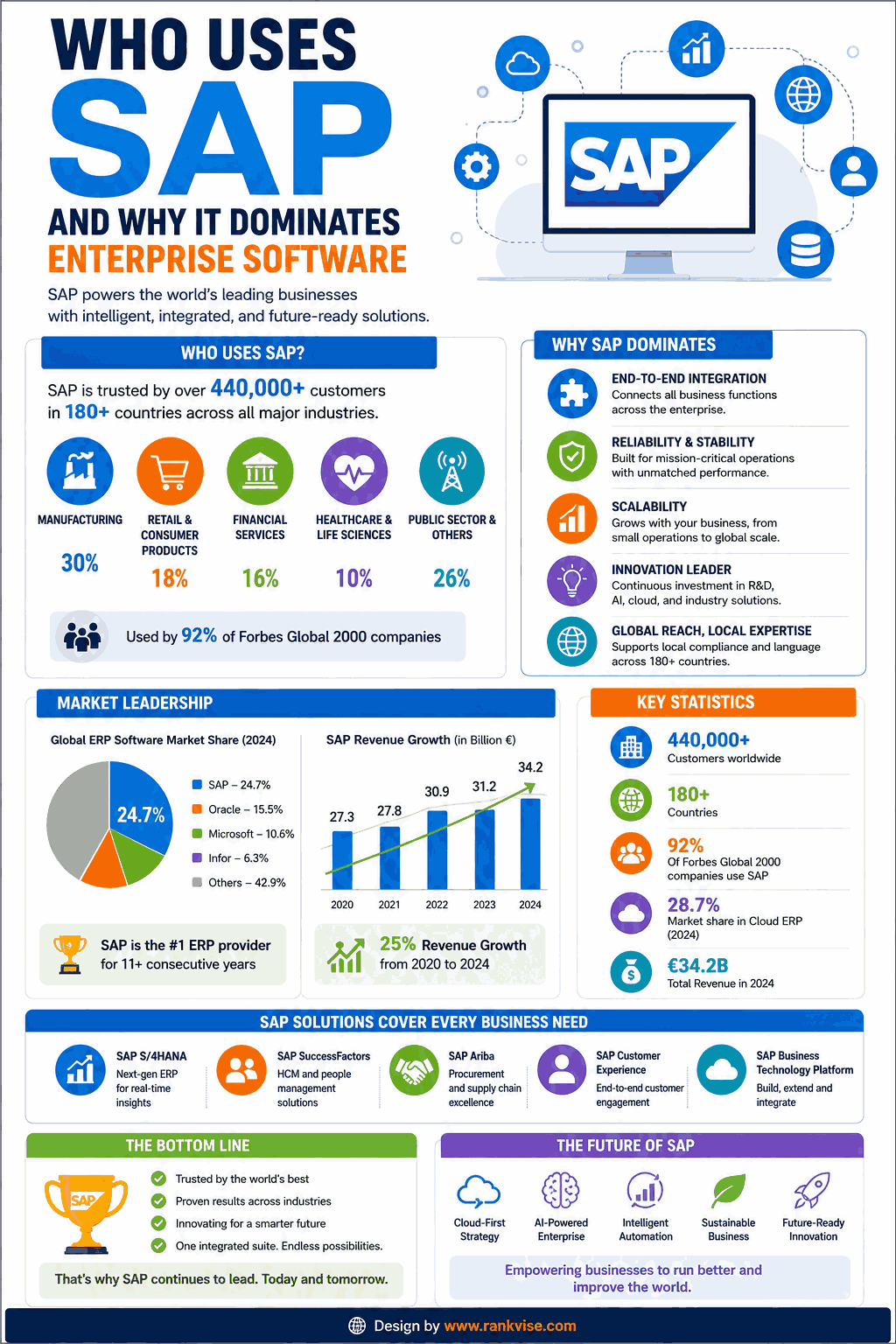
Enterprise resource planning software from SAP dominates the market for specific reasons. Large organizations face complexity that simpler tools cannot handle. SAP addresses that complexity head-on.
Key reasons companies invest in SAP:
- Integrates all departments into a single unified platform
- Handles multi-country operations with local compliance built in
- Scales from thousands to millions of transactions daily
- Provides real-time reporting across the entire business
- Supports complex manufacturing, logistics, and financial processes
- Offers industry-specific solutions for specialized requirements
The total cost of ownership is significant. SAP implementations often cost millions and take 12 to 36 months. Yet companies accept this investment because fragmented systems cost more through inefficiency, errors, and missed opportunities over time.
Major Companies That Use SAP ERP
The list of SAP ERP companies reads like a global business directory. Nearly 90% of Forbes Global 2000 companies run at least one SAP product. Here are notable examples across industries.
| Industry | Companies Using SAP |
|---|---|
| Automotive | BMW, Toyota, Volkswagen, Ford |
| Consumer Goods | Nestlé, Procter & Gamble, Unilever, Coca-Cola |
| Technology | Apple, Microsoft, Intel, Samsung |
| Pharmaceuticals | Pfizer, Johnson & Johnson, Roche |
| Energy | Shell, ExxonMobil, Chevron, BP |
| Retail | Walmart, IKEA, Adidas, Nike |
| Aerospace | Boeing, Airbus, Lockheed Martin |
These organizations chose SAP because their operational scale demands robust, enterprise-grade infrastructure. Managing global supply chains, multi-currency accounting, and regulatory compliance across dozens of countries requires software built for that exact purpose.
SAP ERP Products: Which Solutions Do Companies Use?
SAP offers multiple ERP products serving different business sizes and needs. Understanding the product landscape helps you identify which solution fits various organizational requirements.
SAP S/4HANA
SAP S/4HANA represents the company’s flagship next-generation ERP suite. It runs on the SAP HANA in-memory database, delivering dramatically faster processing speeds. Most large enterprises are migrating to S/4HANA as their primary business system.
The platform comes in three deployment options: on-premise, cloud, and hybrid. Cloud adoption accelerates annually as companies seek lower infrastructure costs and automatic updates.
SAP Business One
SAP Business One targets small and mid-sized businesses. It provides core ERP functionality—accounting, purchasing, inventory, sales—without the complexity of S/4HANA. Companies with 5 to 500 employees typically find this product appropriate.
SAP Business ByDesign
This cloud-based solution serves mid-market companies needing more capability than Business One but less complexity than S/4HANA. It works well for growing organizations planning future expansion.
SAP SuccessFactors, Ariba, and Concur
Beyond core ERP, SAP operates specialized cloud solutions. SuccessFactors handles human capital management. Ariba manages procurement and supplier networks. Concur automates travel and expense reporting. Many companies use these alongside their primary ERP system.
Top SAP Implementation and Consulting Companies
Implementing SAP requires specialized expertise. A large ecosystem of consulting firms helps businesses deploy, customize, and maintain SAP systems. These SAP partner companies play a critical role in successful implementations.
Global Systems Integrators
- Accenture – Largest SAP practice globally with deep industry expertise
- Deloitte – Strong in complex S/4HANA transformations and change management
- IBM Consulting – Combines SAP implementation with broader technology modernization
- Capgemini – Known for manufacturing and supply chain SAP deployments
- Infosys – Cost-effective delivery with significant offshore capability
- Wipro – Strong presence in utilities, banking, and healthcare SAP projects
Mid-Market SAP Partners
Smaller consulting firms specialize in SAP Business One and mid-sized S/4HANA projects. Companies like Seidor, NTT DATA Business Solutions, and All for One Group serve organizations that need SAP expertise without enterprise-scale budgets.
How to Choose an SAP Implementation Partner
Selecting the right partner affects project success more than almost any other decision. Evaluate potential partners on these criteria:
- Proven experience in your specific industry vertical
- Certified SAP consultants with relevant module expertise
- Reference customers of similar size and complexity
- Clear methodology with defined milestones and governance
- Post-implementation support and managed services capability
- Cultural fit and communication style with your team
Industries Where SAP ERP Dominates
Certain industries adopt SAP at higher rates due to their operational complexity and regulatory requirements.
Manufacturing
Manufacturers rely on SAP for production planning, materials management, quality control, and shop floor execution. The software handles complex bills of materials, multi-level production scheduling, and supply chain coordination across global facilities.
Oil and Gas
Energy companies use SAP to manage asset-intensive operations, complex joint ventures, and regulatory reporting. The industry-specific modules handle production sharing agreements, hydrocarbon accounting, and maintenance planning for critical infrastructure.
Pharmaceuticals and Life Sciences
Strict regulatory compliance drives SAP adoption in pharma. Batch traceability, quality management, serialization, and FDA reporting requirements demand systems purpose-built for these challenges. SAP’s validation frameworks satisfy GxP requirements.
Retail and Consumer Products
Large retailers manage thousands of SKUs across hundreds of locations. SAP handles demand forecasting, replenishment, pricing optimization, and omnichannel order management at scale. Real-time inventory visibility prevents stockouts and overstock situations.
Benefits of Running SAP ERP
Companies that implement SAP successfully report measurable improvements across their operations.
- 20–30% reduction in inventory carrying costs through better planning
- 50% faster financial close processes with automated consolidation
- Significant reduction in manual data entry and associated errors
- Real-time visibility into cash flow, orders, and production status
- Standardized processes across all global business units
- Improved regulatory compliance through built-in controls and audit trails
These benefits materialize only with proper implementation and organizational commitment. Poorly executed SAP projects deliver none of these outcomes and can actually harm operations.
Challenges SAP ERP Companies Face
Running SAP is not without difficulties. Organizations should understand common challenges before committing to the platform.
- High total cost of ownership including licenses, infrastructure, and consultants
- Complex implementations that frequently exceed original timelines
- Heavy customization creates technical debt and upgrade difficulties
- Skilled SAP professionals command premium salaries and remain scarce
- User adoption requires extensive training and change management
- Migration from legacy SAP versions to S/4HANA demands careful planning
Companies that underestimate these challenges suffer cost overruns and project failures. Success requires executive sponsorship, realistic timelines, and experienced implementation leadership.
SAP ERP Market Trends in 2026
The SAP ecosystem evolves continuously. Several trends shape how companies approach their SAP strategies today.
Cloud migration dominates conversations. SAP set a 2027 deadline for mainstream maintenance on older ECC systems, pushing customers toward S/4HANA Cloud. This migration wave creates enormous demand for skilled consultants and implementation capacity.
Artificial intelligence embeds deeper into SAP workflows. Predictive analytics, intelligent automation, and AI-assisted decision-making now appear across SAP modules. Companies leverage these capabilities for demand forecasting, anomaly detection, and process automation.
Industry cloud solutions gain traction. SAP delivers pre-configured solutions for specific verticals—automotive, utilities, retail, public sector. These accelerate implementation timelines by providing industry best practices out of the box.
FAQs
Over 440,000 companies across 180 countries use SAP products. Approximately 90% of Forbes Global 2000 companies run at least one SAP solution for their business operations.
Implementation costs range from 50,000 USD for SAP Business One to 50 million+ USD for global S/4HANA deployments. Mid-market projects typically fall between 500,000 and 5 million USD depending on scope and complexity.
No. SAP Business One serves companies with as few as 5 employees. SAP Business ByDesign targets mid-market organizations. However, S/4HANA remains most common among larger enterprises with complex operational needs.
Manufacturing, pharmaceuticals, energy, automotive, and retail see the strongest ROI from SAP implementations. These industries have complex supply chains, strict compliance requirements, and high transaction volumes that justify the investment.
SAP Business One implementations take 3 to 6 months. Mid-market S/4HANA projects require 9 to 18 months. Large global rollouts span 2 to 4 years with phased deployments across regions and business units.