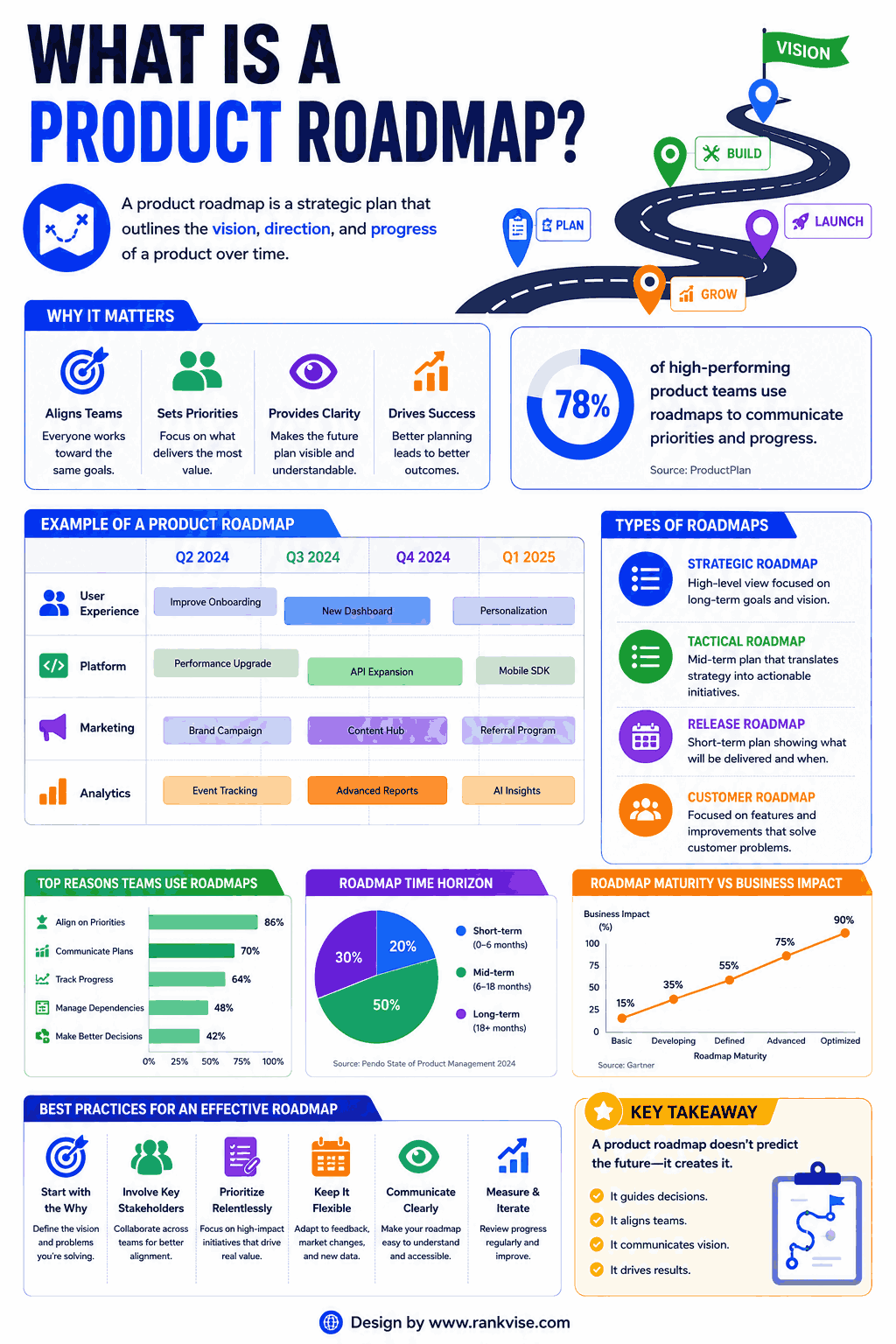
A product roadmap is a strategic document that outlines your product’s direction over time. It communicates what you plan to build, why it matters, and when you expect to deliver it. Think of it as a high-level plan that aligns your entire organization around shared product goals.
Unlike a task list or project plan, a roadmap focuses on outcomes rather than individual assignments. It answers the big-picture questions. Where is this product heading? What problems will it solve next? How does each initiative connect to business objectives?
Every product team needs this clarity. Without a roadmap, development efforts become reactive and scattered.
Why Every Product Team Needs a Roadmap?
Aligns Stakeholders Around a Shared Vision
Product development involves many people—engineers, designers, marketers, executives, and customer success teams. A product roadmap gives everyone a single source of truth. It reduces confusion about priorities and prevents conflicting efforts across departments.
Prioritizes What Matters Most
Resources are always limited. A roadmap forces product managers to make deliberate choices about what to build first. It separates urgent needs from nice-to-have features. This prioritization framework ensures your team invests time in high-impact work.
Communicates Progress to Leadership
Executives want visibility without micromanaging. A well-maintained roadmap shows leadership where the product stands and where it is heading. It builds confidence that the team operates strategically rather than reactively.
Helps Manage Customer Expectations
Sales and support teams constantly field questions about upcoming features. A roadmap gives them honest answers. Sharing a public or customer-facing version builds trust and reduces frustration around feature requests.
Key Components of an Effective Product Roadmap
Not every roadmap looks the same. However, strong roadmaps share essential elements that provide clarity and context.
| Component | Purpose |
|---|---|
| Vision statement | Defines the long-term direction of the product |
| Goals and objectives | Connects planned work to measurable business outcomes |
| Initiatives or themes | Groups related features under strategic categories |
| Time horizon | Indicates rough timing (now, next, later) or quarterly targets |
| Status indicators | Shows progress on each initiative clearly |
| Dependencies | Highlights blockers or cross-team requirements |
Include enough detail to inform decisions without overwhelming readers. A roadmap should communicate strategy, not document every task.
Types of Product Roadmaps and When to Use Each
Different audiences need different views of your product strategy. Choose the format that matches your communication goal.
Timeline-Based Roadmap
This format plots initiatives along a calendar. It shows deadlines and expected delivery dates. Use it when leadership or external partners need date commitments. Be cautious—hard dates create pressure and can compromise quality.
Theme-Based Roadmap
A theme-based roadmap organizes work by strategic categories instead of dates. Themes might include “improve onboarding,” “reduce churn,” or “expand integrations.” This format works well for agile teams that resist rigid timelines.
Now-Next-Later Roadmap
This simple three-column format groups initiatives by proximity. “Now” shows current work. “Next” indicates upcoming priorities. “Later” captures future ideas without committing to dates. Startups and fast-moving teams prefer this flexibility.
Feature-Based Roadmap
A feature roadmap lists specific functionality planned for development. Sales teams often request this format to share with prospects. However, it risks over-committing to solutions before fully understanding problems.
Outcome-Based Roadmap
This approach ties every initiative to a measurable result. Instead of listing features, it states desired outcomes like “increase trial-to-paid conversion by 15%.” Product leaders increasingly favor this format for its strategic clarity.
How to Build a Product Roadmap Step by Step
Step 1: Define Your Product Vision
Start with where you want the product to be in two to three years. This vision anchors every decision. Without it, your roadmap becomes a disconnected list of features.
Step 2: Gather Input From Multiple Sources
Strong roadmaps incorporate data from various channels:
- Customer feedback and support tickets
- Sales team insights on lost deals and feature requests
- Usage analytics showing where users struggle or drop off
- Competitive analysis revealing market gaps
- Business objectives from executive leadership
- Technical debt assessments from engineering
Step 3: Identify and Prioritize Initiatives
Group related ideas into initiatives. Then prioritize using a consistent framework. Popular prioritization methods include RICE scoring, value-versus-effort matrices, and the MoSCoW method. Choose one framework and apply it consistently.
Step 4: Choose Your Format and Time Horizon
Select the roadmap type that fits your audience. Internal engineering teams might need a detailed quarterly view. Board members might prefer a high-level annual overview. Create multiple views from the same underlying strategy.
Step 5: Share, Discuss, and Iterate
A roadmap is not a static document. Present it to stakeholders for feedback. Adjust based on new information. Review and update it at least monthly. The best product planning processes treat roadmaps as living documents.
Common Product Roadmap Mistakes to Avoid
Even experienced product managers make these errors. Awareness helps you sidestep them.
- Treating the roadmap as a fixed promise rather than a strategic guide
- Including too much detail that belongs in a project management tool
- Building features without connecting them to business outcomes
- Ignoring customer data and relying purely on internal opinions
- Never updating the roadmap after initial creation
- Creating one version for all audiences instead of tailoring views
- Letting the loudest stakeholder dictate priorities over data
A roadmap should guide decisions, not constrain them. Stay flexible enough to respond to market changes while maintaining strategic direction.
Best Tools for Creating a Product Roadmap in 2026
Several product management platforms help teams build and maintain roadmaps efficiently.
- Productboard – Connects customer feedback directly to roadmap initiatives
- Aha! – Offers detailed strategy-to-execution planning for product teams
- Linear – Combines roadmapping with issue tracking in a fast interface
- Jira Product Discovery – Integrates prioritization with Atlassian’s development ecosystem
- Notion – Provides flexible templates for teams wanting customizable roadmap views
- Airfocus – Uses modular building blocks for adaptive product planning
Choose a tool that matches your team size and workflow complexity. Simple spreadsheets work for early-stage startups. Growing teams benefit from dedicated product management software.
Who Should Own the Product Roadmap?
The product manager typically owns and maintains the roadmap. However, ownership does not mean dictating every decision alone. Product managers gather input, facilitate prioritization discussions, and make final calls when consensus fails.
In larger organizations, a head of product or VP of product owns the company-wide roadmap. Individual product managers own roadmaps for their specific product areas. Alignment between these levels ensures strategic coherence.
Engineering leaders should contribute technical feasibility assessments. Design leaders provide user experience perspective. Business leaders share market and revenue context. The roadmap reflects collective intelligence, not a single person’s preferences.
How Often Should You Update Your Product Roadmap?
Static roadmaps lose credibility quickly. Markets shift. Customer needs evolve. Technical realities change. Your roadmap must reflect current thinking at all times.
Recommended update cadence:
- Review priorities weekly during product team syncs
- Update the roadmap formally every two to four weeks
- Present a refreshed version to stakeholders quarterly
- Conduct a major strategic review annually
Frequent updates keep the roadmap trustworthy. When stakeholders see outdated information, they stop consulting it entirely. Consistency in maintenance determines whether your roadmap becomes a useful tool or an ignored artifact.
FAQs
A product roadmap shows strategic direction and priorities at a high level. A project plan details specific tasks, assignments, and deadlines needed to execute individual initiatives.
Most roadmaps cover 3 to 12 months with reasonable confidence. Beyond that, keep plans deliberately vague since market conditions and customer needs change frequently.
Absolutely. Even a simple now-next-later format helps small teams prioritize limited resources. It prevents reactive development and keeps founders aligned on what matters most.
The best format depends on your audience. Use timeline roadmaps for executives needing dates. Use outcome-based or theme-based formats for agile teams focused on strategic flexibility.
Use a consistent prioritization framework backed by customer data and business metrics. Objective scoring reduces opinion-based debates and helps teams reach decisions faster.