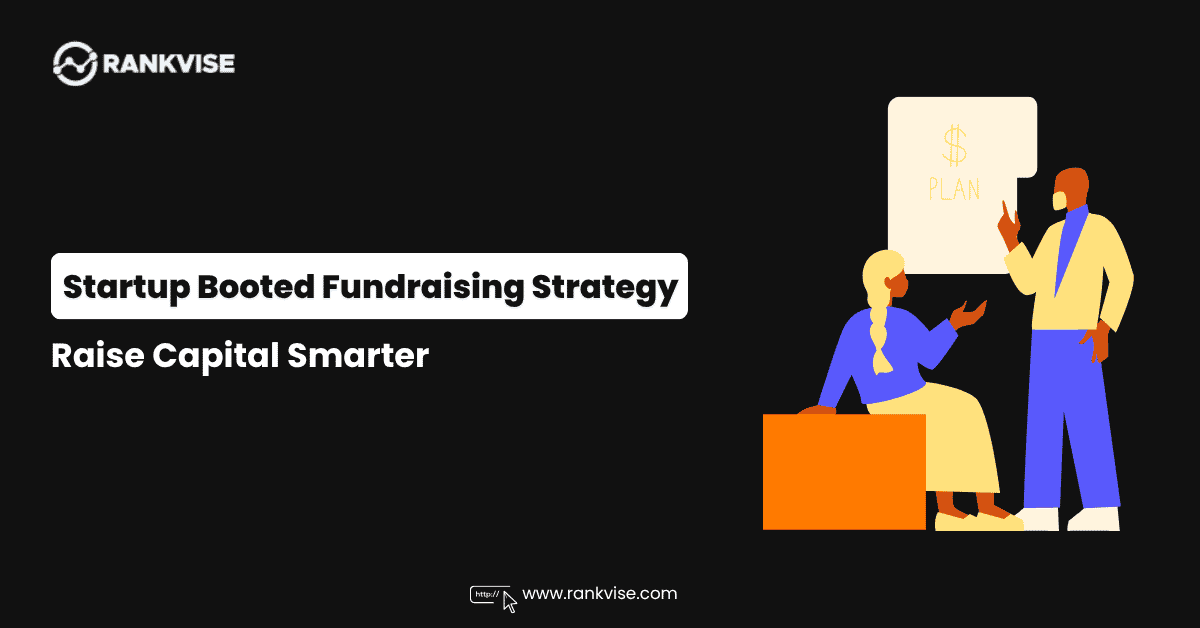
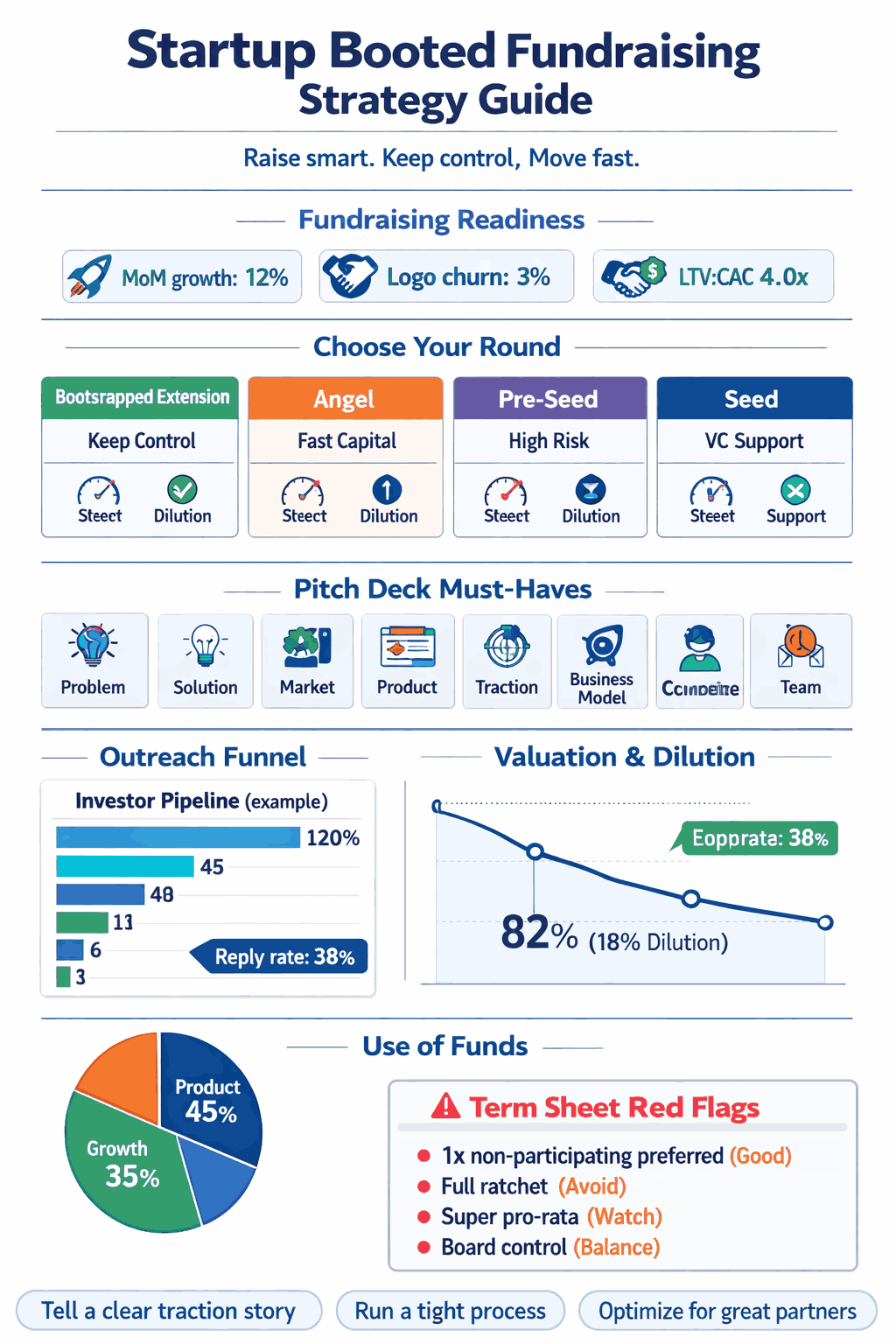
A startup booted fundraising strategy is the approach bootstrapped companies use when they decide to raise external capital. These startups built their business without outside investment first. Now they seek funding from a position of strength rather than desperation.
- Raise when opportunity outstrips cash flow; act quickly to capture market windows or hire talent.
- Lead investor conversations with metrics: MRR growth, CAC to LTV, margins, retention, and revenue per employee.
- Select capital that preserves ownership and efficiency: revenue-based financing, strategic angels, founder-friendly VC terms, or venture debt.
- Prepare thoroughly: clean finances, target investors, warm introductions, keep growth momentum, and negotiate from a position of strength.
Most fundraising advice targets companies that raise money immediately. It assumes you need capital before generating revenue. A booted fundraising strategy flips this assumption entirely. You already have traction. You already proved the model works.
This approach gives founders tremendous leverage during negotiations. Investors compete to back companies with proven revenue and real customers. The dynamic shifts from begging for money to selecting the right partner for your next growth phase.
Why Bootstrapped Startups Have a Fundraising Advantage?
Investors see hundreds of pitches from pre-revenue startups every month. Most present ideas without validation. They ask investors to bet on potential alone. The failure rate among these companies exceeds 90%.
A bootstrapped startup arrives at fundraising conversations with proof. Real customers. Actual revenue. Demonstrated unit economics. Validated product-market fit. Every metric investors wish other startups could show already exists in your business.
This proof reduces perceived risk dramatically. Investors pay higher valuations for companies with traction. You give up less equity for more capital because your negotiating position is fundamentally stronger than pre-revenue founders.
Bootstrapped companies also demonstrate founder capability. Building something profitable without outside help signals resourcefulness, discipline, and execution ability. These qualities predict future success more reliably than polished pitch decks alone.
When Should a Bootstrapped Startup Raise Capital?
Growth Opportunity Exceeds Internal Capacity
Raise money when you identify a growth opportunity your current cash flow cannot capture quickly enough. A competitor might fill the gap. A market window might close. Speed matters more than maintaining full ownership.
Common triggers include expanding into new markets, hiring specialized talent, or funding inventory for large contracts. Each situation requires capital beyond what monthly revenue supports. External funding becomes a growth accelerator rather than a survival necessity.
You Need Capital for Non-Organic Growth
Acquisitions, major technology rebuilds, and geographic expansion require lump-sum investments. Monthly profits cannot fund these initiatives without years of accumulation. Strategic fundraising compresses timelines dramatically.
The Market Rewards Scale Disproportionately
Some markets tip toward winners who achieve scale first. Network effects, marketplace dynamics, and enterprise sales cycles all favor larger players. If your market rewards scale, raising capital to grow faster makes strategic sense.
Evaluate honestly whether your market requires speed or whether patient growth serves you equally well. Not every bootstrapped startup needs external capital. Many thrive permanently without it.
How to Position Your Bootstrapped Startup for Investors
Lead With Metrics, Not Vision
Pre-revenue startups sell stories. Bootstrapped startups sell numbers. Lead every investor conversation with concrete performance data that demonstrates your business works reliably.
Present these metrics prominently:
- Monthly recurring revenue and growth rate
- Customer acquisition cost and lifetime value ratio
- Gross margins and contribution margins by product line
- Retention rates and churn by customer segment
- Revenue per employee demonstrating operational efficiency
These numbers tell your story more persuasively than any narrative. Investors analyze them immediately. Strong metrics generate offers faster than compelling presentations without substance.
Explain Why Now and Why This Amount
Investors want to understand your capital allocation plan specifically. Vague statements about “accelerating growth” do not satisfy serious investors. Show exactly where every dollar goes and what return it generates.
Build a detailed use-of-funds breakdown:
| Category | Allocation | Expected Outcome |
|---|---|---|
| Sales team expansion | 35% | 3x pipeline coverage in six months |
| Product development | 25% | Two new features driving upsell revenue |
| Marketing channels | 20% | Proven channels scaled to new budget levels |
| Operations and infrastructure | 15% | Systems supporting 5x current volume |
| Working capital reserve | 5% | Buffer for unexpected opportunities |
Connect each allocation to measurable outcomes with timelines. This specificity demonstrates the operational thinking investors value in bootstrapped founders.
Emphasize Capital Efficiency as a Core Competency
Your history of bootstrapping proves you spend money wisely. Frame this efficiency as a permanent competitive advantage rather than a temporary constraint you are eager to abandon.
Investors lose money backing companies that burn capital carelessly. Your track record of profitability or near-profitability reassures them. Show that additional capital amplifies your efficient model rather than replacing discipline with spending.
Calculate your revenue per dollar of operating expense. Compare it to venture-backed competitors in your space. If you generate more revenue per dollar spent, you have a powerful fundraising narrative that most startups cannot match.
Choosing the Right Funding Source for Bootstrapped Companies
Revenue-Based Financing
Revenue-based financing provides capital repaid as a percentage of monthly revenue. You receive a lump sum and repay it gradually as you earn. No equity changes hands. No board seats transfer to outsiders.
This option suits bootstrapped startups wanting capital without ownership dilution. Repayment scales with your performance. Strong months repay faster. Slower months require smaller payments. The flexibility matches the startup reality better than fixed loan payments.
Typical revenue-based financing provides three to five times monthly revenue. Repayment runs between 5% and 15% of monthly income until you return the principal plus a fee. Total cost usually ranges from 1.3x to 2x the original amount.
Strategic Angel Investors
Angels investing in bootstrapped startups differ from typical angel investors. They value profitability and sustainable growth. They invest because your model already works rather than hoping it might someday.
Seek angels who bring specific value beyond capital:
- Industry connections that accelerate sales cycles
- Operational expertise in your current growth challenge
- Credibility that attracts larger investors in future rounds
- Customer introductions in your target market segments
The right angel adds more value through connections and expertise than through capital alone. Choose partners who solve specific problems you face during this growth phase.
Venture Capital on Founder-Friendly Terms
Venture capital firms increasingly pursue bootstrapped startups. They recognize these companies carry lower risk and stronger fundamentals. Competition among VCs for profitable startups gives founders leverage to negotiate favorable terms.
Negotiate from strength on key terms:
- Higher valuations reflecting proven traction and reduced risk
- Smaller board representation maintaining founder control
- Fewer restrictive covenants limiting operational flexibility
- Longer runway expectations acknowledging your capital efficiency
- Anti-dilution protections that respect existing equity distribution
You do not need venture capital to survive. This negotiating reality lets you walk away from unfavorable terms. Investors who refuse founder-friendly structures lose deals to competitors who accommodate bootstrapped founders willingly.
Venture Debt
Venture debt provides loans to startups, typically alongside or following equity rounds. For bootstrapped companies with strong revenue, debt offers growth capital without equity dilution.
Lenders evaluate your revenue predictability, customer contracts, and cash flow stability. Bootstrapped startups with recurring revenue and low churn qualify readily. Monthly payments come from operational cash flow rather than future fundraising rounds.
Building Your Fundraising Timeline and Process
Three Months Before: Prepare Materials and Metrics
Organize your financial data into investor-ready formats. Build a concise pitch deck emphasizing traction over vision. Prepare a detailed financial model projecting capital deployment outcomes over 18 to 24 months.
Clean up your accounting and legal structure. Ensure cap tables are clear. Resolve any outstanding legal issues. Investors discover problems during due diligence. Finding them first demonstrates professionalism and saves time.
Two Months Before: Build Your Target List
Research investors who specifically back bootstrapped or capital-efficient startups. Many VCs and angels specialize in this category. They understand your story without requiring education about why you bootstrapped initially.
Prioritize investors with portfolio companies in adjacent spaces. They understand your market dynamics already. Their pattern recognition helps them evaluate your opportunity quickly. Faster evaluation means faster decisions and less distraction from operations.
One Month Before: Warm Introductions
Cold outreach generates low response rates. Warm introductions from mutual connections produce meetings reliably. Activate your network strategically to reach your target investors through trusted intermediaries.
Ask existing customers, advisors, and industry contacts for introductions. Founders of companies your target investors already backed make excellent connectors. They provide credible endorsements alongside the introduction.
During Fundraising: Maintain Business Momentum
Never let fundraising distract you from operations. Your leverage depends on continued growth during the process. Investors watching your metrics improve while negotiating feel urgency to close before your valuation increases further.
Assign fundraising responsibilities clearly. One founder leads investor conversations. Other team members maintain operational execution. Split attention between fundraising and operations weakens both activities simultaneously.
Common Mistakes Bootstrapped Founders Make When Fundraising
Undervaluing Their Company
Bootstrapped founders sometimes anchor valuations too low. Years of frugality create modesty about what they have built. Investors happily accept underpriced deals without correcting founder misperceptions.
Research comparable companies that raised recently. Talk to multiple investors to gauge market expectations. Your profitable company deserves premium pricing relative to pre-revenue startups burning cash without traction.
Raising Too Much Too Soon
Capital efficiency is your competitive advantage. Raising excessive capital and spending aggressively abandons the discipline that built your success. Take enough to fund specific growth initiatives without transforming your operating culture.
Match the raise amount precisely to your capital deployment plan. Add a reasonable buffer for contingencies. Resist the temptation to accept more capital simply because investors offer it enthusiastically.
Choosing Investors Based Solely on Valuation
The highest valuation offer is not always the best deal. Investor alignment, value-added support, and term sheet details matter more than headline numbers. A partner who helps you grow is worth more than one who simply writes a check at favorable pricing.
Evaluate investors on their behavior with existing portfolio companies. Call founders they have backed previously. Ask specifically about difficult moments. Investor character reveals itself during challenges, not during honeymoon periods.
FAQs
A startup booted fundraising strategy is the approach bootstrapped companies use to raise external capital after building traction independently. It leverages existing revenue and profitability to negotiate better terms with investors.
Raise when you identify growth opportunities that exceed your internal cash flow capacity. The best timing is when you have strong metrics and a specific plan for deploying capital that generates measurable returns.
Bootstrapped startups typically give up 10% to 25% equity depending on growth stage and amount raised. Strong traction and profitability justify premium valuations that minimize dilution compared to pre-revenue companies.
Yes. Many VCs actively seek bootstrapped startups because they carry lower risk and demonstrate proven execution. Founders negotiate from strength since they do not need capital for survival, only acceleration.