Startup booted financial modeling is the process of building financial projections for a self-funded business. It focuses on planning revenue, expenses, and cash flow without relying on venture capital or external investors. Founders use it to survive and grow on their own terms.
- Prioritize cash flow and runway: model weekly early, maintain a two to three month cash buffer, and spot shortfalls before they become crises.
- Use bottom-up, realistic forecasts and three scenarios: conservative, realistic, optimistic; base decisions on the conservative case to avoid premature spending.
- Treat your model as a living document: update weekly in year one, revisit after major events, and adjust assumptions to reflect real data.
This approach differs fundamentally from investor-backed planning. You model around constraints, not abundance. Every dollar must justify itself. The financial model becomes your survival map rather than a fundraising pitch deck.
Bootstrapped founders need clarity more than anyone else. When there is no safety net, your financial model must reflect reality with precision. It tells you exactly how long your runway lasts and when profitability arrives.
Why Bootstrapped Startups Need Financial Models
Many self-funded founders skip formal financial planning. They rely on gut instinct and bank account balances. This approach works until it doesn’t. One unexpected expense can create a cash crisis overnight.
A financial model gives you foresight. It reveals problems weeks or months before they become emergencies. You spot cash shortfalls early enough to adjust spending or accelerate revenue efforts.
Financial Planning Reduces Risk
Without external funding cushions, bootstrapped businesses face higher stakes. A revenue projection model helps you answer critical questions before committing resources.
- When can you afford your first hire?
- How many months of operating expenses do you have remaining?
- What sales volume makes you break even?
- Which expenses can you defer without hurting growth?
These answers prevent costly mistakes. They transform guesswork into informed decision-making.
Core Components of a Bootstrapped Financial Model
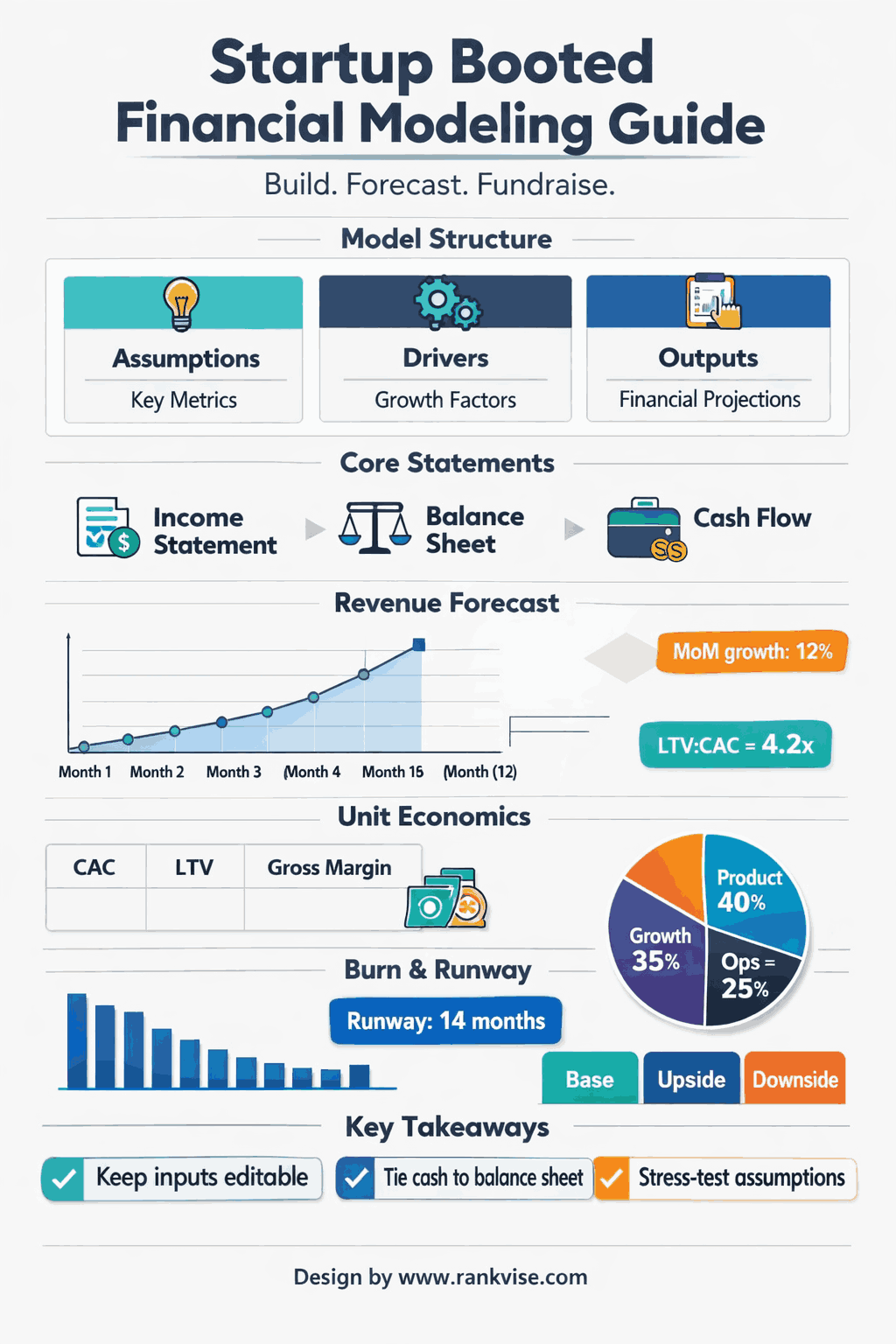
Every startup booted financial modeling exercise includes specific building blocks. Understanding each component ensures your model captures reality accurately.
Revenue Forecasting
Start with how your business generates income. Map every revenue stream separately. Project each one based on realistic assumptions, not optimistic hopes.
Use bottom-up forecasting for bootstrapped businesses. Calculate how many units you can sell given your current capacity and marketing budget. Top-down market sizing belongs in investor decks, not bootstrap planning.
Expense Tracking and Projection
List every cost your business incurs monthly. Separate fixed costs from variable costs. Fixed costs remain constant regardless of sales volume. Variable costs scale with your revenue.
Common categories include:
- Software subscriptions and hosting
- Contractor or freelancer payments
- Marketing and advertising spend
- Office or coworking space
- Insurance, legal, and accounting fees
- Owner compensation and taxes
Cash Flow Projection
Cash flow matters more than profit for bootstrapped startups. You can show profit on paper while running out of cash simultaneously. This happens when customers pay late or expenses hit before revenue arrives.
Model your cash inflows and outflows weekly for the first six months. Switch to monthly projections after that. Always maintain a minimum cash buffer of two to three months of operating expenses.
Break-Even Analysis
Your break-even point tells you exactly when revenue covers all costs. For bootstrapped founders, reaching break-even fast is survival. Every month before break-even drains your personal savings or reinvested profits.
Calculate it simply. Divide your total fixed monthly costs by your contribution margin per unit. The result shows how many sales you need each month to stop losing money.
How to Build Your First Bootstrapped Financial Model
Follow this step-by-step process to create a model that actually serves your business.
Step 1: Document Your Assumptions
Every model rests on assumptions. Write yours down explicitly. Include customer acquisition cost, average sale value, monthly growth rate, and churn rate. Revisit these monthly and update as real data arrives.
Step 2: Choose the Right Timeframe
Model at least 12 months ahead. Extend to 24 months if possible. Short-term models miss seasonal patterns and long-cycle expenses like annual subscriptions or tax payments.
Step 3: Build Three Scenarios
Never rely on a single projection. Create conservative, realistic, and optimistic scenarios. Base your spending decisions on the conservative case. Plan your growth using the realistic case.
| Scenario | Revenue Assumption | Expense Assumption | Purpose |
|---|---|---|---|
| Conservative | 50% of target | All costs included | Survival planning |
| Realistic | 80% of target | Expected costs | Operational decisions |
| Optimistic | 120% of target | Scaled costs | Growth opportunities |
Step 4: Update Weekly in Early Stages
A financial model loses value the moment it becomes outdated. During your first year, update it weekly with actual numbers. Compare projections against reality. Adjust assumptions when they prove wrong.
Best Tools for Bootstrapped Startup Financial Planning
You don’t need expensive enterprise software. Several affordable and free tools serve bootstrapped founders well.
- Spreadsheets – Google Sheets or Excel remain the most flexible option for custom models
- LivePlan – Offers guided financial forecasting with templates designed for small businesses
- Causal – Visual modeling tool that connects assumptions to outputs clearly
- Fathom – Integrates with accounting software for real-time financial reporting
- ProjectionHub – Provides industry-specific templates for revenue and expense modeling
Start with spreadsheets if your budget is tight. Move to dedicated tools once your business generates consistent revenue and complexity increases.
Common Mistakes in Startup Booted Financial Modeling
Founders make predictable errors when building their first financial models. Avoid these to keep your projections useful.
Overestimating Revenue Growth
Optimism is natural for founders. But your model must reflect probable outcomes, not best-case dreams. Assume slower growth than you expect. You’ll either be right or pleasantly surprised.
Ignoring Seasonality
Most businesses experience revenue fluctuations throughout the year. A SaaS product might see lower sign-ups during holidays. An e-commerce brand might spike in Q4. Build these patterns into your projections explicitly.
Forgetting Hidden Costs
Taxes, payment processing fees, refunds, and equipment replacements catch founders off guard. Add a 10-15% buffer to your expense projections for costs you haven’t identified yet.
Building Once and Forgetting
A model you created six months ago and never updated provides zero value today. Treat your financial model as a living document. Schedule weekly or biweekly review sessions to maintain accuracy.
How Financial Modeling Supports Growth Decisions
Your model doesn’t just help you survive. It guides strategic growth decisions with confidence.
Hiring Timing
A cash flow forecast reveals exactly when you can afford new team members. It shows how long a new hire takes to generate positive ROI. This prevents premature hiring that drains limited resources.
Pricing Strategy
Modeling different price points shows their impact on break-even timing and monthly profit margins. You can test scenarios before changing prices in the real market. This removes guesswork from pricing decisions.
Marketing Budget Allocation
When every dollar counts, your model shows which marketing channels deliver the best return. Allocate spend based on projected customer acquisition costs and lifetime value calculations.
Bootstrapped vs Funded: How Financial Models Differ
The goals and structure of financial models change dramatically based on funding status.
| Aspect | Bootstrapped Model | Funded Startup Model |
|---|---|---|
| Primary goal | Cash preservation and profitability | Growth speed and market capture |
| Time horizon | 12–24 months | 3–5 years |
| Revenue approach | Bottom-up, conservative | Top-down, market-sized |
| Expense philosophy | Minimize and justify every cost | Invest ahead of revenue |
| Key metric | Months of runway remaining | Burn rate vs growth rate |
| Update frequency | Weekly to biweekly | Monthly to quarterly |
Neither approach is superior. They serve different business strategies. But bootstrapped modeling demands more discipline because mistakes carry immediate consequences.
When Should You Revisit Your Financial Model?
Certain events should trigger an immediate model review beyond your regular schedule.
- You lose or gain a major client
- A new competitor enters your market
- Your costs increase unexpectedly
- You launch a new product or service
- Market conditions shift significantly
- You consider taking on debt or investment
Each event changes your assumptions. Updated assumptions require updated projections. Delay here means operating on outdated information during critical moments.
FAQs
It is the practice of creating financial projections for self-funded businesses, focusing on cash flow management, break-even analysis, and sustainable growth without external investment.
Weekly during the first year and biweekly after that. Update immediately when major business changes occur, like losing a client or launching a new product.
Google Sheets remains the most flexible free option. It allows custom formulas, scenario planning, and easy sharing without subscription costs.
Plan at least 12 months ahead, ideally 24 months. This timeframe captures seasonal patterns, annual expenses, and gives enough visibility for strategic decisions.
Yes, start with simple revenue minus expenses calculations. Use free templates to structure your model. Focus on cash flow first and add complexity as your business grows.