Growth navigate startup tools are software solutions that help founders and teams scale their businesses strategically. They cover everything from customer acquisition to revenue analytics to operational efficiency.
These tools help startups move beyond guesswork. They provide data, automation, and structure during the chaotic early stages of company building. The right tool stack turns scattered efforts into repeatable growth systems.
Every startup faces the same core challenge: limited resources and unlimited demands. Growth navigate startup tools solve this by multiplying what small teams can accomplish without adding headcount prematurely.
Why Do Startups Need Dedicated Growth Tools?
Startups operate differently from established companies. They move faster, pivot frequently, and lack the infrastructure that larger organizations take for granted. Generic enterprise software often creates more friction than it removes.
Dedicated startup scaling tools address this reality. They prioritize speed of implementation, ease of use, and affordability. Most offer freemium models or startup-friendly pricing that grows with your revenue.
Without proper tools, these problems compound quickly:
- Founders spend hours on manual tasks that software handles in seconds
- Customer data lives in scattered spreadsheets with no single source of truth
- Marketing spend goes untracked, making ROI invisible
- Sales pipelines lack visibility, causing deals to slip through cracks
- Team communication breaks down as headcount grows past ten people
The cost of not investing in tools early exceeds the subscription fees by orders of magnitude.
How to Choose the Right Growth Tools for Each Stage
Not every tool fits every stage. A pre-revenue startup needs different capabilities than a Series B company scaling to 100 employees. Match your tool stack to your current reality, not your aspirations.
Pre-Seed and Seed Stage
At this stage, validate your idea fast. You need lightweight tools that help you talk to customers, build landing pages, and track basic metrics.
Focus on customer discovery platforms, no-code website builders, and simple analytics. Keep your stack minimal. Three to five tools should cover your needs entirely.
Series A and Growth Stage
Product-market fit is confirmed. Now you scale acquisition channels and build repeatable processes. Invest in CRM software, marketing automation, and business intelligence dashboards.
This stage demands tools that integrate well with each other. Data must flow between systems without manual exports. Automation replaces repetitive tasks your team previously handled by hand.
Series B and Beyond
Operational complexity increases dramatically. You need enterprise-grade tools for financial planning, workforce management, and advanced analytics. SaaS growth platforms become essential for forecasting and retention analysis.
Essential Categories of Startup Growth Tools
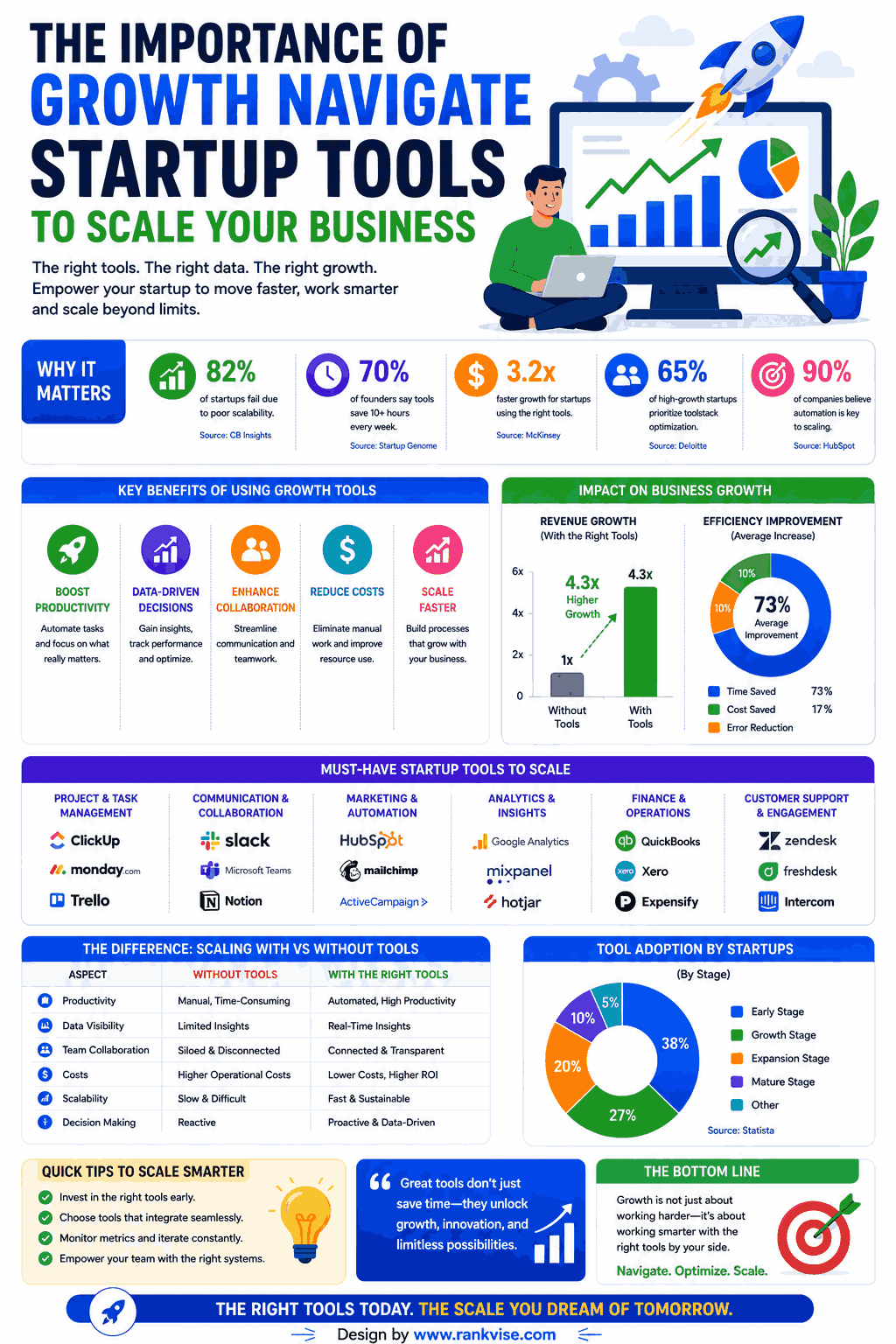
The startup tool ecosystem spans dozens of categories. Focus on these core areas first. Each one directly impacts your ability to acquire, retain, and monetize customers.
| Category | What It Solves | Popular Options |
|---|---|---|
| CRM and sales | Tracks deals and customer relationships | HubSpot, Pipedrive, Close |
| Marketing automation | Scales outreach without adding headcount | Mailchimp, ActiveCampaign, Customer.io |
| Product analytics | Reveals how users behave inside your product | Mixpanel, Amplitude, PostHog |
| Financial planning | Projects runway, burn rate, and revenue scenarios | Runway, Pry, LivePlan |
| Project management | Coordinates team work and priorities | Linear, Notion, Asana |
| Customer support | Resolves issues fast and builds loyalty | Intercom, Zendesk, Freshdesk |
| Data and BI | Centralizes metrics for decision-making | Metabase, Looker, Google Looker Studio |
Resist the urge to adopt tools from every category simultaneously. Add them as specific pain points emerge. Premature tooling wastes time on setup and maintenance.
Top Growth Navigate Startup Tools to Consider in 2026
The landscape evolves rapidly. These tools earn consistent praise from founders navigating growth challenges right now.
HubSpot for Unified Growth Management
HubSpot combines CRM, marketing, sales, and service on one platform. Startups love its free tier. Teams consolidate customer data without juggling multiple disconnected systems.
The platform scales as you grow. Start with the free CRM. Add marketing automation when acquisition efforts formalize. Upgrade sales tools when your pipeline demands structured management.
Mixpanel for Product-Led Growth Analytics
Product-led companies need deep behavioral analytics. Mixpanel tracks user actions inside your product. You see which features drive retention and where users abandon their journey.
This data informs product development priorities. Build what users actually engage with. Cut features that create complexity without delivering value.
Notion for Operational Coordination
Startups need flexible workspaces that adapt as processes evolve. Notion serves as a knowledge base, project tracker, and documentation hub simultaneously.
Teams align faster when information lives in one accessible place. New hires onboard quicker. Decisions get documented for future reference. Tribal knowledge transforms into organizational knowledge.
Stripe for Revenue Infrastructure
Payments, subscriptions, invoicing, and revenue recognition all live within Stripe. Startups avoid building billing infrastructure from scratch. The platform handles global payments across currencies and compliance requirements.
Revenue analytics within Stripe show monthly recurring revenue, churn rates, and expansion revenue clearly. Financial visibility improves without separate reporting tools.
How to Build a Growth Tool Stack That Scales
Building your tool stack strategically prevents expensive migrations later. Follow these principles to make smart decisions now.
Start with integration capability. Every tool you adopt should connect to your other systems. Check for native integrations or API access before committing. Isolated tools create data silos that slow your team.
Prioritize tools with strong onboarding. Startup teams lack time for lengthy implementations. Choose platforms with intuitive interfaces and solid documentation. If setup takes more than a week, reconsider.
Evaluate total cost of ownership. Free tiers attract startups, but pricing jumps at scale matter. Model your costs at 10x your current usage. Avoid tools with aggressive per-seat pricing if you plan to hire rapidly.
Consolidate where possible. One platform covering three needs beats three separate tools. Fewer tools mean fewer logins, fewer integrations to maintain, and fewer vendor relationships to manage.
Common Mistakes Startups Make When Choosing Growth Tools
Founders often fall into predictable traps. Awareness of these patterns saves time, money, and frustration.
- Adopting enterprise tools too early, then drowning in configuration complexity
- Choosing tools based on feature lists rather than actual current needs
- Switching tools every few months instead of committing and optimizing
- Ignoring data portability, making future migrations painful and expensive
- Letting individual team members choose tools without coordination, creating fragmentation
The best approach balances discipline with pragmatism. Audit your tool stack quarterly. Remove what nobody uses. Double down on what drives measurable results.
Measuring ROI from Your Startup Tool Stack
Every tool should justify its cost through measurable impact. Track these indicators to ensure your investments deliver returns.
- Time saved per team member per week on automated tasks
- Conversion rate improvements tied to marketing and sales tools
- Customer retention improvements linked to support and engagement platforms
- Revenue visibility and forecasting accuracy from financial tools
- Team productivity gains measured through project completion velocity
If a tool cannot demonstrate clear value within 90 days, replace it. Startups cannot afford software that sits unused or underutilized.
Emerging Trends in Startup Growth Tools for 2026
The startup tool ecosystem shifts constantly. Several trends reshape what founders should expect from their software stack.
AI-native tools replace traditional workflow automation. Instead of rule-based triggers, AI agents handle complex tasks like lead qualification, content creation, and customer support autonomously.
Vertical SaaS solutions target specific industries. Generic tools lose ground to platforms built exclusively for fintech, healthcare, or e-commerce startups. Industry-specific features reduce customization needs.
Usage-based pricing becomes standard. Startups pay for what they consume rather than committing to fixed monthly fees. This model aligns tool costs with actual growth trajectory.
Composable tool stacks gain popularity. Instead of monolithic platforms, startups assemble best-of-breed solutions connected through integration layers like Zapier, Make, or native APIs.
FAQs
HubSpot CRM, Google Analytics, Notion, Mailchimp, and Stripe cover most early-stage needs. Start with free tiers and upgrade only when limitations actually slow your growth.
Keep your stack between three and seven tools. More creates unnecessary complexity. Focus on customer communication, analytics, and project coordination as your foundation.
Yes, even a simple free CRM prevents lost leads and forgotten follow-ups. Start with HubSpot or Pipedrive free plans. Organize customer data before your pipeline outgrows spreadsheets.
Review every quarter. Remove unused tools, consolidate overlapping ones, and evaluate whether current tools still match your growth stage and team size.
Over-investing in complex tools before establishing product-market fit. Sophisticated software cannot compensate for unclear positioning or weak demand signals from customers.