Supply chain disruptions cost businesses billions every year. Manual tracking across suppliers, warehouses, and shipping partners creates blind spots. One missed shipment or inventory error cascades into lost revenue and unhappy customers.
Supply chain software gives businesses real-time visibility across every stage of their operations. It connects procurement, manufacturing, warehousing, and delivery into one coordinated system. Companies using these platforms reduce costs by 15–25% while improving delivery speed.
In 2026, global supply chains remain complex. Businesses that invest in the right logistics management tools gain resilience competitors cannot match.
What Is Supply Chain Software?
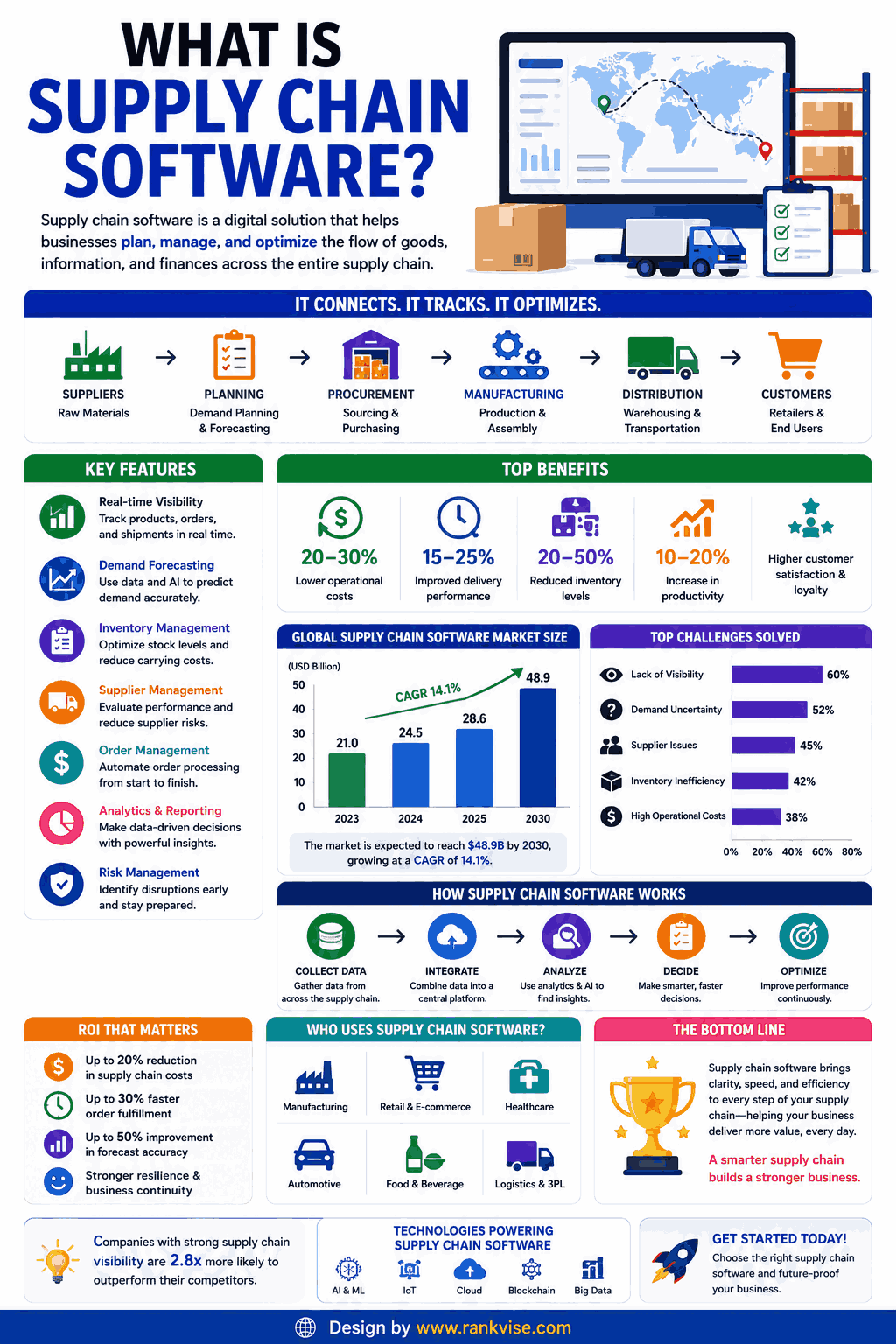
Supply chain software is a digital platform that manages the flow of goods from raw materials to final delivery. It tracks inventory levels, coordinates with suppliers, plans demand, and optimizes shipping routes.
These tools replace fragmented spreadsheets and disconnected systems with unified dashboards. They automate purchase orders, monitor shipments, and alert teams to potential disruptions before they impact customers.
Modern supply chain management systems range from focused tools handling one function to enterprise platforms managing end-to-end operations across global networks.
Core Features to Evaluate in Supply Chain Management Systems
Different businesses need different capabilities. Prioritize features based on your industry, supply chain complexity, and growth stage.
Look for these essential functions:
- Demand forecasting and planning using historical data
- Inventory management with real-time stock visibility
- Procurement automation and supplier relationship tools
- Warehouse management with pick, pack, and ship workflows
- Transportation management and route optimization
- Order management across multiple sales channels
- Analytics and reporting dashboards for decision-making
- Integration with ERP, accounting, and ecommerce platforms
21 Supply Chain Software Platforms Compared
Enterprise Supply Chain Planning Platforms
| Platform | Best For | Key Strength |
|---|---|---|
| SAP Integrated Business Planning | Large enterprises | End-to-end planning and S&OP |
| Oracle Supply Chain Management | Complex global operations | Unified cloud ERP integration |
| Kinaxis RapidResponse | Concurrent planning | Real-time scenario modeling |
| Blue Yonder | AI-driven supply chains | Machine learning demand sensing |
SAP IBP connects sales, operations, and financial planning in one environment. Large manufacturers use it to align demand forecasts with production capacity and supplier commitments across regions.
Oracle SCM Cloud offers comprehensive modules covering procurement, manufacturing, inventory, and logistics. Businesses already using Oracle ERP benefit from seamless data flow between systems.
Kinaxis RapidResponse specializes in concurrent planning. It lets supply chain teams model multiple scenarios simultaneously and see how changes ripple across the entire network instantly.
Blue Yonder leverages artificial intelligence to sense demand shifts earlier than traditional forecasting. Retailers and consumer goods companies use it to reduce stockouts and overstock situations.
Inventory and Warehouse Management Software
| Platform | Best For | Starting Price | Key Strength |
|---|---|---|---|
| NetSuite Inventory Management | Mid-size to enterprise | Custom pricing | Multi-location inventory control |
| Fishbowl | Manufacturers and warehouses | 329 USD/month | QuickBooks integration |
| Cin7 | Multichannel retailers | 349 USD/month | Connected inventory across channels |
| SkuVault | Ecommerce warehouses | Custom pricing | Barcode-driven accuracy |
| Zoho Inventory | Small businesses | Free for basic plan | Affordable multichannel tracking |
NetSuite provides real-time inventory visibility across warehouses, stores, and drop-ship locations. Its demand planning tools automatically calculate reorder points based on sales velocity.
Fishbowl bridges the gap between warehouse operations and accounting. Manufacturers use it to track raw materials through production into finished goods without leaving their QuickBooks ecosystem.
Cin7 connects inventory across online marketplaces, physical stores, and wholesale channels. It updates stock counts automatically as sales occur anywhere in the network.
Zoho Inventory gives small businesses enterprise-grade tracking at accessible pricing. Its free tier handles basic needs while paid plans add automation and integrations.
Transportation and Logistics Management Software
| Platform | Best For | Key Strength |
|---|---|---|
| FreightPOP | Multi-carrier shipping | Rate comparison across carriers |
| project44 | Supply chain visibility | Real-time shipment tracking |
| Descartes | Global logistics compliance | Customs and trade documentation |
| Transplace (Uber Freight) | Managed transportation | Network optimization |
| ShipBob | Ecommerce fulfillment | Distributed warehouse network |
project44 provides real-time visibility into shipments across ocean, air, rail, and truck. Companies track every order from supplier departure to final delivery with predictive arrival estimates.
FreightPOP simplifies carrier selection by comparing rates and transit times across dozens of providers. Shippers book the best option directly from one interface without calling multiple carriers.
ShipBob combines software with physical fulfillment infrastructure. Ecommerce brands distribute inventory across ShipBob warehouses to reduce delivery times and shipping costs automatically.
Procurement and Supplier Management Platforms
| Platform | Best For | Key Strength |
|---|---|---|
| Coupa | Enterprise procurement | Spend visibility and savings |
| Jaggaer | Complex sourcing needs | Supplier network management |
| Precoro | Mid-market purchasing | Simple purchase order automation |
| SAP Ariba | Global supplier collaboration | Largest B2B trading network |
Coupa gives procurement teams complete visibility into company spending. It identifies savings opportunities, enforces purchasing policies, and automates approval workflows across departments.
SAP Ariba connects buyers and suppliers through the world’s largest B2B commerce network. Companies discover new suppliers, negotiate contracts, and manage orders through one digital marketplace.
Precoro offers straightforward procurement automation without enterprise complexity. Growing businesses use it to control purchasing, track budgets, and eliminate unauthorized spending.
Demand Planning and Forecasting Tools
| Platform | Best For | Key Strength |
|---|---|---|
| Anaplan | Connected planning across teams | Flexible modeling engine |
| RELEX Solutions | Retail and grocery | AI-powered fresh product planning |
| Demand Caster | Mid-market forecasting | Accessible demand planning |
| Streamline (GMDH) | SMB inventory planning | Automated forecasting |
Anaplan enables connected planning across finance, sales, and supply chain teams. Changes in one plan automatically update related forecasts and budgets elsewhere.
RELEX Solutions dominates retail demand planning, especially for perishable goods. Its AI calculates optimal order quantities considering shelf life, promotions, and weather patterns.
Streamline makes demand forecasting accessible to smaller businesses. It imports sales history and generates forecasts automatically, recommending optimal inventory levels without requiring data science expertise.
How to Choose the Right Supply Chain Software
Selecting a platform requires understanding your specific operational challenges. Follow this evaluation process:
- Map your supply chain end-to-end. Identify every step from sourcing to delivery. Note where delays, errors, or visibility gaps occur most frequently.
- Rank your top three pain points. Focus on the problems costing you the most in revenue, time, or customer satisfaction.
- Match solutions to pain points. Choose platforms that directly address your priority challenges rather than buying the most features.
- Verify integration compatibility. Confirm the software connects with your existing ERP, accounting, and sales systems.
- Calculate total cost versus impact. Compare subscription fees, implementation costs, and training time against projected savings and efficiency gains.
Common Mistakes When Implementing Supply Chain Software
Avoid these pitfalls that derail supply chain technology projects:
- Selecting platforms based on vendor demos rather than real workflow testing
- Underestimating data cleanup required before migration
- Implementing all modules simultaneously instead of phasing rollout strategically
- Ignoring change management and user training needs
- Choosing enterprise solutions when mid-market tools solve current requirements adequately
Phased implementation reduces risk significantly. Start with your highest-impact module. Stabilize it fully before activating additional features.
Benefits of Modern Supply Chain Management Systems
Organizations investing in proper logistics technology report measurable improvements:
- 20–30% reduction in inventory carrying costs through better forecasting
- 15–25% improvement in on-time delivery performance
- 50% faster order processing through automated workflows
- 10–15% reduction in transportation costs via route optimization
- 80% improvement in supply chain visibility across partners and geographies
These results require proper implementation and ongoing optimization. Software alone does not fix broken processes. It amplifies good practices and exposes weak ones.
Industry Trends Shaping Supply Chain Software in 2026
Several developments influence how businesses approach supply chain technology:
- AI-powered demand sensing replaces traditional statistical forecasting with real-time signals
- Control tower platforms provide single-pane visibility across multi-tier supplier networks
- Sustainability tracking becomes mandatory for regulatory compliance and ESG reporting
- Autonomous logistics planning reduces human intervention in routine decisions
- Supply chain digital twins simulate disruptions before they happen
Early adopters of these capabilities build supply chains that adapt faster than competitors when disruptions occur.
FAQs
Zoho Inventory and Streamline offer affordable, easy-to-use supply chain tools that scale with small businesses without requiring enterprise budgets or dedicated IT teams.
Small business tools start at 100–500 USD monthly. Enterprise platforms like SAP and Oracle range from 50,000 to 500,000+ USD annually depending on scope.
Yes. Most modern platforms offer pre-built integrations with SAP, Oracle, NetSuite, and QuickBooks. API connections handle custom integration requirements.
ERP manages broad business operations including finance and HR. Supply chain software focuses specifically on procurement, inventory, logistics, and demand planning.
Simple tools deploy in 2–4 weeks. Mid-market platforms take 2–3 months. Enterprise implementations typically require 6–12 months for full deployment.