Traditional search is no longer the only way people find brands. AI search engines like ChatGPT, Google AI Overviews, Perplexity, and Copilot now answer questions directly. They summarize information instead of showing ten blue links.
- Structure content as concise, question-first answers with clear facts, lists, and schema so AI models can extract and cite your brand.
- Publish comprehensive topic clusters and earn citations on authoritative third party sites and community platforms so AI repeatedly links your brand to expertise.
- Continuously track AI mention frequency across tools, measure share of voice and referrals, then refine content and outreach based on gaps.
This shift changes how businesses get discovered. If AI tools do not mention your brand in their responses, potential customers never see you. Improving brand visibility in AI search engines requires a fundamentally different approach than traditional SEO.
Businesses that adapt early capture attention in these new discovery channels. Those that wait risk becoming invisible to a growing segment of searchers.
How Do AI Search Engines Decide Which Brands to Mention?
AI search engines generate responses by synthesizing information from multiple sources. They pull from websites, databases, reviews, forums, and structured data to create answers.
Several factors influence whether your brand appears in AI-generated responses:
- Frequency and consistency of brand mentions across authoritative sources
- Clarity and structure of your website content
- Presence in third-party reviews, directories, and expert roundups
- Topical authority demonstrated through comprehensive content coverage
- Structured data that helps AI systems understand your business context
Unlike traditional search ranking, AI tools do not simply reward backlinks. They prioritize sources that answer questions clearly, accurately, and authoritatively.
What Is Generative Engine Optimization (GEO)?
Generative engine optimization is the practice of optimizing content so AI systems reference your brand in their outputs. It builds on traditional SEO but focuses specifically on how large language models select and cite information.
GEO differs from conventional search optimization in key ways:
| FactorTraditional SEOGenerative Engine Optimization | ||
|---|---|---|
| Goal | Rank on search result pages | Get mentioned in AI responses |
| Content style | Keyword-optimized pages | Clear, factual, quotable statements |
| Authority signals | Backlinks and domain rating | Brand mentions and source diversity |
| Format priority | Long-form with headers | Concise, structured, entity-rich content |
| Measurement | Rankings and clicks | Brand mention frequency in AI outputs |
Businesses need both strategies working together. Traditional SEO feeds AI training data. GEO ensures AI systems surface your brand when generating answers.
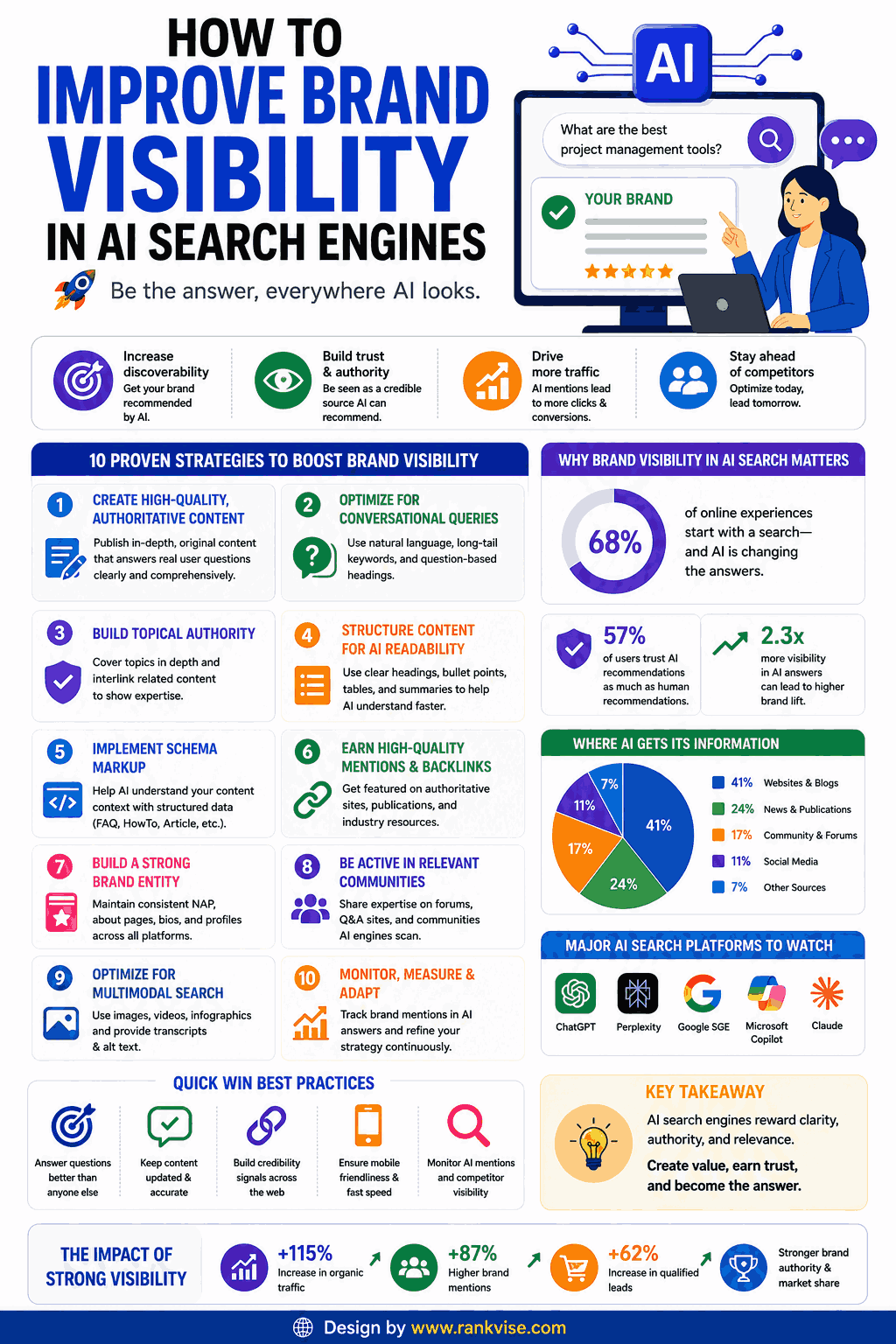
9 Strategies to Improve Brand Visibility in AI Search Engines
1. Create Content That Directly Answers Questions
AI systems favor content that answers specific questions concisely. Structure your pages around clear questions and provide direct, factual answers in the first paragraph.
Use question-based headings that match how people ask AI tools for information. Follow each question with a definitive answer before expanding with details. This format makes your content easy for AI models to extract and cite.
2. Build Topical Authority Across Your Niche
AI tools recommend brands they encounter repeatedly across a topic. Publishing comprehensive content clusters signals expertise. Cover your subject from every angle with interconnected pages.
A cybersecurity company should not publish one article about firewalls. It should cover network security, endpoint protection, threat detection, compliance, and incident response thoroughly. This breadth tells AI systems your brand owns that topic.
3. Earn Mentions on Third-Party Authoritative Sites
AI models train on diverse sources. Your brand needs presence beyond your own website. Pursue mentions on industry publications, review sites, expert roundups, podcasts, and news outlets.
Each independent mention reinforces your brand as a legitimate entity worth recommending. Focus on quality sources that AI systems trust and reference frequently.
4. Optimize for Entity Recognition
AI systems understand brands as entities with attributes. Help them categorize your business correctly by maintaining consistent information across all platforms.
Ensure your brand name, description, category, and offerings match exactly across your website, Google Business Profile, social media, Wikipedia (if eligible), Crunchbase, and industry directories. Consistency strengthens entity recognition.
5. Use Structured Data and Schema Markup
Schema markup helps AI systems understand your content contextually. Implement Organization, Product, FAQ, HowTo, and Review schema types on relevant pages.
Structured data does not guarantee AI mentions. But it makes your information easier to parse accurately. AI tools processing thousands of sources favor content they can interpret without ambiguity.
6. Maintain Active Presence on Community Platforms
AI models train on Reddit, Quora, Stack Overflow, and niche forums. When real users recommend your brand in authentic discussions, AI tools learn those associations.
Encourage genuine community participation. Support customers publicly on forums. Answer industry questions where your expertise adds value. These organic mentions influence how AI systems perceive your brand authority.
7. Publish Original Research and Data
AI tools cite sources with unique information they cannot find elsewhere. Original research, surveys, benchmarks, and proprietary data give AI systems reasons to reference your brand specifically.
Companies publishing annual industry reports see their data cited across AI responses regularly. Create statistics and insights that others reference and AI tools surface.
8. Optimize Your Brand for AI Answer Formats
AI responses follow predictable patterns. They list top options, compare features, explain concepts, and recommend solutions. Structure your content to fit these output formats naturally.
Include clear comparison tables, definitive lists, and concise definitions. When AI systems need to recommend options in a category, content formatted for easy extraction gets chosen more frequently.
9. Monitor Your AI Search Visibility Regularly
Track how often AI tools mention your brand. Regularly query ChatGPT, Perplexity, Google AI Overviews, and Copilot with questions your customers ask. Document which brands appear and where you are missing.
Tools like Profound, Peec AI, and Otterly help automate AI visibility tracking. Use these insights to identify gaps and adjust your strategy continuously.
How AI Overviews and Chatbots Select Sources Differently
Not all AI search tools work identically. Understanding their differences helps you optimize effectively.
Google AI Overviews pull heavily from pages already ranking in traditional search. Strong SEO foundations directly influence AI Overview inclusion. They favor recent, well-structured content from authoritative domains.
ChatGPT and similar chatbots rely on training data plus real-time web access. Brand mentions across diverse, high-authority sources influence their recommendations. They weight expertise signals and user sentiment heavily.
Perplexity cites sources explicitly and favors content with clear, factual statements. It pulls from recent web content and rewards pages that answer queries directly without excessive filler.
Optimizing across all three requires combining traditional SEO strength with broad brand authority and clear, structured content.
Common Mistakes That Hurt AI Search Visibility
Avoid these errors that prevent AI systems from featuring your brand:
- Publishing thin content that adds no unique perspective or data to existing information
- Inconsistent brand information across platforms confusing entity recognition
- Ignoring third-party presence and relying solely on owned website content
- Writing for keywords only instead of answering questions comprehensively
- Neglecting community platforms where authentic brand discussions happen
AI tools reward genuine authority. Shortcuts that worked in traditional SEO often fail in generative search environments.
Measuring Your Brand Visibility in AI-Powered Search
Tracking AI visibility requires new measurement approaches:
- Query AI tools weekly with your target questions and record brand mentions
- Monitor share of voice compared to competitors in AI-generated responses
- Track referral traffic from AI platforms like Perplexity and ChatGPT with search
- Measure branded search volume increases indicating AI-driven discovery
- Use specialized AI visibility tools to automate tracking across multiple platforms
Set baselines today. AI search adoption grows monthly. Early measurement lets you demonstrate ROI as visibility improves over time.
What Results Can Businesses Expect From AI Search Optimization?
Companies investing in AI search visibility report meaningful business impact:
- 15–30% increase in branded search queries within 6 months
- Higher quality referral traffic from AI platforms with stronger purchase intent
- Improved traditional search rankings as content quality increases
- Competitive advantage in categories where rivals ignore AI optimization
- Stronger brand perception as AI tools position them as industry leaders
Results compound over time. AI models update their knowledge continuously. Consistent effort builds lasting visibility advantages.
FAQs
Most businesses see measurable changes within 3–6 months of consistent optimization. AI models update regularly, so improvements appear gradually as new content gets indexed.
Yes. Strong traditional SEO feeds AI training data and directly influences Google AI Overviews. Both strategies work together to maximize overall search visibility.
Start with Google AI Overviews and ChatGPT. They have the largest user bases and directly influence how millions of people discover brands daily.
Yes. AI tools favor topical authority over brand size. Small businesses dominating a specific niche often get recommended over larger generalist competitors.
Clear, factual content with direct answers, original data, structured formatting, and expert-level depth performs strongest across all major AI search platforms.