Brand name normalization is the process of standardizing how brand names appear across your systems. It eliminates duplicates, fixes inconsistencies, and creates one clean version of each brand name.
- Create and maintain a master brand registry as the single source of truth, updated regularly and referenced by all systems and teams.
- Automate cleaning rules for casing, spacing, special characters, and suffix removal, reserving human review for ambiguous matches.
- Assign data ownership and governance: maintain alias tables, enforce entry controls, and schedule regular audits and updates.
Think of it this way. Your database might contain “Coca-Cola,” “CocaCola,” “coca cola,” and “COCA COLA.” These all refer to the same company. Normalization merges them into one standardized entry.
Without normalization, your data becomes unreliable. Reports split a single brand into multiple entries. Analytics lose accuracy. Teams make decisions based on fragmented information.
Why Brand Name Standardization Matters for Your Business
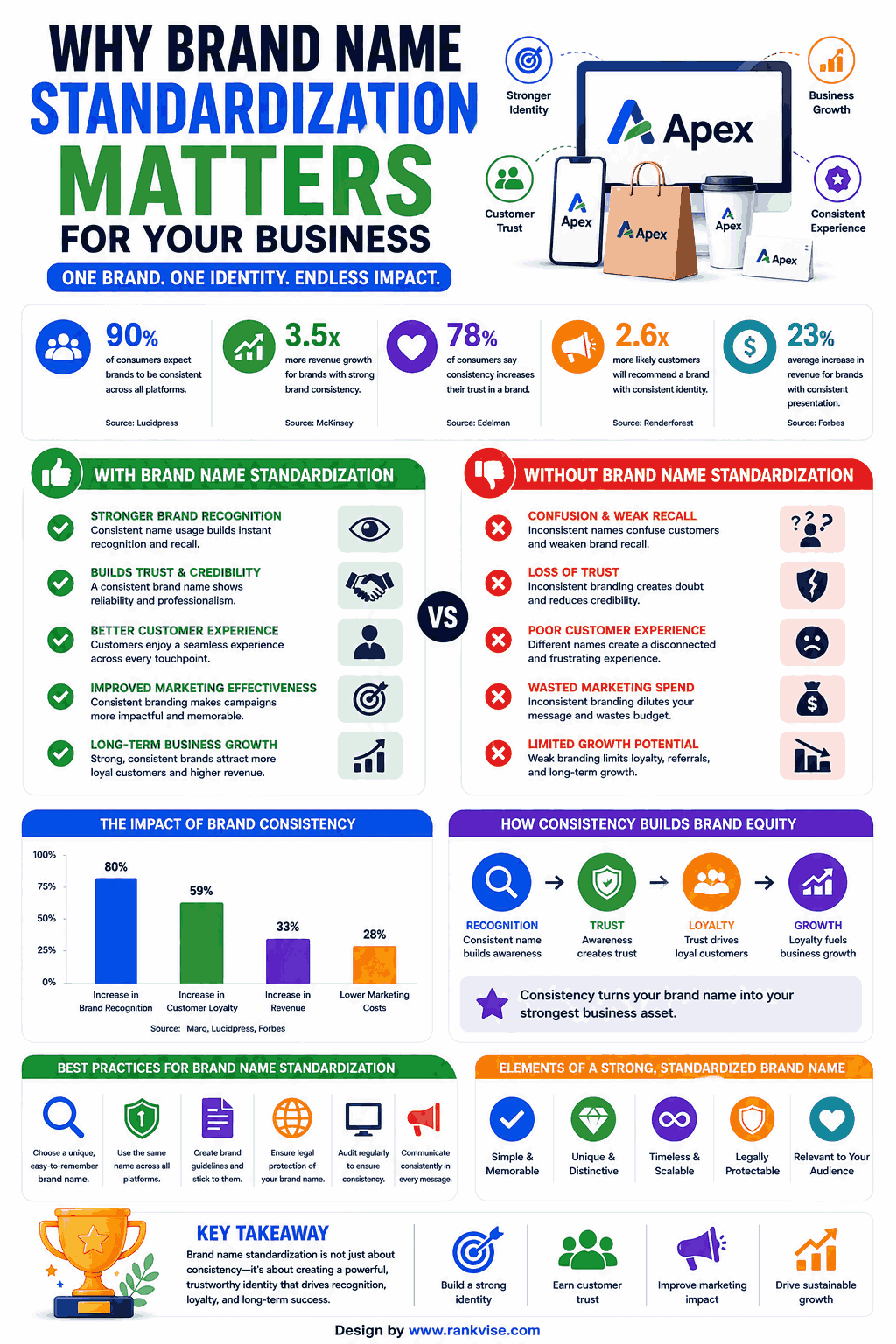
Messy brand data costs real money. It distorts market analysis, weakens supplier management, and confuses customers. Here is what happens when you skip normalization.
Your procurement team might create duplicate vendor records. Marketing might track the same competitor under three different names. Product catalogs might display inconsistent manufacturer names to customers.
Clean brand data improves every downstream process. It strengthens reporting accuracy, speeds up search functionality, and builds trust with customers who see consistent information.
Companies managing hundreds or thousands of brand names face this challenge daily. The larger your catalog, the greater the need for strict normalization rules.
Core Brand Name Normalization Rules Every Organization Needs
Rule 1: Establish a Single Source of Truth
Pick one authoritative version of each brand name. Document it in a master brand registry. Every system, team, and process should reference this single registry.
Your source of truth should reflect how the brand owner officially presents their name. Check their corporate website, trademark filings, or official press materials. When in doubt, use the legally registered trademark version.
Update this registry quarterly. Brands rebrand, merge, and evolve. Your master list must keep pace with these changes.
Rule 2: Define Capitalization Standards
Capitalization inconsistencies are the most common brand data problem. Set clear rules for how your systems handle letter casing.
| Scenario | Rule | Example |
|---|---|---|
| Standard brands | Use official capitalization | McDonald’s, not Mcdonalds |
| All-caps brands | Preserve if intentional | BMW stays BMW |
| Stylized lowercase | Follow official usage | adidas stays lowercase |
| Unknown brands | Use title case as default | Generic Brand Name |
Never let systems auto-capitalize brand names without checking them against your registry. Automated title-casing breaks brands like “iPhone” or “eBay.”
Rule 3: Handle Special Characters Consistently
Brands use hyphens, ampersands, apostrophes, and accents. Your normalization rules must address each type.
- Hyphens: Preserve when part of official name (Rolls-Royce, not Rolls Royce)
- Ampersands: Keep if official (AT&T), convert to “and” if informal usage
- Apostrophes: Always preserve (Levi’s, McDonald’s)
- Accents: Maintain for accuracy (Nestlé, not Nestle) when systems support Unicode
- Periods: Keep when official (S.C. Johnson), remove when informal
Document exceptions clearly. Some brands intentionally omit or include special characters as part of their identity.
Rule 4: Manage Abbreviations and Acronyms
Many brands go by both full names and abbreviations. Decide which version serves as your standard and map all variants to it.
For example, “International Business Machines” maps to “IBM.” “Bayerische Motoren Werke” maps to “BMW.” Create explicit alias tables linking every known variant to the canonical entry.
Your rules should specify when abbreviations are acceptable. Short, universally recognized acronyms often work better than full legal names. Nobody searches for “Bayerische Motoren Werke” in a product catalog.
Rule 5: Strip Unnecessary Legal Suffixes
Corporate suffixes like Inc., LLC, Corp., Ltd., and GmbH rarely belong in customer-facing brand data. They clutter search results and confuse matching algorithms.
Remove legal suffixes unless they are genuinely part of the brand identity. Store them in a separate field if needed for legal or procurement records.
This rule has exceptions. Some brands incorporate suffixes into their identity deliberately. Apply judgment case by case and document your decisions.
Rule 6: Address Spacing and Formatting Variations
Extra spaces, missing spaces, and inconsistent formatting create phantom duplicates. Your normalization process should handle these automatically.
- Trim leading and trailing whitespace
- Collapse multiple internal spaces into one
- Decide whether compound names use spaces (Land Rover vs. LandRover)
- Standardize separator characters (dash vs. space vs. nothing)
Automated trimming catches most spacing issues. Compound name decisions require human review against official brand usage.
Rule 7: Create Alias Mapping Tables
Real-world data contains misspellings, informal names, and regional variations. Alias mapping connects these variants to the correct canonical brand name.
Build a lookup table that includes common misspellings, former brand names, regional translations, and informal abbreviations. Update it continuously as new variants appear in your incoming data.
| Variant | Canonical Name |
|---|---|
| Chevy | Chevrolet |
| Lulu | Lululemon |
| Merc | Mercedes-Benz |
| Panasonic Corp | Panasonic |
| MSFT | Microsoft |
This table becomes your most valuable normalization asset over time.
How to Implement Brand Data Cleansing in Practice
Start With an Audit
Export all brand names from every system. Sort them alphabetically. You will immediately spot duplicates, inconsistencies, and errors that need correction.
Count how many unique brand entries you have versus how many you should have. The gap between these numbers reveals your data quality problem’s scale.
Prioritize High-Impact Brands
You cannot fix everything at once. Start with your top brands by revenue, transaction volume, or strategic importance. Clean these first for immediate business impact.
The 80/20 rule applies here. Twenty percent of your brands likely drive eighty percent of your business activity. Focus your initial normalization effort there.
Automate Where Possible
Manual normalization does not scale. Use automated matching algorithms to catch obvious duplicates. Apply rule-based transformations for capitalization, spacing, and suffix removal.
Reserve human review for ambiguous cases. Fuzzy matching algorithms can suggest potential duplicates, but people should make final merge decisions.
Build Prevention Into Data Entry
Normalization becomes easier when you prevent dirty data from entering your systems. Implement dropdown selections, auto-complete fields, and validation rules at every data entry point.
When users must type brand names manually, run real-time checks against your master registry. Suggest the canonical version before saving the record.
Common Challenges in Brand Name Normalization
Parent Companies vs. Sub-Brands
Procter & Gamble owns Tide, Gillette, and Pampers. Should your system link these? The answer depends on your use case.
Procurement teams need parent company relationships. Marketing teams need individual brand tracking. Build your data model to support both views without forcing one hierarchy on everyone.
Regional and Language Variations
Global brands sometimes use different names in different markets. Samsung is consistent worldwide. But “Lay’s” becomes “Walkers” in the UK and “Smith’s” in Australia.
Decide whether your normalization rules operate globally or regionally. Document regional exceptions clearly in your brand registry.
Mergers, Acquisitions, and Rebrands
Brands change names. Facebook became Meta. Weight Watchers became WW. Your normalization system must handle historical data gracefully.
Maintain name history with effective dates. Allow systems to query both current and former names depending on the reporting period.
Brand Name Normalization Rules for E-Commerce and Retail
Online retailers face unique normalization challenges. Seller-submitted brand data arrives messy, inconsistent, and sometimes intentionally misleading.
Build automated screening for incoming product listings. Flag brand names that do not match your master registry for human review. Reject obvious misspellings that might indicate counterfeit products.
Search functionality depends heavily on normalized brand data. Customers expect to find all Nike products under one filter, regardless of how individual sellers typed the brand name.
Measuring the Success of Your Normalization Efforts
Track these metrics to evaluate your brand data quality over time:
- Duplicate rate: Percentage of brand entries that are redundant
- Match accuracy: How often automated matching correctly identifies the same brand
- Data entry compliance: Percentage of new entries matching the canonical registry
- Search success rate: How often customers find brands on the first attempt
- Reporting consistency: Whether analytics tools show unified brand-level data
Set quarterly targets for improvement. Even small gains in data quality compound into significant business value over time.
Tools and Technologies for Brand Name Standardization
Several approaches exist for automating brand normalization. Your choice depends on data volume, budget, and technical capabilities.
Master Data Management platforms offer enterprise-grade normalization. They handle matching, merging, and governance at scale. These suit large organizations with complex brand ecosystems.
Custom scripts using fuzzy matching libraries work for smaller datasets. Python libraries like FuzzyWuzzy or RapidFuzz identify potential duplicates programmatically.
Database-level rules handle simple transformations. Triggers can auto-trim spaces, standardize casing, and strip suffixes during data insertion.
Building a Brand Name Governance Framework
Rules without enforcement decay quickly. Assign clear ownership for brand data quality. Someone must maintain the master registry, review exceptions, and update alias tables.
Create a governance document that covers decision-making authority, escalation paths, and review cadences. Distribute it to every team that creates or modifies brand data.
Train new employees on your normalization standards during onboarding. Data quality is everyone’s responsibility, not just the data team’s job.