Bad decisions cost businesses millions every year. Most of those decisions fail because people skip the thinking step. They react instead of reason.
- Practice structured critical thinking exercises to pause, evaluate evidence, and question assumptions before deciding.
- Build core reasoning skills: analysis, evaluation, inference, self-regulation, and interpretation to improve judgment.
- Use exercises like Five Whys, assumption mapping, and steelmanning to find root causes, test assumptions, and strengthen opposing views.
- Run team activities: structured debates, red teams, and Socratic questioning to surface flaws and normalize constructive dissent.
- Commit to short daily habits, track outcomes and belief updates, and assess progress regularly to compound better decision-making.
Critical thinking exercises fix this problem at the source. They train you to pause, evaluate evidence, and question assumptions before committing to action. In an era of information overload and AI-generated content, this skill separates effective leaders from everyone else.
The best part is that these exercises require no special tools. They fit into your existing workflow. And they produce measurable improvements within weeks of consistent practice.
What Exactly Are Critical Thinking Exercises?
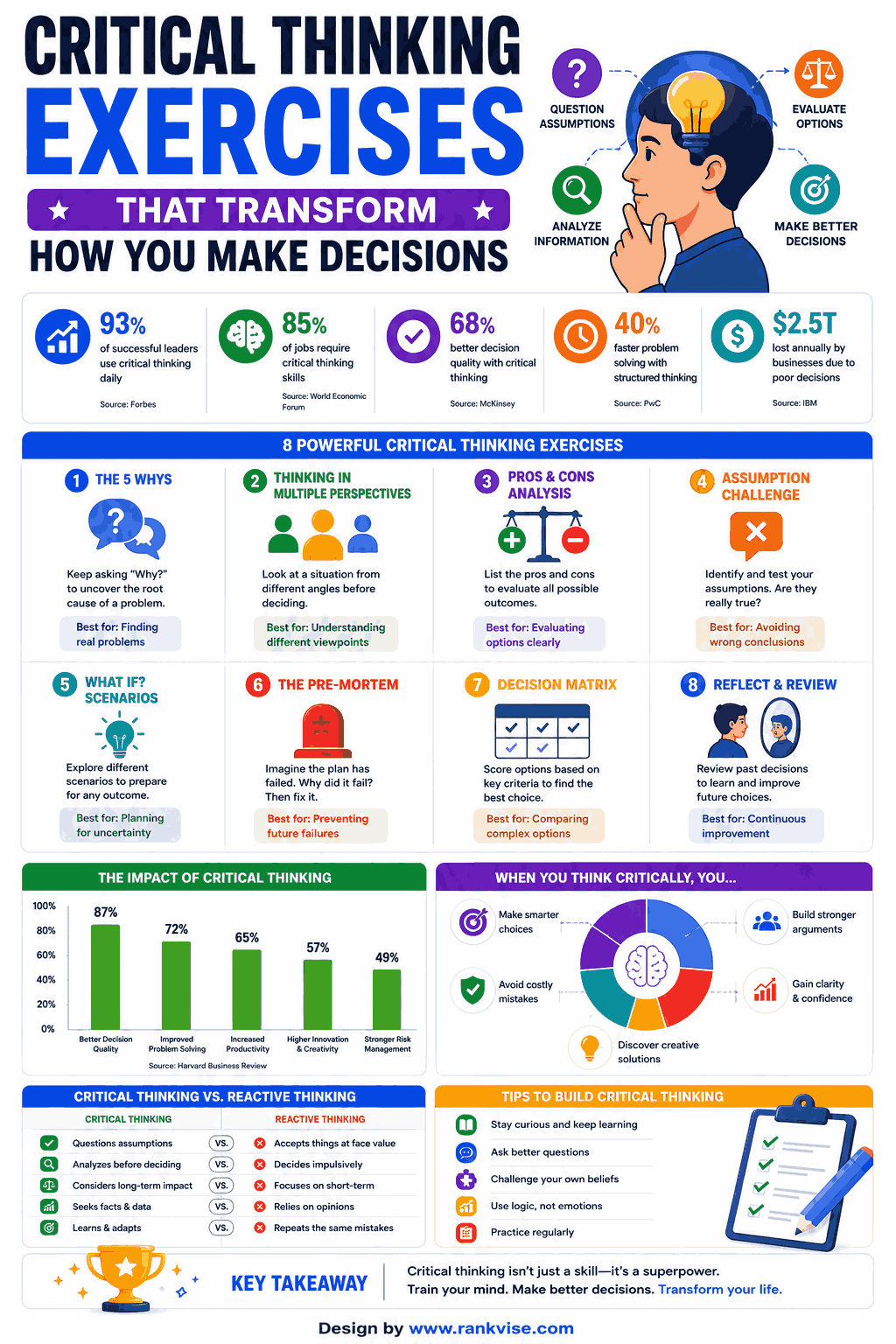
Critical thinking exercises are structured activities that strengthen your ability to reason clearly. They challenge you to analyze information, spot flaws in logic, and consider alternative perspectives before drawing conclusions.
Think of them as mental fitness training. Athletes train their bodies with specific drills. Professionals should train their minds with equal discipline. These cognitive exercises build the mental habits that lead to better judgment.
Some exercises take five minutes. Others work best as hour-long team workshops. All of them target the reasoning skills that drive sound business decisions in complex environments.
The Core Reasoning Skills These Activities Build
Critical thinking combines several distinct abilities. Each exercise in this guide targets one or more of these foundational skills.
| Skill | Description | Workplace Example |
|---|---|---|
| Analysis | Breaking problems into components | Diagnosing project delays |
| Evaluation | Judging evidence quality | Reviewing vendor claims |
| Inference | Drawing logical conclusions | Forecasting market shifts |
| Self-regulation | Monitoring personal bias | Checking gut reactions |
| Interpretation | Understanding context and meaning | Reading between the lines in reports |
Understanding these components helps you choose exercises that address your specific weaknesses. A balanced practice targets all five over time.
Individual Exercises for Sharpening Analytical Thinking
The Five Whys Method
Pick any problem you currently face. Ask “why” five consecutive times. Each answer feeds the next question.
This technique moves you past obvious explanations into root causes. Most people stop at the first or second level. Real insight lives deeper.
Example: Sales dropped this quarter. Why? Fewer leads converted. Why? Response time increased. Why? The team was pulled into a side project. Why? Leadership lacked clear priorities. Now you know what to fix.
Assumption Mapping
Choose a decision you feel confident about. List every assumption supporting it. Then challenge each one with available evidence.
You will often find that one untested assumption carries the entire argument. When that assumption fails, so does the decision. This exercise catches those hidden vulnerabilities early.
Business strategists use assumption mapping before major investments. It directly reduces the risk of confirmation bias and groupthink in planning sessions.
The Steelman Exercise
Take any position you disagree with. Build the strongest possible argument in its favor. Write it as though you genuinely believed it.
This develops intellectual flexibility. It forces you to understand opposing viewpoints at a level most people never reach. Strong critical thinkers can argue any side convincingly.
Teams that practice this skill anticipate objections and build more resilient strategies. They stop dismissing alternatives and start engaging with them honestly.
Team-Based Problem-Solving Activities
Structured Debate Format
Split your team into two groups. Randomly assign each side of a business question. Give twenty minutes for preparation, then hold a timed debate.
Random assignment is essential. It prevents people from simply defending their existing opinions. The exercise builds reasoning skills precisely because people must argue positions they did not choose.
Debrief afterward by discussing which arguments held up under scrutiny. Identify logical fallacies and unsupported claims together. This reflection phase delivers the deepest learning.
Red Team Analysis
Assign a small group to attack a proposed plan. Their job is finding every weakness, risk, and failure point. No idea is sacred during this exercise.
This problem-solving technique originated in military strategy. It works equally well for product launches, hiring decisions, and market entry plans. The red team creates structured space for productive dissent.
Rotate membership so everyone experiences both building and critiquing ideas. This normalizes constructive challenge and prevents defensiveness from taking root.
Socratic Questioning Rounds
One person presents a recommendation. Everyone else responds only with questions. No statements, no opinions, just probing questions about logic and evidence.
Effective questions include: What evidence supports this? What would change your mind? How might this fail? What are we not seeing? These questions improve decision quality immediately.
This analytical reasoning activity teaches people to examine ideas without triggering defensiveness. The question-only format keeps conversations exploratory and productive.
Quick Daily Exercises for Busy Schedules
Consistency beats intensity with cognitive skill development. These activities fit into five-minute windows throughout your day.
- Prediction journaling: Write a prediction before each meeting. Review accuracy afterward to calibrate your judgment.
- Bias check: Identify one cognitive bias that influenced a decision you made today.
- Evidence ranking: List three reasons you hold a belief. Rank them by actual reliability.
- Perspective writing: Describe a disagreement from the other person’s viewpoint in three sentences.
- Logic tracing: Follow one conclusion back to its original premise. Check if the chain holds.
Five minutes daily outperforms one hour weekly. Attach these exercises to existing habits like your morning coffee or commute for maximum consistency.
How to Track Your Progress Over Time
Improvement in reasoning feels abstract without measurement. Use these concrete markers to confirm your growth.
Review decision outcomes quarterly. Count how many achieved their intended results. Note recurring reasoning errors and eliminated ones. This creates an objective performance record.
Monitor how frequently you update beliefs based on new evidence. Flexible thinkers change their minds regularly. Track this frequency as a key indicator of cognitive development.
Request feedback from colleagues on your reasoning quality. Ask specifically whether your arguments have become more structured and your questions more precise. External perspectives reveal growth you cannot self-assess.
Building a Thinking Culture That Lasts
Individual practice creates personal improvement. Culture determines whether it scales across your organization.
Start every meeting with one question: What assumptions are we making right now? This single habit shifts team dynamics. It gives permission to challenge ideas without challenging people.
Reward analytical thinking publicly. Celebrate when someone spots a flaw in a popular plan. Promote people who demonstrate rigorous reasoning, not just confident opinions.
Create safety for dissent. People will not engage in genuine critical thinking if challenging ideas carries professional risk. Make it acceptable to be wrong, to question authority, and to change course based on evidence.
Your Action Plan for 2026
Select two individual exercises and one team activity from this guide. Practice daily for thirty days. Run team exercises weekly. Assess results at month end.
The five whys and assumption mapping require zero preparation. Start there tomorrow morning. Add complexity as your confidence and capability grow over the coming weeks.
Critical thinking is a practice, not a talent. Every exercise compounds over time into fundamentally better judgment. Start small, stay consistent, and watch your decision-making transform.
FAQs
prediction journaling require no training and deliver fast results. Both build foundational analytical habits within the first week of practice.
Most professionals notice sharper reasoning within two to three weeks of daily practice. Meaningful improvement in decision outcomes typically becomes visible after sixty to ninety days.
Yes. Structured debates, Socratic questioning, and red team exercises translate well to video calls. Use breakout rooms and collaborative documents to maintain full engagement.
Analytical thinking breaks problems into smaller parts for examination. Critical thinking includes analysis but adds evaluation, bias detection, and judgment about what conclusions the evidence actually supports.
Five to ten minutes of focused daily practice produces strong results. Consistency matters far more than session length. Short daily habits outperform occasional long workshops.