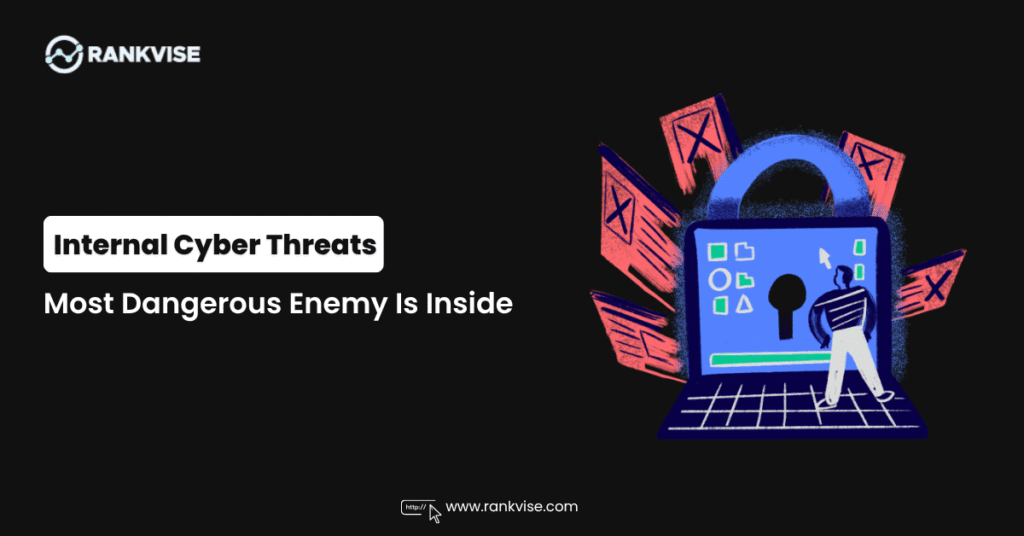
Most companies associate cyber threats with outsiders trying to get in. The usual thinking follows: if the perimeter is strong enough, everything inside will be safe. But in reality, the biggest risks don’t always come from the outside.
In practice, many critical incidents don’t start with a perimeter breach but from within: where access already exists, systems trust users by default, and suspicious actions are hard to distinguish from normal activity. Existing access often turns out to be more dangerous than an external intrusion attempt. That’s exactly why internal threats are an area businesses often seriously underestimate.
Internal Threats in Modern Infrastructure
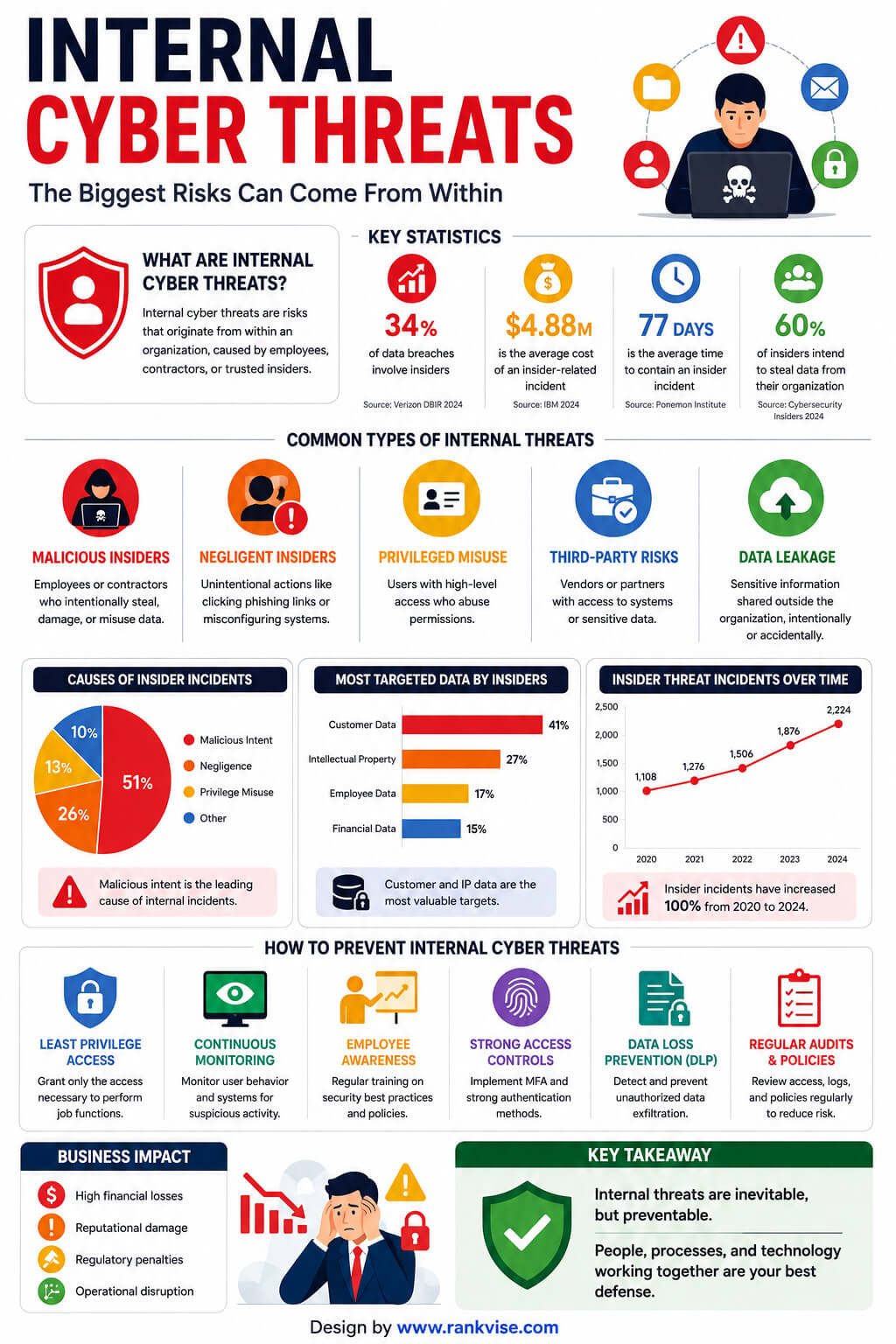
Internal threats are often reduced to the idea of a “malicious employee,” but that’s only a small part of the picture. In practice, cybersecurity experts consider a much broader range of sources as internal risk:
- regular employees making mistakes or acting carelessly;
- contractors and external partners with system access;
- compromised accounts already controlled by someone else;
- services and applications with overly broad permissions.
Internal access doesn’t equal safe access — and this is where most companies have a significant blind spot.
Why Existing Access Changes the Game
An external attacker first has to find a vulnerability and quietly establish a foothold — that takes time and leaves traces. Someone already inside starts from a completely different position.
First, there’s no need to break through the perimeter — they’re already past it. Second, systems tend to trust internal activity far more than external actions. Third, monitoring and control inside the network are usually much weaker than at the entry point. That’s why internal incidents can go unnoticed for months: the activity looks legitimate, no alerts are triggered, and the damage accumulates quietly.
Typical Internal Threat Scenarios
In practice, internal threats tend to follow several common patterns, all sharing one key trait: they look almost identical to normal operations. That’s exactly what makes them so dangerous.
Here are four of the most typical scenarios:
- Abuse of access privileges. An employee or contractor with overly broad permissions views or copies data outside their actual responsibilities. Most often, it’s not malicious — permissions were simply never reviewed after a role change.
- Lateral movement. After gaining access to one service, an attacker moves further. Weak network segmentation turns a single compromised node into a gateway to the entire infrastructure.
- Privilege escalation. Starting from a regular account, configuration flaws allow escalation to administrative access, opening up far more opportunities for an attacker.
- Use of legitimate tools. Actions carried out through standard utilities and built-in system functions — without any suspicious software or obvious anomalies in logs.
How Internal Risks Are Typically Detected
Most companies rely on a standard set of measures: access policies, event monitoring, compliance audits, and network segmentation. This is a necessary foundation — without it, security simply doesn’t hold.
But all these approaches share a common limitation: they validate rules and configurations, not how the system actually behaves during an attack. An audit shows whether permissions are set correctly. Monitoring records events in logs. However, none of them answers the key question: what happens if a single account is compromised — how far can an attacker actually move inside?
How Internal Pentesting Reveals the Real Level of Risk
Internal penetration testing services involve a controlled simulation of an attacker who already has internal access. Specialists start from the position of a regular user or a compromised account and test whether privileges can be escalated, which systems and data can actually be reached, whether monitoring detects suspicious activity, and how quickly.
Its main value lies in exposing the exact blind spots that neither audits nor automated scanners can uncover. Scanners check configurations. A pentest shows what actually happens when a real attack scenario unfolds — and where the gaps are that an attacker would exploit.
Who Can Objectively Assess Internal Risks
Teams within an organization have a deep understanding of their internal systems, and this can occasionally be a limitation. Daily work with a particular configuration leads to a sense of security and stability, yet this stability isn’t necessarily due to recent evaluation but to how things have always been. Simultaneously, the majority of these internal groups are not accustomed to handling actual security breaches. Their priority is consistent system operation, not evaluating vulnerabilities.
In contrast, outside security professionals offer a different outlook. They are not tied to an existing system’s habits, and they draw on a broad range of experiences and prior incidents. As a result, they are typically able to identify weaknesses more quickly because they have encountered comparable problems previously.
Datami is one example of that kind of experience: 9 years in the field, work across 34 countries, 400+ pentests, and 26 certifications. That kind of background shows up in how they approach the work — not just reviewing configurations, but actually mapping out how an internal attack could play out.
Conclusion
Frequently, the most significant security threat isn’t an external attack; instead, vulnerabilities are commonly found within the organization, such as overly broad authorization, a user account that has been illegally used, a lack of proper network division, or access rights that have not been assessed.
While standard security reviews will illustrate how systems are configured, they don’t demonstrate how they will perform under duress.
An internal pentest with an experienced external team helps surface those risks early, before they turn into real incidents.