The value of research and development data is much more than just steering the product improvements. Analyzing it with purpose can identify unfulfilled needs, the new customer behaviors and the new market segments altogether. Companies that consider the results of R&D as part of their strategic intelligence and not internal records have a strong upper hand in determining the areas of future demand.
The transformation of technical discoveries into business opportunities involves the need to change the mindset. Businesses need to analyze trends, deviations, and surprises, instead of looking at whether a project is successful or not. These observations frequently indicate uses or audiences that were not originally intended, and allow innovation that was not originally within the scope.
Understanding the Structure of R&D Data
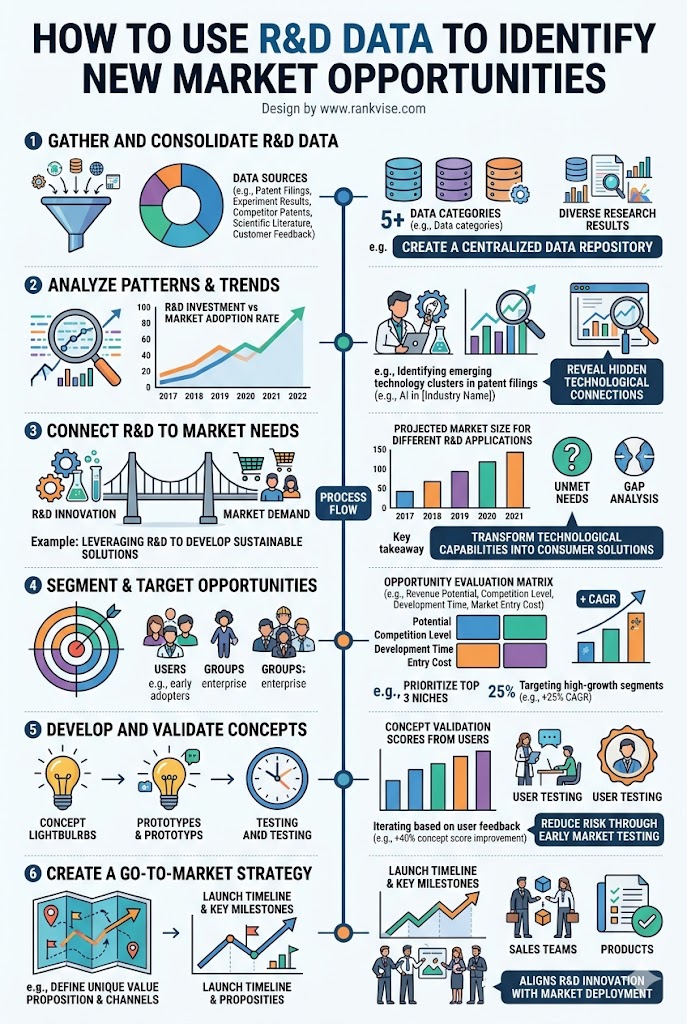
R&D information generally encompasses the results of experiments, prototype performance measurements, testing documentation, and technical observations. All these aspects give hints regarding the way in which a product or idea performs at varying circumstances. This information can be more readily analyzed to draw wider implications when organized and classified appropriately.
A well-defined data structure enables teams to relate technical knowledge with the possible user requirements. When organizations match the variables of performance constraints or unforeseen efficiencies with the use cases of the real world, then organizations can start to notice where their innovations would be used in a different context than they were initially designed. This systematic methodology helps to minimize the possibility of missing important insights.
Determining Patterns and Trends in Data
Among the best methods to discover new opportunities is to determine the recurring patterns of R&D outcomes. Examples of trends include steady improvement in performance given certain conditions or recurrence of user feedback during testing stages, which may be a good match to a given application or industry.
In addition to the obvious trends, there can be subtle correlations that can also show opportunities. Indicatively, a material which works remarkably well in high-temperature conditions has not necessarily been developed to a certain industry, but the data indicates a high fit. These interrelationships need to be identified with a lot of scrutiny and an openness to consider possibilities that are not within the original scope of the research.
Linking Technical Insights to Market Needs
There is a translation of technical data into market opportunities that requires the linking of what is being revealed in the data to what is needed by the customers. This step involves both the technical teams and market analysts to work together in such a way that the findings are put in a practical context. In the absence of this linkage, meaningful information can be tied up in closed reports.
In this process understanding of customer pain points is crucial. When a technical solution offers a better solution to a problem than what is currently available, it is an indication of a market opportunity. Organizations can also map their R&D successes to the actual problems encountered by industries or consumers to place their innovations in the most successful areas.
Evaluating Commercial Viability
Not all of the insights based on the R&D data will result in a viable market opportunity. One should determine whether a potential application is scalable, can be produced efficiently, and delivered at a competitive cost. This analysis makes sure that resources are channeled in on opportunities that have a realistic growth potential.
The timing and the competitive situation are also important in regards to market viability. A good technical solution might not work in case the market is not prepared yet or whether there are already competing products that are dominating the market. Through R&D knowledge and market analysis, companies will be in a position to know whether the opportunity is worth exploring or would need further development.
Leveraging Cross Industry Applications
R&D information can frequently show applications that are not necessarily within the initial industry focus. There are often other markets that an initially-unrelated technology can be used to support. Being aware of these cross industry opportunities can greatly increase the scope of an innovation.
There has to be cross-departmental thinking and co-operation to explore alternative applications. Teams need to study the way their findings relate to the problems faced in other industries and should take into consideration collaboration or pilot projects to experiment with these concepts. This not only discovers new markets but also maximizes the value of the research investments made.
Incorporating External Expertise
Although teams based inside the company are central to the analysis of R&D data, external opinions may offer further insight. Experts with knowledge of technical development and regulatory or funding conditions may be able to see opportunities that might not be obvious at a glance. As an illustration, engaging an SR&ED consultant may provide information on how the results of research findings relate to the larger industry trends and incentives to innovate.
Outside knowledge is also useful in justifying assumptions and minimising bias in decision making. With the introduction of professional employees, the organizations will be able to view the data they have in a more objective way and see how it can be applied. This partnership enhances the identification and exploration of new market opportunities.
Using Data Visualization and Tools
Contemporary data analysis instruments are essential in explaining intricate R&D data sets. Graphs, heat maps and trend models are visualization tools that enable one to determine relationships and trends that would not have been noticed otherwise. These are tools that convert raw data to actionable insights.
Advanced analytics can also model the possible results and forecast the performance of innovations in various markets. With the help of these technologies, organizations can test their hypotheses before investing in them. This eliminates uncertainties and enables informed decision making in case of exploring new opportunities.
Encouraging a Culture of Exploration
Organizational culture is critical in determining the ability to find new market opportunities based on R&D information. The teams need to be urged to think outside the box and think about the wider implications of their work. This attitude encourages innovativeness and augments the chances of making some unforeseen uses.
It should be made a culture whereby experimentation is welcomed so that employees would feel free to express unusual ideas. People who are not bound to strict ideals are more inclined to relate technical discoveries with new market opportunities. This cultural transformation is critical in maximizing the potential of R&D data.
Integrating Feedback Loops
R&D-market facing department feedback loops play an important role in refining insights. Real world feedback is able to confirm or refute initial assumptions as new opportunities are explored. This flow of information makes the decisions to be based on both the technical and market realities.
Constant feedback also enables organizations to be easily adapted. When there is a promising opportunity that needs to be changed, teams can optimize their strategy that is based on data and market feedback. This repetitive cycle will enhance the possibility of succeeding in the new markets.
Monitoring Competitor Activity
R&D data are not to be analyzed separately. The knowledge of how competitors are innovating allows valuable background on how to see the opportunities. Comparing the internal findings with the external developments, organizations are able to identify gaps in the market which have not been filled by others.
Observing the actions of competitors is also useful in preventing duplication of efforts. In a case where a similar solution is already available, companies can either vary in their approach or target underserved markets. This strategic consciousness will make sure R&D knowledge is leveraged to generate value in a unique way.
Aligning Strategy with Insights
After identifying the potential opportunities, there is a need to align them with the overall strategy of the organization. This alignment will help in efficient distribution of resources and that new initiations serve long term objectives. Even the promising opportunities might not yield meaningful results without the strategic alignment.
During this stage, effective communication between the leadership and R&D teams is crucial. The decision makers should be able to interpret the consequences of technical findings whereas the researchers should be able to interpret the business priorities. This partnership will also make sure that the opportunities identified are both novel and strategic.
Managing Risk and Uncertainty
There is a level of uncertainty in exploring new markets in accordance with R&D information. Organizations should be ready to deal with risks of entering new territories. This involves an assessment of regulatory needs, entry barricades and resource limitations.
The decision making process should be incorporated with risk management strategies. By evaluating the possible obstacles beforehand, companies will be able to work out strategies to counteract them. This is an active strategy that enhances the level of confidence in taking new opportunities and minimizes the chances of incurring expensive failures.
Measuring Success and Outcomes
Continuous improvement needs to track the success of initiatives based on R&D data. Measures like adoption in the market, increase in revenue, and customer response give an insight as to whether an opportunity has been adequately fulfilled. Such measurements are used to perfect future plans.
Assessment is not to be based on financial results. The experience of failures and successes helps to learn more about the way R&D data can be utilized beneficially. Such knowledge enhances the capacity of the organization to discover and exploit emerging opportunities in the long run.
Conclusion
R&D data is a great tool that goes well beyond technical development. Thoughtfully analyzed, it can have insights that can be used to direct organizations to new and lucrative markets. The trick is to be able to relate technical discoveries to real world requirements and be able to be flexible in approaching innovation.
Through collaboration, the use of analytical tools, and exploration culture, businesses can access the potential of their research processes. This will not only spur growth, but also keep innovation in line with changing market demands.