Agile transformation is the process of shifting an entire organization toward agile principles, not just its software teams. It changes how people collaborate, make decisions, and deliver work across every department.
This goes far beyond adopting a single framework like Scrum or Kanban. It rewires culture, governance, and operational rhythms. Teams move from rigid annual planning to iterative delivery cycles that respond to real customer needs.
The goal is simple: deliver value faster, adapt to change quicker, and empower teams to solve problems without waiting for top-down approval.
Why Are Organizations Pursuing Agile Transformation in 2026?
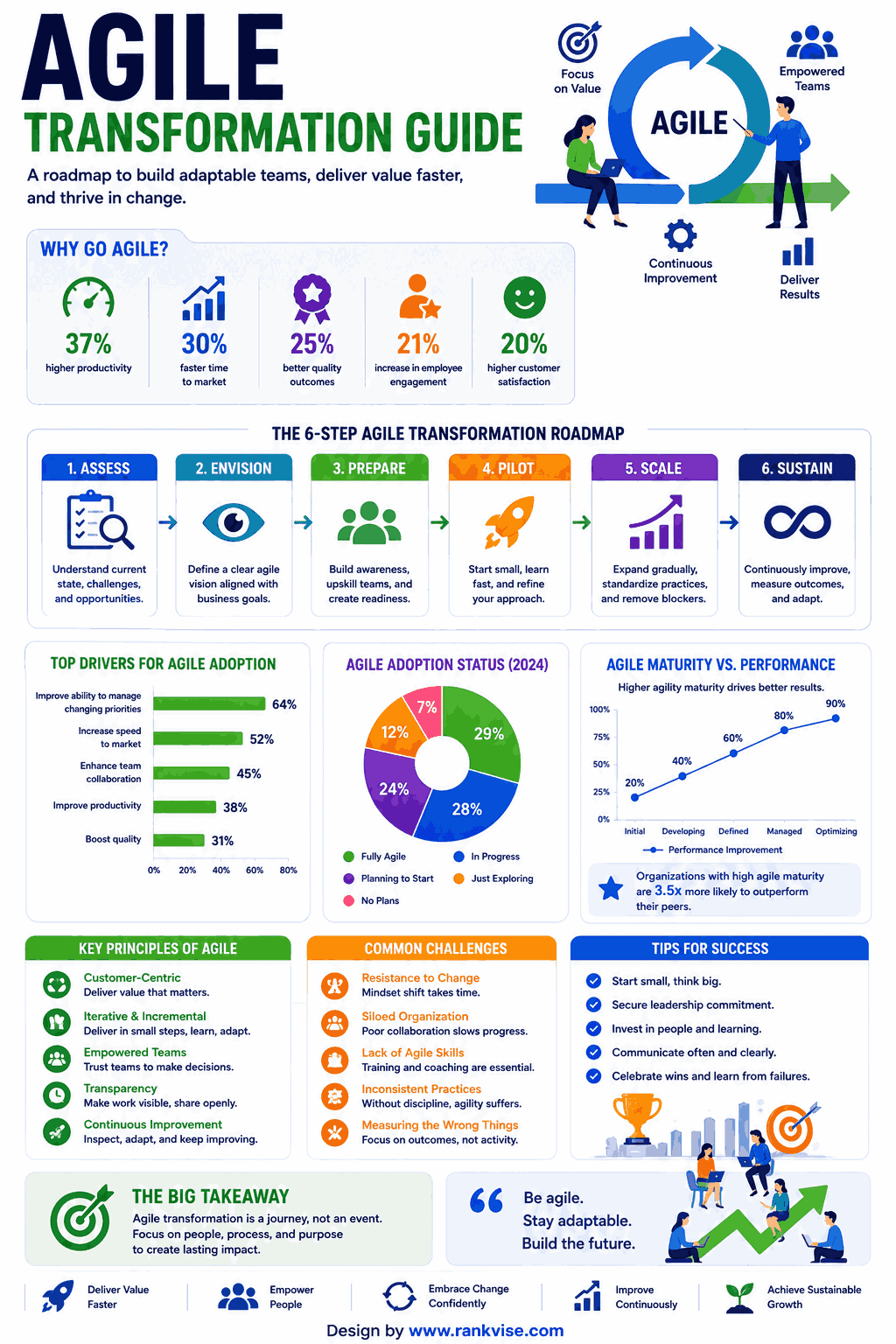
Market conditions demand speed. Customer expectations shift monthly, not yearly. Traditional hierarchies struggle to keep pace with this rate of change.
Organizations pursuing enterprise agility report faster time-to-market and higher employee engagement. They respond to competitive threats in weeks rather than quarters. This adaptability becomes a genuine strategic advantage.
Several forces drive the urgency right now:
- Digital disruption compresses product lifecycles across industries
- Remote and hybrid work demands flexible collaboration models
- Customers expect continuous improvement, not annual product releases
- Talent retention improves when teams have autonomy and purpose
Companies that delay transformation risk irrelevance. Those that commit early build compounding advantages over slower competitors.
How Does Agile Transformation Differ from Simply “Doing Agile”?
Many organizations adopt agile practices at the team level. They run sprints, hold standups, and use boards. This is “doing agile.” It helps, but it hits a ceiling fast.
True organizational change management requires systemic shifts. Leadership behaviors change. Funding models adapt. Cross-functional teams replace siloed departments. Decision-making pushes closer to the customer.
The Surface Level vs. the Deep Shift
Doing agile applies mechanics. Transformation rewires mindset. Here is the difference in practice:
| Doing Agile | Agile Transformation |
|---|---|
| Teams run sprints | Entire value streams organize around outcomes |
| Standups happen daily | Leaders remove blockers in real time |
| Backlogs exist per team | Portfolio prioritization aligns to strategy |
| Retrospectives occur | Culture embraces continuous learning at every level |
| Scrum masters coach teams | Leadership models servant leadership behaviors |
Without the deeper shift, agile practices become theatre. Teams follow rituals but decision-making stays slow and centralized.
Core Principles That Drive Successful Agile Transformation
Every successful transformation rests on foundational principles. These guide decisions when frameworks alone fall short.
Customer centricity over internal politics. Every initiative ties back to a customer outcome. Teams measure success by impact delivered, not tasks completed.
Iterative progress over perfect plans. Organizations launch small, learn fast, and adjust. They accept uncertainty as a feature, not a flaw.
Empowered teams over command-and-control. People closest to the work make operational decisions. Leaders set direction and remove obstacles instead of approving every move.
Transparency over information hoarding. Data, progress, and challenges stay visible to everyone. This builds trust and accelerates problem-solving across teams.
These principles sound straightforward. Living them requires consistent reinforcement from senior leadership over months and years.
What Does an Agile Transformation Roadmap Look Like?
No two transformations follow identical paths. However, successful change initiatives share a common structure. A phased approach reduces risk and builds momentum.
Phase 1: Assess and Align
Start by understanding your current state. Map how work flows today. Identify bottlenecks, handoff delays, and decision-making gaps.
Align leadership on the “why” behind the transformation. Without executive sponsorship, change stalls at the first sign of resistance. Leaders must articulate a compelling vision that connects agility to business outcomes.
Phase 2: Pilot and Learn
Select two or three teams to pilot new ways of working. Choose teams with willing leaders and visible deliverables. Their success creates proof points for the broader organization.
During this phase, invest in agile coaching. External coaches accelerate learning and prevent teams from reverting to old habits under pressure.
Phase 3: Scale Across the Organization
Expand proven practices to additional teams and departments. Introduce scaled frameworks where coordination across teams becomes necessary. Adjust organizational structures to support cross-functional collaboration.
This phase typically requires changes to budgeting, performance management, and talent development processes. These structural adjustments signal permanence and commitment.
Phase 4: Embed and Sustain
Transformation succeeds when agile becomes the default operating model. Leaders reinforce behaviors through recognition and resource allocation. Continuous improvement becomes embedded in daily operations.
Measurement shifts from activity tracking to outcome delivery. Teams own their metrics and use them for self-improvement, not compliance reporting.
Common Challenges That Derail Agile Transformation
Understanding failure patterns helps you avoid them. Most transformations struggle not because of bad frameworks, but because of human and organizational dynamics.
- Leadership misalignment – Executives support the idea but resist changing their own behaviors or governance models
- Middle management anxiety – Managers fear losing relevance when teams gain autonomy
- Transformation fatigue – Teams exhaust their patience when results take longer than promised
- Framework obsession – Organizations debate Scrum vs. SAFe vs. LeSS instead of focusing on outcomes
- Ignoring culture – New processes layered onto old mindsets produce frustration rather than agility
Address these challenges proactively. Name them openly. Create safe spaces where people express concerns without judgment.
How Long Does an Agile Transformation Take?
Expect a meaningful shift within 12 to 18 months for a mid-sized organization. Full enterprise-wide change often takes three to five years. Culture changes slowly, even when structures change quickly.
Early wins appear within the first quarter. Teams deliver faster. Collaboration improves visibly. These quick results sustain energy for the longer journey ahead.
Avoid setting a fixed end date. Transformation is not a project with a finish line. It transitions into a continuous improvement mindset that persists indefinitely.
Measuring Success: Key Metrics for Agile Transformation
You need clear indicators that your transformation delivers business value. Vanity metrics like “number of teams using Scrum” tell you nothing meaningful.
Focus on these outcome-oriented measures:
- Time to market – How quickly do ideas reach customers as working products?
- Customer satisfaction – Are Net Promoter Scores or satisfaction ratings improving?
- Employee engagement – Do teams report higher autonomy, mastery, and purpose?
- Release frequency – Are you delivering updates more often with fewer defects?
- Business agility – Can you pivot strategy within weeks when market conditions shift?
Review these metrics quarterly. Share them openly. Celebrate progress and address regressions honestly.
The Role of Leadership in Agile Transformation
Leadership commitment determines whether transformation succeeds or fails. This is not delegation. Executives must visibly change their own working patterns.
Leaders in agile organizations ask questions instead of giving orders. They attend team demos. They fund experiments without demanding guaranteed outcomes. They tolerate productive failure.
Servant leadership replaces directive management. This shift feels uncomfortable initially. It requires vulnerability and trust. But it unlocks discretionary effort across the workforce that no mandate ever achieves.
Building an Agile Culture That Lasts
Culture is the hardest element to change and the most important to sustain. It lives in daily interactions, not in posters on walls.
Reinforce desired behaviors through recognition. When a team admits a failure and shares learnings publicly, celebrate that transparency. When someone escalates a blocker early, thank them for visibility.
Hire for agile mindset, not just technical skill. Promote people who collaborate, coach others, and embrace change. These signals shape culture faster than any training program.
FAQs
Large enterprises typically need three to five years for full transformation. Early improvements appear within three to six months as pilot teams demonstrate faster delivery.
Lack of leadership commitment causes most failures. When executives support agile in words but resist changing governance and decision-making, teams lose trust and revert to old patterns.
Yes. Marketing, HR, finance, and operations teams all benefit from iterative planning, cross-functional collaboration, and faster feedback loops that agile ways of working provide.
SAFe, LeSS, and Spotify-inspired models support scaling. However, no framework works without cultural change. Choose one that fits your context and adapt it continuously.
Measure outcomes like time to market, customer satisfaction, employee engagement, and release frequency. Avoid measuring only process compliance or framework adoption rates.