The healthcare industry operates under a unique, non-negotiable compliance burden. Data breaches are costly – the average healthcare breach costs $10.93 million, more than any other sector and regulatory scrutiny is escalating. Maintaining compliance with standards like HIPAA, HITRUST, and SOC 2 is no longer a seasonal audit preparation task; it requires continuous, real-time monitoring.
Governance, Risk, and Compliance (GRC) software provides the crucial infrastructure to meet this challenge. For modern healthcare organizations, GRC platforms automate the complex, manual processes of evidence collection, control monitoring, and risk management, transforming compliance from a manual checklist into a visible, integrated component of IT and security operations.
This article outlines 5 leading GRC platforms for healthcare organizations, comparing their strengths, limitations, pricing, and best-fit scenarios.
1. Vanta: continuous compliance automation with deep HITRUST support
Vanta is a continuous compliance automation platform built to keep healthcare security and compliance teams audit-ready without living in spreadsheets.
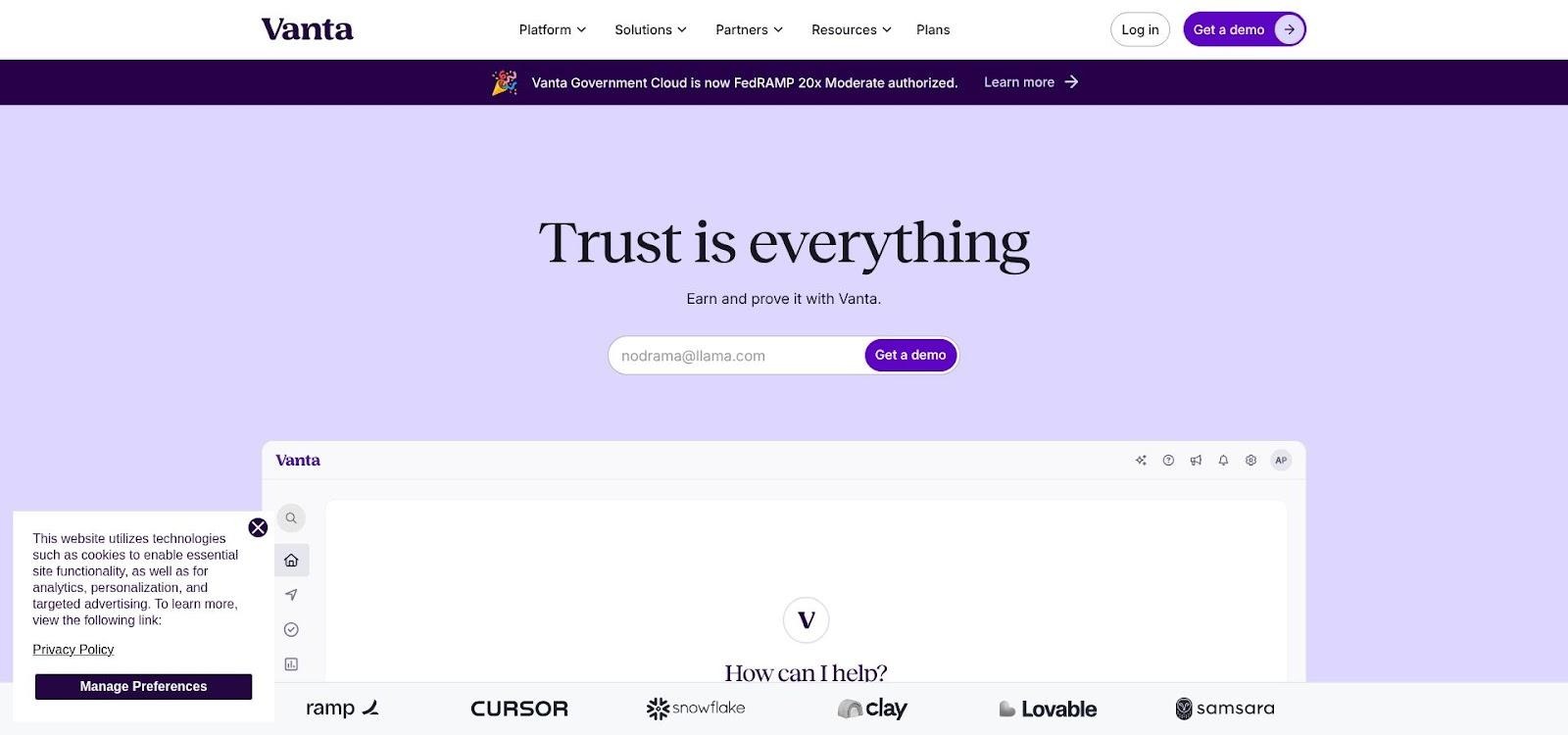
Recent buyer research suggests that automation depth and cross-framework mapping are among the key factors healthcare teams consider when evaluating GRC tools, as outlined in Vanta’s GRC software guide.
Its standout differentiator for healthcare programs is HITRUST depth, including the first and only two-way MyCSF integration, so evidence and control status stay aligned with how HITRUST is actually managed.
Why healthcare teams choose it
- Cross-framework mapping that reflects real overlap. Vanta supports toggle-based cross-mapping across frameworks. In practice, teams find existing SOC 2 policies typically satisfy about 40 to 50 percent of HIPAA safeguards, which can materially reduce duplicate policy work when you expand into healthcare requirements.
- Healthcare-ready control content, plus AI help when controls fail. Vanta ships with pre-mapped HIPAA and HITRUST controls, and its Vanta AI Agent can suggest concrete remediation steps, including code snippets, so failed tests turn into actionable fixes instead of audit churn.
- Built for external scrutiny. Features like Smart Policy Builder and a Trust Center with an AI chatbot help you package evidence in a way customers and auditors can actually consume. Vanta also supports automated BAA tracking and risk assessment workflows with quantitative scoring.
Integrations and automation depth
Vanta has 400+ native integrations (April 2026) across cloud, identity, endpoint, and security tooling, including AWS, Azure, GCP, Okta, CrowdStrike, Jamf, and on-prem device scanners. The integrations are designed to run deep. Azure alone can trigger 60+ automated tests mapping to 190 controls.
Automation is also where Vanta separates from “checkbox” platforms:
- Hourly automated test runs and continuous evidence collection
- AI-powered remediation suggestions when tests fail
- An automated auditor portal for evidence sharing and review
Important limitation for clinical environments: Vanta is not an EHR compliance system. It has no deep native Epic or EHR integration, so clinical-system evidence typically comes in via API work or manual upload.
Time to value, pricing, and ROI
Vanta is quote-based across multiple packages (see vanta.com/pricing). Teams typically get initial compliance posture visibility in weeks, then expand coverage as integrations come online.
For ROI, an IDC Business Value White Paper (January 2025) reported a 3-month payback period and 526 percent three-year ROI, along with 56 percent improvement in IT management efficiency. IDC also calculated average three-year discounted benefits of $1.28M per organization, plus ~$35K in annual operational cost savings from platform consolidation alone.
Best for: Mid-market providers and digital-health companies, plus security-mature hospitals (roughly 50 to 5,000 employees) that want continuous compliance across multiple frameworks, especially if HITRUST is on the roadmap.
Not a fit for: Teams looking for clinical operations compliance tooling such as credentialing, Joint Commission survey readiness, or billing audits. Vanta is strongest in IT and InfoSec compliance automation, not healthcare operations management.
Social proof
Vanta is recognized as a G2 Leader in multiple categories, has 7,000+ customers across industries, and is the first and only platform with a two-way MyCSF integration for HITRUST.
2. MetricStream: enterprise GRC for unified clinical, cyber, and financial risk
MetricStream positions itself as a connected risk layer for large healthcare organizations that want audit, risk, and compliance data across multiple domains in one model. It is built for regional IDNs, payers, and life-sciences enterprises where risk management spans IT security, operations, suppliers, and finance, and where leadership expects a single source of truth.
Framework coverage and how it works
MetricStream supports major frameworks such as HIPAA, PCI DSS, ISO 27001, NIST, SOX, and GDPR, plus hundreds more through its Unified Control Framework (UCF). UCF includes 9,300+ IT control statements across 1,200 regulations.
The trade-off is important: MetricStream does not rely on pre-packaged templates you turn on. Frameworks are implemented through UCF configuration, which gives you breadth and consistency, but also pushes real work onto your GRC team up front.
Capabilities that matter in healthcare enterprises
MetricStream is strongest when you need to normalize risk across complex structures, not just pass a single audit.
- Cross-hospital aggregation: Roll up risks and control performance across multiple facilities into enterprise reporting that Internal Audit and the board can use.
- Audit management and third-party risk: Bring audit workflows and supplier risk into the same system of record, instead of keeping them in separate tools and spreadsheets.
- AppStudio customization: MetricStream’s AppStudio low-code builder supports custom workflows, which is useful when your processes do not match off-the-shelf GRC playbooks.
Integrations and automation expectations
MetricStream is designed to integrate into large environments through APIs and connectors. In practice, integration setup typically requires consulting support, especially when you want multiple systems feeding a unified data model.
Automation is also largely configurable rather than “pre-automated.” MetricStream can automate what you build, but the platform generally expects you to design programs and workflows through UCF and AppStudio. That makes it powerful for mature teams, and heavy for lean ones.
Time to value, cost, and ROI
Full-suite MetricStream rollouts typically take 6 to 12 months and require dedicated GRC architects plus a consulting budget. Enterprise deployments often reach the seven-figure range.
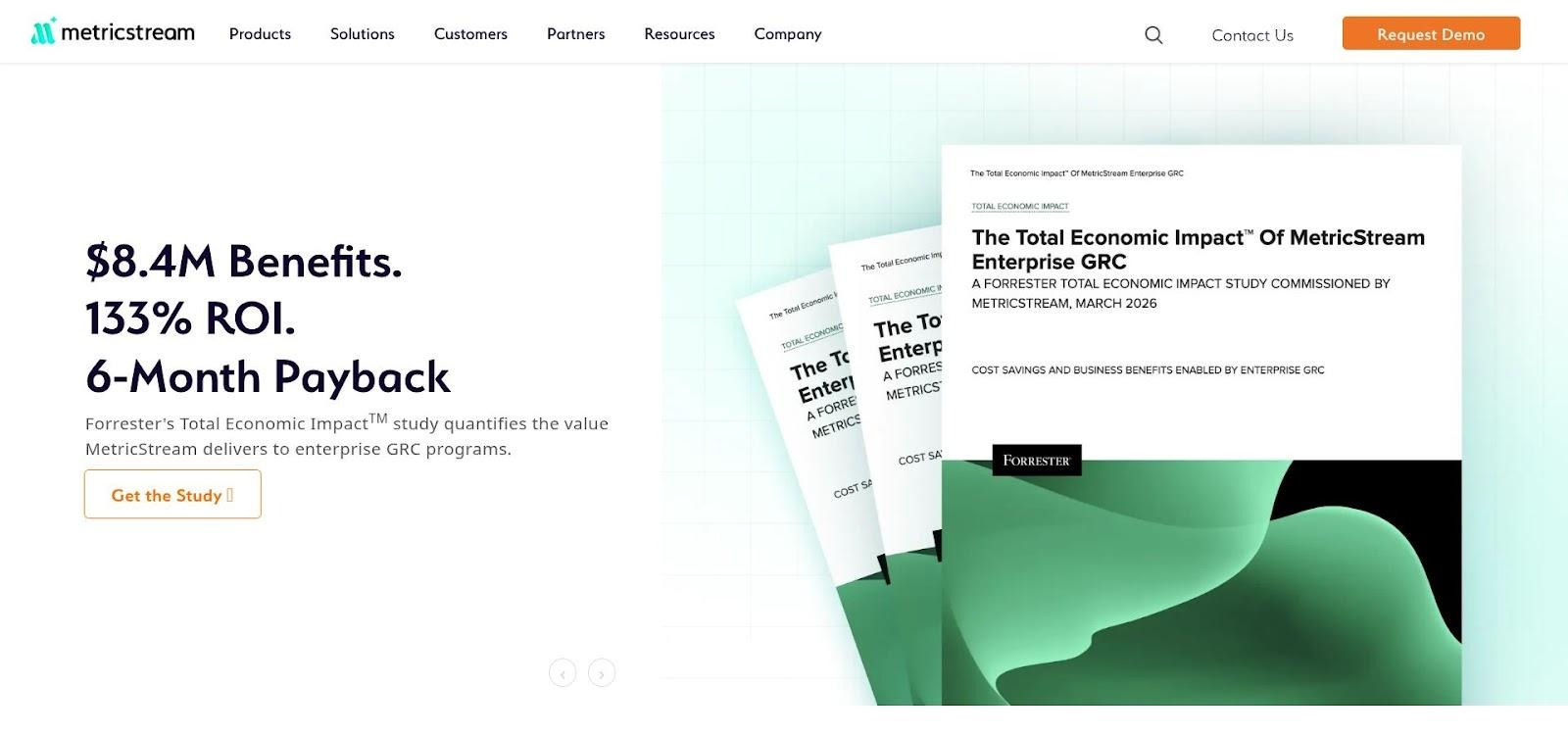
For quantified outcomes, Forrester Total Economic Impact (April 2026) reports:
- 133 percent three-year ROI
- Payback under six months
- $8.4M total quantified benefits for MetricStream Enterprise GRC
Best for: MetricStream is best for large healthcare enterprises that need a unified view of clinical, cyber, and financial risk, and have the staffing and budget to implement a configurable, organization-wide GRC model.
Limitations and trade-offs to plan around
- Blank-canvas reality: Broad coverage comes from UCF configuration, not out-of-the-box templates, so implementation is a build effort.
- User complexity: The platform can feel dense, and IDC MarketScape (2025) recommends MetricStream “prioritize reducing user complexity through automation, AI, and ML.”
- Limited crowd-sourced product feedback: MetricStream’s G2 rating is 3.8/5 from 14 reviews, which is a small sample size for buyers relying heavily on peer reviews.
Bottom line: If you want enterprise-grade unification and can invest in configuration, MetricStream can become a true system of record for risk. If you need fast, pre-built healthcare templates and automated tests on day one, it is likely more platform than you need.
3. OneTrust: privacy-first governance for HIPAA plus state law sprawl
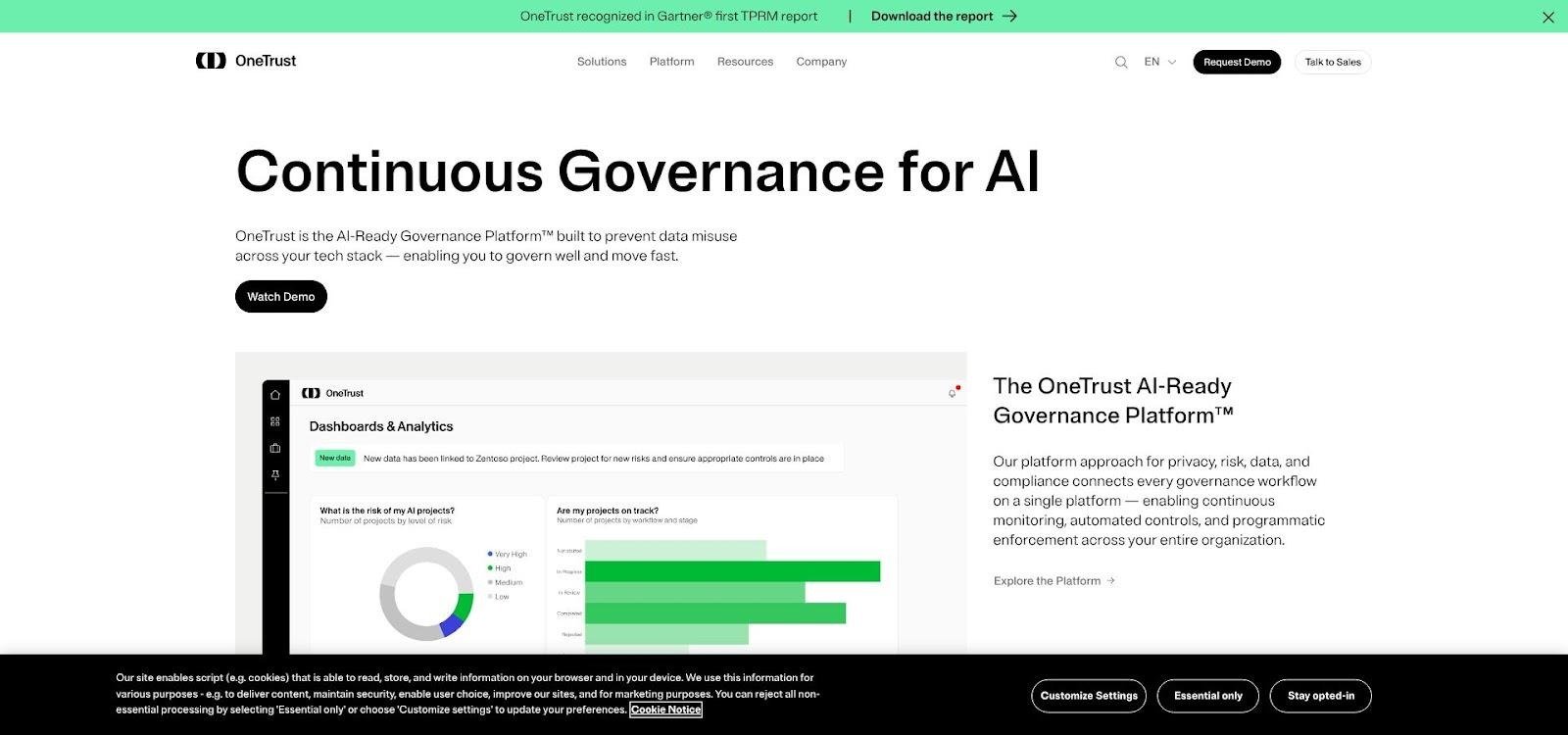
OneTrust started as a privacy platform and expanded into a broader governance, risk, and compliance stack through 11 acquisitions. For healthcare teams, the appeal is straightforward: it is built to operationalize privacy at enterprise scale when you are balancing HIPAA with GDPR-style state laws, consent requirements, and complex data flows across cloud, SaaS, and on-prem systems.
Framework coverage
OneTrust supports 55+ out-of-the-box frameworks, including HIPAA, GDPR, CCPA, ISO 27001, SOC 2, NIST, and PCI DSS. Its compliance automation capabilities were strengthened by its acquisition of Tugboat Logic (2021).
Where it shines for healthcare privacy programs
OneTrust is strongest when the problem is not “run more control tests” but “understand where PHI lives, why it is there, and what rules apply.”
- Data mapping for PHI: Inventory PHI locations across cloud services, SaaS apps, and on-prem databases, then connect each system to processing purpose, legal basis, and retention rules.
- PIA automation: Templates and an AI agent speed up privacy impact assessment workflows and reduce the friction of repeatable reviews.
- Vendor risk depth for privacy: Vendorpedia includes thousands of pre-scored vendor security and privacy profiles, which can accelerate intake and triage for vendor reviews.
- Operational privacy tooling: BAA management and consent management support broader privacy governance beyond a single audit cycle.
Integrations and automation level
OneTrust’s automation profile is uneven by design.
Privacy workflows such as data mapping, consent, and PIAs are where it is most mature. In contrast, the compliance evidence collection side is less “continuous monitoring” than automation-first platforms:
- The compliance automation module has fewer than 50 out-of-the-box evidence collectors
- Monitoring cadence is weekly at best, not hourly
If your program’s success depends on high-frequency technical testing and automated evidence streaming, those constraints matter.
Time to value and implementation reality
OneTrust is a large, modular platform. G2 feedback consistently points to a steep learning curve and higher implementation complexity, especially when multiple modules are deployed at once. In practice, many organizations limit scope at first by enabling only the modules they need, then expanding after the operating model is stable.
Pricing
OneTrust is sold per module and user. Enterprise GRC deployments typically start around $50,000 per year, then scale with module count and breadth of use.
Best for: OneTrust is best for health systems that are moving toward enterprise-wide privacy maturity, especially those managing cross-border research data, telemedicine footprints, or heavy state-by-state privacy requirements.
Limitations and trade-offs
- Built through acquisitions, so modules can feel disconnected in day-to-day use, based on user reports
- Fewer than 50 out-of-the-box evidence collectors for compliance evidence collection
- Weekly monitoring cadence at best, which is not ideal for programs aiming for near-real-time compliance visibility
- Complexity can lead to feature sprawl if you do not map requirements tightly to modules before buying
Social proof and rating clarity
On G2, OneTrust’s Tech Risk & Compliance product is rated 4.6/5 from 108 reviews (Spring 2026). Note that OneTrust’s 4.3/5 rating from 1,900 reviews applies to its Privacy Management product, not the Tech Risk and Compliance module.
4. ServiceNow GRC (IRM): compliance that runs inside IT operations
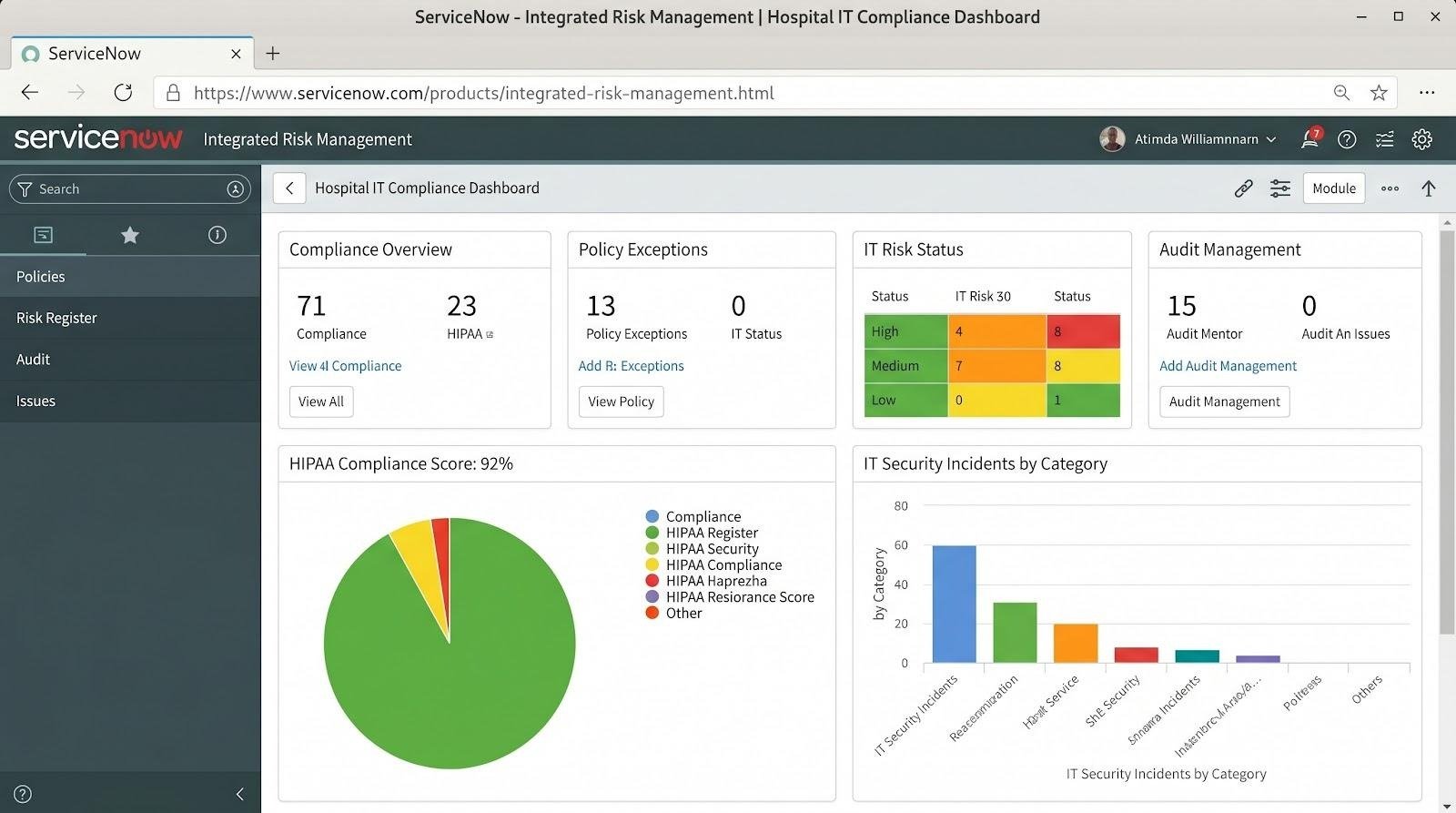
ServiceNow Integrated Risk Management (IRM) is built for health systems that already use ServiceNow to run IT operations. Instead of treating compliance as a separate reporting exercise, IRM embeds controls into the same workflows your teams use every day, including tickets, change management, and asset inventory through the CMDB.
Framework coverage, with an important HIPAA caveat
ServiceNow can support common frameworks such as SOC 2, ISO 27001, NIST, SOX, PCI DSS, and GDPR through configuration. In healthcare, HIPAA is supported, but it is not “pre-packaged.” HIPAA typically requires content accelerators and manual admin setup because ServiceNow does not ship with pre-built healthcare framework templates.
If you want a tool that comes pre-mapped for HIPAA safeguards on day one, plan for additional build effort here.
What it enables in a hospital IT environment
When IRM is implemented well, it turns compliance into a living system tied to real infrastructure.
- Policy-to-asset mapping: Link controls to assets in the CMDB, so compliance is tied to real systems, not a static spreadsheet.
- Automated control testing: Pull scanner data into tests mapped to controls, then track results continuously.
- Ticket-driven remediation: When a control fails, IRM can open and route incidents. Controls can close automatically when the underlying ticket is resolved.
- Blast-radius modeling: Use ServiceNow’s dependency mapping to visualize downstream impact, which matters when a single database supports multiple clinical workflows.
Integration depth and why it matters
IRM’s biggest advantage is integration depth inside ServiceNow. It can connect tightly with the broader ecosystem, including ITSM, CMDB, SecOps, and HR. That is why IRM is rarely a good standalone purchase. The value comes from already having ServiceNow as the operational backbone.
Automation level
Automation in IRM is workflow-native:
- automated tests based on scanner data and CMDB relationships
- automated incident creation and assignment on failures
- ticket-based closure that reduces “screenshot evidence” work
At the same time, HIPAA content does not arrive pre-built. You still need to design and administer the control library and mappings that make the automation meaningful for healthcare audits.
Time to value and pricing reality
Multi-hospital deployments typically take 4 to 6 months with partner-led configuration. Full optimization often extends beyond the first year, especially when teams expand into additional modules and automate more evidence sources.
Licensing is tiered across IRM Standard, Professional, and Enterprise. Third-party risk management (TPRM) and Privacy are separate add-ons. For realistic enterprise healthcare deployments, total licensing commonly lands in the several-hundred-thousand to $1M+ per year range, depending on modules, users, and overall platform footprint.
For ROI, Forrester Total Economic Impact (January 2021) reported a 235 percent three-year ROI and an $8.6M NPV for a large composite provider that replaced five legacy GRC tools with ServiceNow.
Best for: ServiceNow IRM is best for large enterprises already running ServiceNow for ITSM and CMDB, and who want compliance embedded directly in day-to-day IT workflows.
Limitations and trade-offs
- No pre-built healthcare framework templates, HIPAA requires content accelerators and manual setup
- Implementation and admin complexity are significant, especially across multi-hospital environments
- High total cost in enterprise deployments, especially once add-ons are included
- Value is tightly tied to existing ServiceNow maturity, without it the platform is hard to justify
Social proof
On G2, ServiceNow IRM holds a 4.2/5 rating from 108 reviews (Spring 2026). Forrester’s TEI study provides a quantified ROI benchmark for large-scale consolidations.
5. Compyl: AI-driven GRC for teams that want evidence to write itself
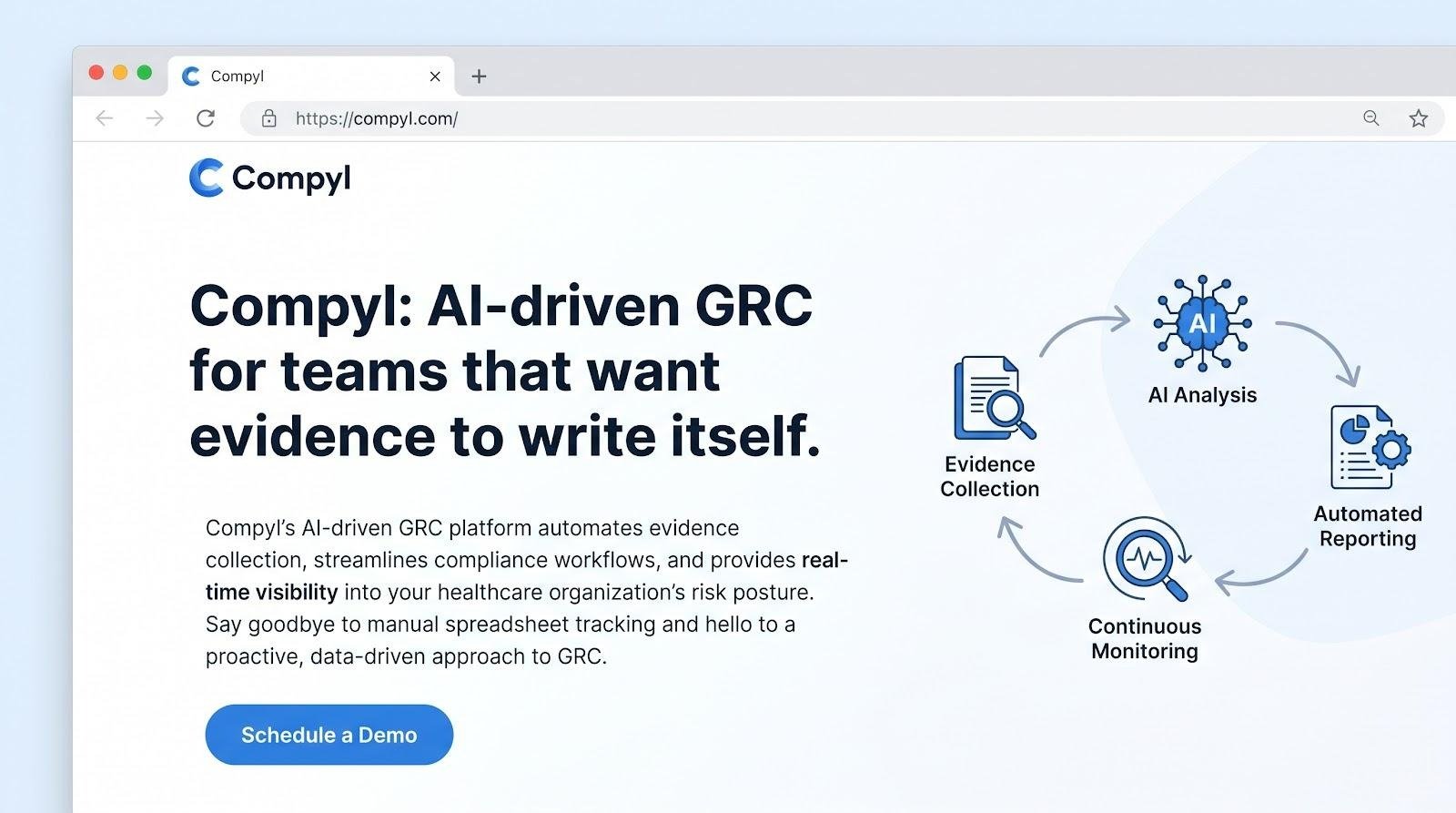
Compyl is an AI-driven GRC platform focused on two things: continuous control monitoring and faster documentation. It is also an emerging vendor, based in NYC and founded in 2020, with roughly 57 employees and $18M in funding. That combination—strong product velocity and a shorter track record—is exactly what some healthcare teams want and others will avoid.
Framework coverage
Compyl supports 80+ frameworks, including pre-mapped HIPAA, HITRUST, and SOC 2. It also supports widely used security frameworks such as ISO 27001, PCI DSS, NIST, GDPR, and CMMC, which helps when your healthcare program spans both patient-data obligations and broader security requirements.
What stands out
Compyl is built to reduce the time spent turning “what happened” into “audit-ready evidence.”
- Compyl Copilot (AI assistant): Helps draft risk assessment narratives, flag policy gaps, and generate responses for questionnaires.
- Evidence Studio: Includes 1,500+ pre-built evidence blueprints, which can speed up how teams package and standardize evidence across frameworks.
- Visual cross-mapping: Close a gap once and reflect progress across multiple frameworks without duplicating work.
- Continuous monitoring: Designed to keep control status current without waiting for quarterly check-ins.
Integrations and automation depth
Compyl offers 125 native integrations across cloud providers and common security tools, which is where its continuous evidence collection is strongest.
There is also a major boundary to plan around in healthcare environments: Compyl has zero EHR integrations. There are no Epic, Cerner, or other clinical-system connectors. If your audit evidence strategy depends on pulling directly from clinical applications, Compyl will not cover that surface area.
Time to value, pricing, and ROI
Compyl is quote-based with four tiers—Audit Prep, GRC, Enterprise, and Enterprise+. Based on available estimates, mid-market deployments often land around $30,000 to $60,000 per year.
Compyl does not have published ROI studies, and there is not enough customer data to cite a reliable time-to-value benchmark. It also has only two published case studies, which is worth factoring into procurement when leadership expects extensive healthcare references.
Best for: Compyl is best for tech-forward hospitals and digital-health companies that want AI-assisted documentation plus continuous evidence collection from cloud and security tooling, and that are comfortable adopting an emerging vendor.
Limitations and trade-offs
- No EHR integrations, which limits its fit for clinical-system evidence collection
- Limited public track record, only two published case studies
- Not included in major analyst reports (IDC, Forrester, Gartner), which can be a concern for risk-averse boards
- Small review sample on G2 compared to established platforms
Social proof
Compyl is rated 5.0/5 on G2 from 46 reviews (Spring 2026). That is a strong score, but it comes from a comparatively small sample size.
Future outlook: GRC’s next act in healthcare
Healthcare compliance is moving from documentation to telemetry. Over the next few years, the platforms that win will look less like audit trackers and more like always-on operating systems for risk.
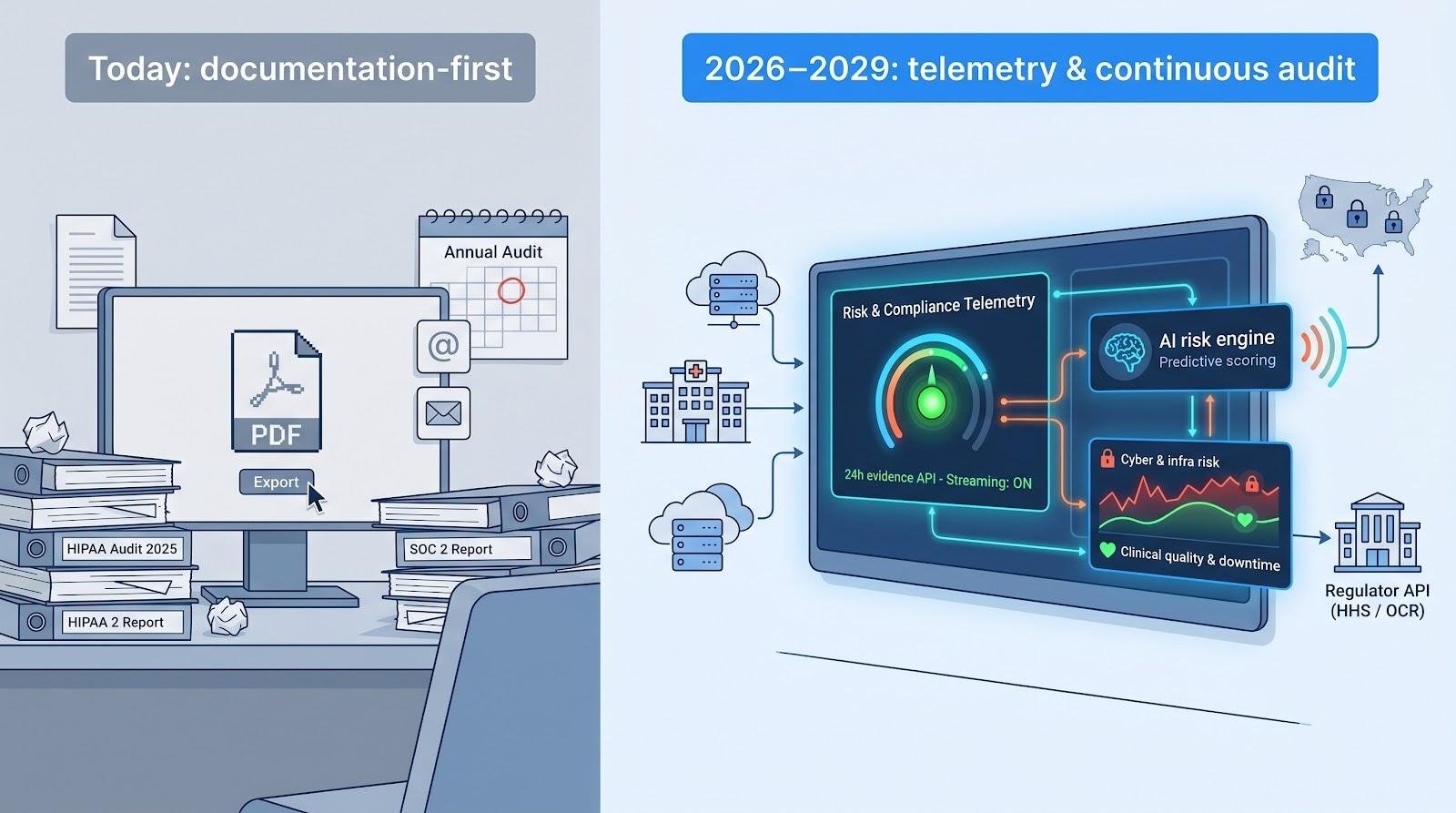
- AI moves from draft to prediction (2026 to 2028).
- IDC predicts that 60 percent of GRC platforms will embed generative AI by 2027 for evidence drafting and risk scoring (IDC MarketScape, October 2025).
- Early pilots already feed SIEM data into AI models so a newly connected medical device with a critical CVE opens a risk ticket and assigns a work order automatically.
- Continuous audit becomes regulatory reality by 2029.
- An HHS OCR discussion paper (July 2025) proposes ingesting API-based control evidence every 24 hours instead of annual PDFs for HIPAA desk audits.
- Vendors that can stream immutable logs directly to regulators will outpace tools that still depend on manual exports and screenshots.
- Clinical quality and cyber risk converge.
- A 2025 Joint Commission bulletin links ransomware downtime to a 13 percent average delay in time-critical treatments. Expect board dashboards to merge threat status with patient-safety KPIs. This shift is moving from “nice to have” to mandate.
- Privacy creep accelerates.
- Twenty-three United States states now have GDPR-style health-data laws on the books or in committee (Thomson Reuters Regulatory Tracker, March 2026). Platforms with dynamic, region-aware data maps will keep showing up in RFP shortlists.
FAQs: clearing up common GRC misconceptions
Is software alone enough to make us HIPAA compliant?
No. A platform can centralize controls, track evidence, and surface gaps, but your workforce still has to implement safeguards and operate them consistently. Treat GRC software as the system that makes compliance visible and repeatable, not the thing that “creates” compliance.
How does healthcare GRC differ from a generic platform?
Most buyers are really choosing between three categories, and each “solves” healthcare compliance differently:
- IT and InfoSec automation platforms focus on continuous technical evidence collection and multi-framework audits (HIPAA, HITRUST, SOC 2).
- Enterprise GRC platforms unify risk, audit, and compliance across the business.
- Healthcare operations compliance tools cover credentialing, policy attestation, billing audits, exclusions, and survey readiness. They often complement, rather than replace, IT control monitoring.
The right answer depends on where your compliance work actually lives, in cloud controls, enterprise risk governance, or hospital operations.
Are there credible free or open-source options?
Tools like SimpleRisk exist, but they generally lack HIPAA-specific templates, continuous monitoring, and dedicated support. They can be a starting point for very small teams, but most providers move on once audit expectations and evidence volume exceed what manual workflows can handle.
Conclusion
Bottom line: Tomorrow’s healthcare GRC is proactive, API-driven, and inseparable from day-to-day operations.