Better website performance is not just a technical concern. It directly affects how people find, use, trust, and buy from your business online.
A slow or confusing website can waste strong marketing efforts. You may run great ads, publish useful content, or build a strong social presence. Yet visitors may leave if your site loads slowly or feels hard to use.
In simple terms, your website is where marketing interest becomes business action. Better performance helps turn clicks into leads, enquiries, sales, bookings, and repeat visits.
Driving SEO Rankings and Organic Traffic
Since search engines prioritize user experience, website performance is an essential factor in SEO ranking. Fast-loading pages reduce bounce rates and increase average time on site. Algorithms read this as high-quality content and boost visibility in search results. A website designed for SEO performance ultimately drives more organic traffic to your site and helps convert casual visitors into valuable leads.
Why Does Website Performance Matter for Digital Marketing Goals?
Website performance matters because every digital marketing channel sends people somewhere. Most of the time, that place is your website.
Search ads, SEO, email campaigns, social posts, and referral links all rely on your site to complete the journey. If your website performs well, users can act quickly and confidently. If it performs poorly, your marketing budget loses value.
Performance includes more than page speed. It also includes mobile usability, page stability, navigation, content clarity, and response time.
A high-performing website helps digital marketing goals by improving:
- Search visibility
- User experience
- Lead generation
- Conversion rates
- Customer engagement
- Brand trust
- Campaign return on investment
Think of website performance as the foundation under your marketing strategy. If the foundation is weak, every campaign works harder than it should.
How Does Website Speed Optimization Improve Marketing Results?
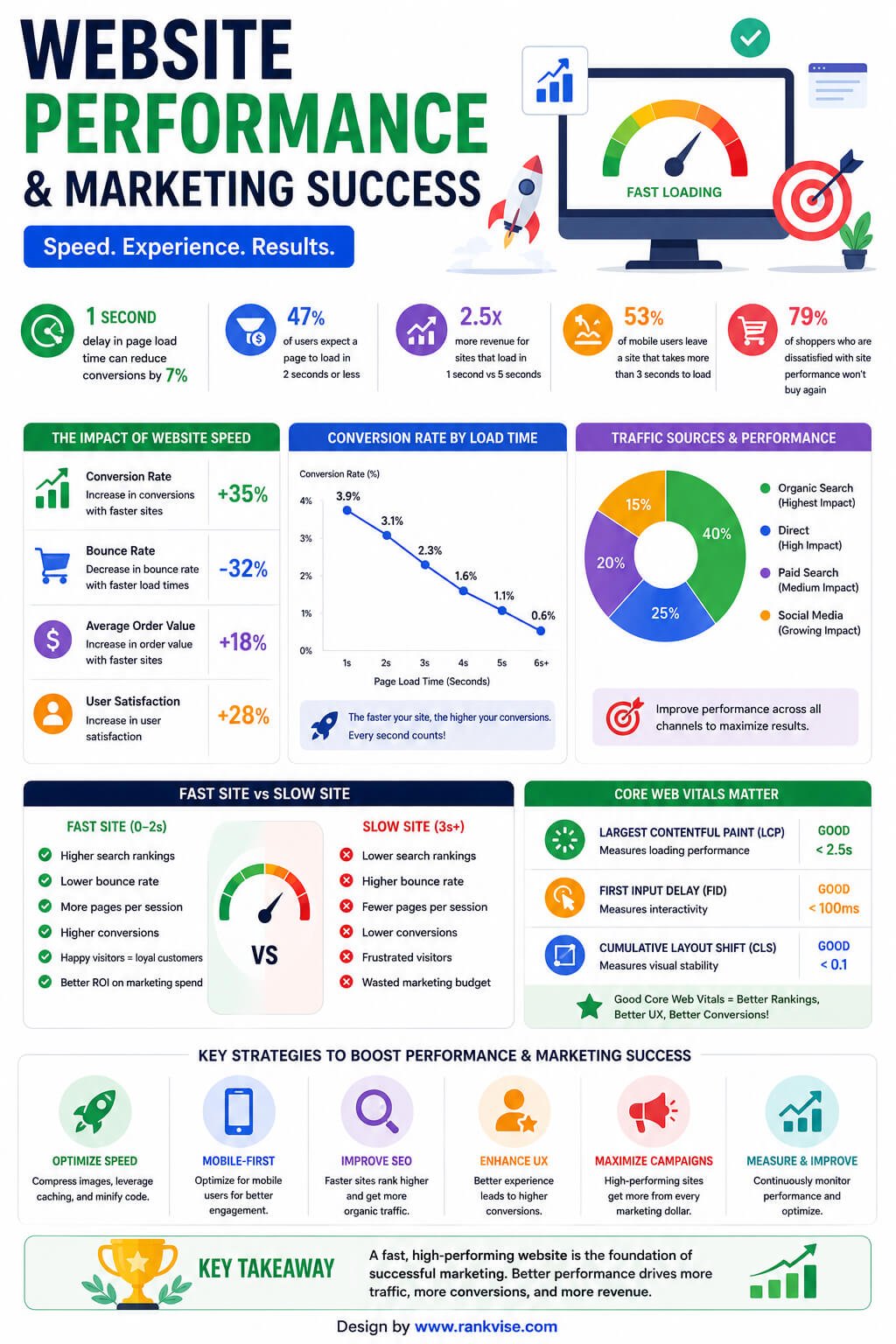
Website speed optimization helps users reach the right information faster. This simple improvement can have a major business impact.
People expect websites to load quickly. When pages take too long, visitors often leave before reading your message. That means fewer leads, fewer sales, and higher wasted ad spend.
Speed also shapes first impressions. A fast website feels reliable, modern, and professional. A slow website can make even a strong brand look less trustworthy.
Key areas that affect website speed include:
- Large image files
- Heavy scripts
- Poor hosting
- Too many plugins
- Unoptimized code
- Slow server response
- Unused tracking tags
For example, an ecommerce brand may spend heavily on paid ads. If product pages load slowly, shoppers may abandon the site before viewing prices. Better website performance helps that same ad budget produce more revenue.
How Does Better Website Performance Support SEO?
Better website performance supports SEO by improving how users and search engines experience your site. Search engines want to recommend pages that are useful, fast, and easy to access.
Search engine rankings depend on many factors. Content quality, backlinks, search intent, and technical health all matter. Website performance supports these factors by making pages easier to crawl, load, and use.
A fast, stable website can help reduce bounce rates and increase engagement. These user signals can support better visibility over time. Strong performance also helps search engines access your pages more efficiently.
Important SEO performance factors include:
- Fast page loading
- Mobile-friendly design
- Clear site structure
- Secure browsing
- Stable page layout
- Easy internal linking
- Accessible content
Better website performance will not replace strong content. However, it helps your content compete more effectively.
What Role Does User Experience Play in Digital Marketing Success?
User experience decides whether visitors stay, explore, and take action. It connects website performance with real marketing outcomes.
A visitor may arrive from Google, LinkedIn, Instagram, or an email campaign. Once they land on your site, they need a clear path forward. They should understand what you offer and what to do next.
Good user experience removes friction. It makes decisions easier. Visitors can compare services, read proof, submit forms, or complete purchases without confusion.
Common user experience issues include:
- Crowded page layouts
- Hidden contact details
- Confusing menus
- Hard-to-read text
- Weak calls to action
- Slow mobile pages
- Forms with too many fields
Better website performance creates a smoother journey. This helps visitors focus on your offer instead of fighting the website.
What Does a Good Website Experience Look Like?
A good website experience feels simple, fast, and helpful. Users should not need to think too hard.
Strong website experiences usually include:
- Clear headlines
- Fast-loading pages
- Simple navigation
- Helpful visuals
- Direct calls to action
- Trust signals
- Easy forms
For a service business, this could mean a clear “Book a Consultation” button on every key page. For an online store, it could mean fast filters, clear product images, and a simple checkout.
How Can Better Website Performance Increase Conversion Rates?
Conversion rate optimization focuses on getting more visitors to take action. Better website performance supports this goal by reducing delays, confusion, and frustration.
A conversion may mean different things for different businesses. It could be a purchase, demo request, phone call, quote form, newsletter signup, or account registration.
Small website improvements can create meaningful gains. Faster landing pages can reduce drop-offs. Clear buttons can increase clicks. Shorter forms can increase submissions.
Here is how performance affects conversions:
| Performance Area | Marketing Impact | Business Result |
|---|---|---|
| Faster loading | Fewer visitors leave early | More leads and sales |
| Mobile usability | Easier browsing on phones | Higher mobile conversions |
| Clear navigation | Faster decision-making | More page views and actions |
| Stable layout | Less frustration | More trust and engagement |
| Simple forms | Lower effort for users | More enquiries and signups |
For example, a B2B company may drive traffic to a whitepaper landing page. If the page loads slowly and the form asks for too much information, users may leave. Improving speed and simplifying the form can increase qualified leads.
Why Is Mobile Website Performance So Important?
Mobile website performance is critical because many users discover brands on mobile devices. They search, compare, click ads, read emails, and browse social media on their phones.
A desktop site may look perfect in the office. Yet customers may experience something very different on a mobile connection. If buttons are too small or pages load slowly, users may leave fast.
Mobile users often act with clear intent. They may want directions, prices, reviews, product details, or quick contact options. Better website performance helps them complete these tasks without delay.
Mobile performance improves when businesses focus on:
- Responsive design
- Compressed images
- Short forms
- Clear tap targets
- Fast checkout
- Click-to-call buttons
- Simple page layouts
In local marketing, mobile performance can directly affect calls and store visits. A restaurant, clinic, agency, or repair service can lose leads if mobile pages are slow or hard to use.
How Does Website Performance Improve Paid Marketing ROI?
Paid marketing works best when landing pages support the promise made in the ad. If users click an ad and reach a slow page, campaign performance suffers.
Every paid click has a cost. Poor website performance wastes that cost by losing visitors before they convert. Better website performance helps more paid traffic become measurable results.
Landing page performance affects:
- Cost per lead
- Cost per sale
- Ad quality
- User engagement
- Form completions
- Checkout completion
- Return on ad spend
Imagine a company running ads for a limited-time offer. The ad copy may be strong, and the targeting may be accurate. But if the landing page takes too long, interested buyers may leave. The problem is not the ad. The problem is the experience after the click.
Better landing page performance creates a stronger connection between attention and action.
How Does Performance Build Customer Trust?
Website performance influences trust before users read your full message. People judge businesses quickly online.
A fast, clean, secure website feels credible. A slow, broken, or unstable website creates doubt. Visitors may wonder whether the company is active, reliable, or safe to buy from.
Trust matters across every digital marketing goal. Users need confidence before sharing contact details or payment information.
Performance-related trust signals include:
- Secure HTTPS pages
- Fast checkout
- Working forms
- Clear contact details
- Consistent branding
- No broken links
- Smooth page loading
For professional services, trust can decide whether someone books a call. For ecommerce, trust can decide whether someone completes payment. Better website performance supports both outcomes.
What Website Performance Metrics Should Marketers Track?
Marketers do not need to become developers. However, they should track performance metrics that connect to business results.
The goal is not to chase perfect technical scores. The goal is to improve the user journey and campaign outcomes.
Useful website performance metrics include:
- Page load time
- Bounce rate
- Conversion rate
- Average session duration
- Mobile conversion rate
- Form abandonment rate
- Cart abandonment rate
- Landing page speed
- Core Web Vitals
These metrics help teams find weak points. For example, high traffic with low conversions may show a landing page issue. High mobile bounce rates may show poor mobile website performance.
The best approach combines performance data with marketing data. This helps teams understand both what happened and why it happened.
How Can Businesses Improve Website Performance Without Overcomplicating It?
Businesses can improve website performance by starting with high-impact fixes. You do not need to rebuild the entire website first.
Start with the pages that matter most. These usually include your homepage, service pages, product pages, checkout pages, and campaign landing pages.
Practical steps include:
- Compress large images before uploading them.
- Remove unused plugins and scripts.
- Improve hosting if server response is slow.
- Make mobile layouts easier to use.
- Reduce form fields where possible.
- Add clear calls to action.
- Fix broken links and errors.
- Test landing pages before campaigns launch.
This approach keeps performance work tied to business value. It also helps teams avoid technical projects that do not improve marketing results.
Which Pages Should You Optimize First?
Focus first on pages with high traffic or high commercial intent. These pages have the biggest impact on digital marketing goals.
Priority pages often include:
- Paid ad landing pages
- Product category pages
- Top SEO pages
- Lead generation pages
- Pricing pages
- Contact pages
- Checkout pages
Improving these pages can produce faster results than fixing low-traffic pages first.
How Do Content and Website Performance Work Together?
Content attracts attention, but performance helps keep it. Both need to work together.
A helpful blog post may rank well and bring qualified visitors. Yet slow loading, poor layout, or intrusive pop-ups can reduce engagement. Users may leave before reaching your call to action.
Better website performance helps users read more content and explore related pages. It also supports internal linking, lead magnets, and newsletter signups.
Strong content performance depends on:
- Clear formatting
- Fast page loading
- Readable fonts
- Helpful headings
- Relevant internal links
- Clean design
- Strong calls to action
For example, a software company may publish comparison guides to attract buyers. If those guides load quickly and link to demo pages, they can support lead generation. If they load poorly, the content may fail to convert interest into pipeline.
How Can Better Website Performance Support Long-Term Growth?
Better website performance supports long-term growth by improving every stage of the customer journey. It helps people discover, trust, compare, and choose your business.
Marketing costs continue to rise in many industries. This makes website efficiency more important. When your site converts more visitors, you can get more value from the same traffic.
Performance improvements also compound over time. Faster pages can support better SEO. Better mobile usability can increase conversions. Stronger user experience can improve repeat visits and referrals.
In practical terms, better website performance helps businesses:
- Lower wasted traffic
- Improve campaign ROI
- Increase qualified leads
- Support organic growth
- Build stronger trust
- Improve customer satisfaction
- Turn more visits into revenue
A website should not only look good. It should support measurable business goals.