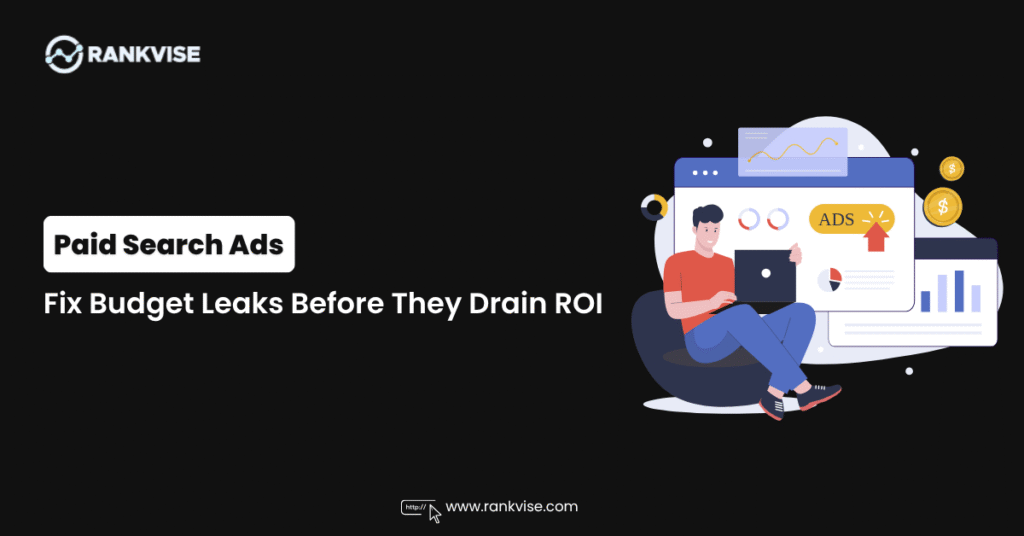
Paid traffic can look successful right up until someone asks the ugliest question in the room: “So… where did the money go?”
- Protect budgets by fixing conversion tracking and sending qualified, backed by CRM events so algorithms learn from real revenue, not cheap form fills.
- Map keywords and creative to buyer intent, giving each group a clear role and optimizing for awareness, qualified leads, booked calls, or purchases.
- Use decision rules and reports that follow spend to pipeline and revenue; cut weak signals, protect high value winners, and tie tools to CRM data.
The dashboard looks busy. Clicks are moving. Impressions are climbing. Conversions are noticeable as well. Then sales checks the leads, and the mood changes. Some of them are curious, but nowhere near ready to buy. Some look like they filled out the form just to see what would happen.
This is why marketers need to check for AI pattern blindness in campaign data before trusting the next budget move. A report can look polished and still point your budget in the wrong direction.
Weak signals hide inside lazy tracking, broad targeting, shallow conversion goals, and vanity metrics. The job is not to collect more numbers. The job is to know which numbers deserve your trust before the platform spends more money chasing the wrong people.
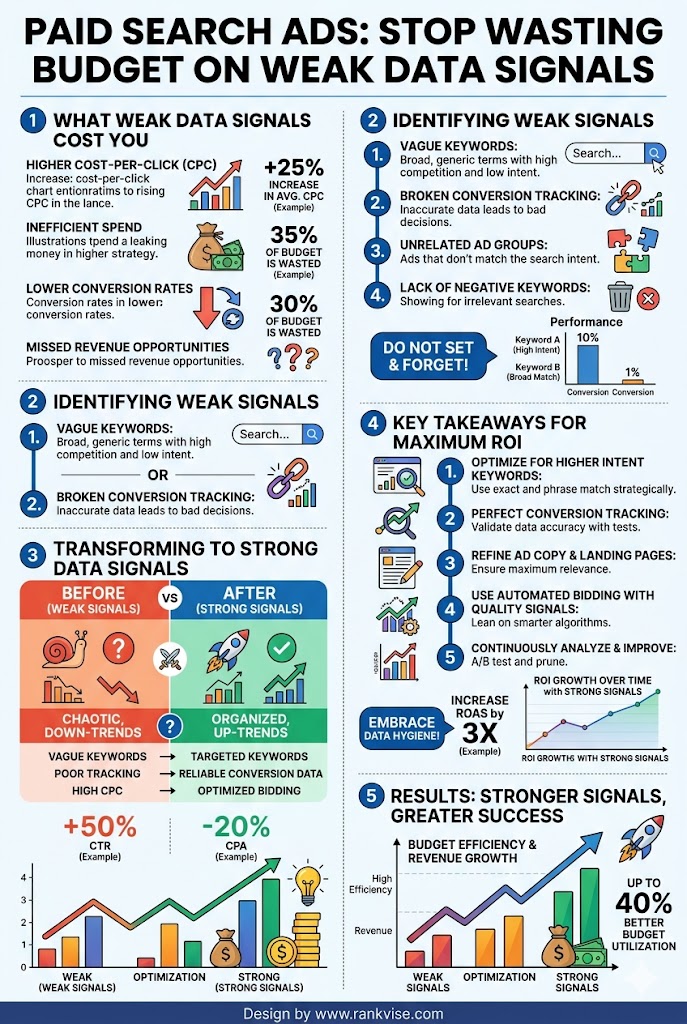
Budget waste starts with one weak signal
Most campaigns do not fail in one dramatic scene. They leak through small assumptions that nobody questions early enough.
A form fill gets counted as a win. A click gets treated like a serious interest. A cheap lead looks good because nobody checks whether that person ever became a real sales opportunity. One keyword keeps spending high because the platform says it performs well, even though the strongest buyers come from somewhere else.
That is how weak data becomes expensive. The campaign is trained on the wrong definition of success.
Ad platforms learn fast, which sounds helpful until you feed them bad inputs. If every demo request is marked as equally valuable, the system cannot tell the difference between a serious buyer and someone who wrote “asdf” in the company field.
The algorithm sees a conversion. It finds more people likely to do the same thing. Congratulations, your campaign now has a talent for collecting nonsense.
A better setup starts with a simple question: what action should this campaign optimize for?
Before you scale the budget, define the goal:
- Traffic if the campaign is built for awareness
- Qualified leads if sales follow-up matters
- Booked calls if the offer needs a conversation
- Purchases if the path to revenue is direct
- Pipeline or revenue, if your CRM can send that data back
This sounds obvious. It is also where many paid campaigns go sideways. If the campaign is asked to find cheap leads, it will find cheap leads. If it is asked to find future customers, the tracking has to prove what a future customer looks like.
Clicks can lie
Clicks stack up and make the campaign look alive. Still, a click only means someone was curious enough to tap. It does not mean they understood your offer, had a budget, matched your audience, or planned to buy anything this decade.
This is where teams get fooled, especially when a keyword or ad brings a healthy click-through rate.
Say, you sell project management software for agencies. A keyword like “free content calendar template” could bring plenty of traffic. People love free templates. People also love free snacks at conferences. Neither proves they want to buy software.
Intent matters more than raw activity. A search for “how to organize marketing tasks” sits in a different mental place than “agency project management software pricing.” Both can belong in your funnel, but they need different goals and different judgment.
Map keywords by intent before scaling spend:
- Problem-aware searches: users know the pain, but may not know the solution yet.
- Solution-aware searches: users compare options, methods, tools, or services.
- Purchase-aware searches: users ask about price, demos, reviews, or alternatives.
- Brand and competitor searches: users may already be close to choosing.
This gives each keyword group a clear role. Early-stage keywords can build remarketing pools or capture soft interest. Bottom-funnel terms need harder proof, like qualified leads, booked calls, trials, purchases, or revenue.
Once every keyword group has a job, the report becomes easier to read. You stop judging every click by the same standard, and you stop punishing useful early-stage traffic for not behaving like a ready-to-buy lead.
Fix conversion tracking before you move on to bids
Bid changes are tempting because they feel active: raise this, lower that, pause the ugly number… The problem is, bid changes cannot rescue bad conversion tracking.
If your campaign treats a newsletter signup, a chatbot click, a demo request, and a purchase as equally valuable, optimization is already compromised. The platform will chase the easiest signal, and easy rarely means profitable.
Start by separating primary conversions from secondary signals. Primary conversions should represent actions worth optimizing toward. Secondary signals can still help you understand behavior, but they should not steer bidding unless they strongly predict revenue.
For lead generation, basic form submissions are not enough. You need to know which leads became qualified, which reached sales, which entered the pipeline, and which became customers. That means connecting ad platforms to your CRM or importing offline conversions when possible.
A simple lead quality layer can make a huge difference. Score leads by fit, budget, urgency, location, company size, or service need. Then send the stronger events back into the ad platform, so the system learns from better examples.
Use a conversion audit before changing bids:
- Which actions are marked as primary conversions?
- Which actions only show interest, not buying intent?
- Which conversion events connect to CRM or sales data?
- Which campaigns bring leads that sales accepts?
- Which “winning” campaigns look worse after revenue is checked?
This is the boring work nobody puts in a flashy case study. It is also where a lot of wasted spend dies.
Paid social media ads need different signal rules
Search captures demand that already exists. Social usually interrupts someone who was doing something else.
That difference changes how you read performance.
On social, a click may come from curiosity rather than buying intent. A high engagement rate may show that the creative is entertaining, not that the audience is ready to act. A funny ad can attract the wrong crowd with impressive efficiency. Very charming. Very expensive.
Social data becomes useful when it connects creative angles to buyer behavior:
- Which problem makes people stop scrolling?
- Which proof gets qualified clicks?
- Which offer brings serious leads?
- Which message attracts people who never convert?
Track performance by creative theme. One ad can fail because the hook is weak, but the pain point behind it may still deserve another test. Another ad can win on clicks and fail on lead quality because the promise is too broad.
Creative fatigue also matters. A drop in performance may mean the audience has seen the same visual too many times. The offer may still be fine.
Watch frequency, conversion rate, and cost per meaningful action together. One number alone will make you dramatic. Connected numbers will make you useful.
Better reporting should follow the money
Your reporting should not stop at the conversion column. That is where too many campaigns become fiction.
Good paid ads analytics connects spend to what happens after the click. The view should follow the path from keyword or audience to landing page behavior, conversion action, lead quality, sales outcome, and revenue.
That path reveals patterns platform dashboards often hide. Maybe one campaign has a higher cost per lead but produces buyers. Maybe another looks efficient because it collects cheap form fills from people sales would rather never meet. Maybe mobile traffic converts well on paper but rarely closes. Maybe one location burns money because users can click, but they cannot actually use your service.
This is also how you avoid panic optimization. Without deeper reporting, teams overreact to normal swings. A strong campaign has a quiet week, so someone cuts the budget. A weak campaign gets one lucky day, so someone celebrates it as if they have figured it all out.
A useful report should answer four things:
- Are we reaching people who match the business goal?
- Are they taking an action that shows their intent?
- Does that action create a pipeline or revenue?
- What should we change, protect, or stop?
That is enough. Everything else can earn its place.
Choose tools that reduce guesswork
The best paid social media tools help you make sharper decisions. They do not bury the team under rainbow charts and call it insight.
Look for platforms that connect creative, audience, spend, and post-click behavior. You want to see which message worked, who responded, and what happened after the click. Bonus points if the tool connects with your CRM, tracks experiments, monitors budget pacing, and gives stakeholders a report they can understand.
Be careful with automated recommendations. A suggestion to increase the budget can make sense only when the campaign is optimizing for the right outcome. If the signal is weak, automation scales the problem faster.
Before adding another tool to the stack, ask:
- Will it show lead quality, not only lead volume?
- Can it connect ad performance to CRM or revenue data?
- Does it help compare creative angles?
- Can non-media stakeholders understand the report?
- Does it reveal patterns you cannot already see?
A useful tool reduces guesswork. A weak tool decorates it.
Best paid social ads begin with a clear hypothesis
Before launch, know what you are testing. A pain point. A proof point. A visual style. A price angle. A testimonial. A use case. One main idea, not seven changes shoved into the same test and called a strategy.
Messy testing creates muddy learning. If you change the audience, headline, image, offer, and landing page at once, performance might improve, but you will not know why. That makes the next decision harder.
Strong ads also filter. This part gets ignored because marketers love big numbers. A good ad should attract the right people and repel poor-fit users.
Platform context matters, too. LinkedIn can handle more business details. Meta often needs a stronger visual hook. Short-form video needs speed and clarity. Still, the main rule holds: the creative should qualify attention, not collect attention from anyone with a thumb.
When ads are built from a real hypothesis, results become easier to read. A failed test can still teach you something. A random ad that fails just wastes your afternoon.
Study competitors for signals only
People love looking for the best ads on social media because competitor research feels productive. Fair. It can teach you a lot.
Copying the surface usually teaches you less.
You do not know their targeting, budget, funnel, audience maturity, or lead quality. You only see the hook, format, offer, and maybe the landing page if you click through and feel nosy in a professional way.
The smarter move is to reverse-engineer the strategy. Look at what the ad is trying to prove.
Study competitor ads through questions like these:
- What problem does the ad lead with?
- What belief is it trying to change?
- What proof does it use?
- What objection does it answer?
- What action does it ask for next?
This turns ad research into signal research because you are looking for patterns in buyer attention.
Decision rules save the budget faster than opinions
Before a campaign goes live, agree on action rules. If a search term spends a certain amount without a qualified conversion, review it. If a lead source produces poor sales feedback for two cycles, reduce spend or change targeting. If frequency climbs and conversion rate drops, refresh creative. If one keyword produces revenue, protect it before expanding into weaker terms.
This removes some emotion from optimization. The team is no longer arguing from vibes. You made the rule while calm, so you can act when the numbers get messy.
Set rules for moments like these:
- A keyword spends past its test limit with no qualified action.
- A campaign brings cheap leads that sales keeps rejecting.
- A creative angle gets clicks but no meaningful follow-through.
- A landing page converts, but the resulting leads do not progress.
- A high-value segment starts showing stronger revenue signals.
Good paid media management is part analysis, part restraint. You need enough discipline to cut weak signals and enough patience to let strong signals prove themselves.
To wrap it up
Paid campaigns rarely waste budget because one setting is wrong. The bigger problem is trust. Teams trust clicks that do not show intent, conversions that do not show quality, and dashboards that stop before revenue enters the story.
Stronger data changes the whole rhythm of paid advertising. You stop feeding platforms weak signals. You stop scaling campaigns because the top-line report looks cheerful. You start asking what each number proves, what it hides, and what decision it supports.
Better tracking helps the algorithm learn from stronger outcomes. Smarter reporting shows which campaigns create business value. Sharper testing makes creative work braver and less random.
Paid traffic will always involve risk, but it should not feel like tossing money into a fog machine. When your signals are reliable, your budget has somewhere smarter to go.