An effective nonprofit web site is important in assisting organizations to connect with supporters, donors and societies using search engines. Most nonprofits pay much attention to storytelling and mission and neglect the technical and structural aspects that define the ease with which their content may be found online. Search engines are based on clear organization, logical navigation, and well connected pages to comprehend what a web site provides. With no such structure, the most necessary content can be concealed behind the scenes of the people who will require it the most.
The initial step in enhancing search visibility is to understand the interaction between users and search engines to a site. The visitors desire to get information in a fast and intuitive manner, whereas search engines strive to index pages in an efficient way and to match them with the queries. A nonprofit site that fulfills both demands will be better in search engines and will result in a more fluid experience to the user. Structural planning is the key to any other online endeavor.
Importance Of Clear Site Architecture
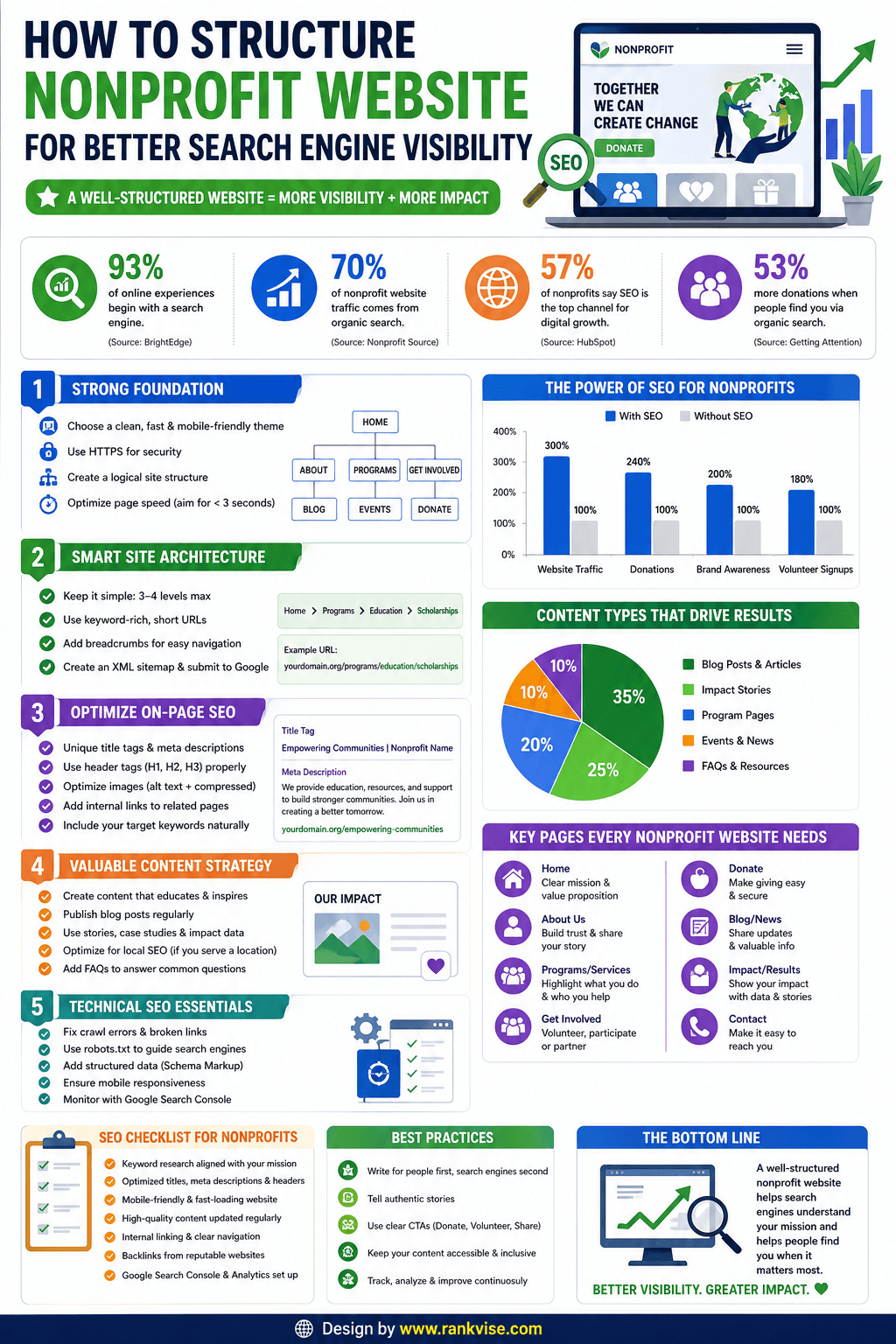
It is necessary to have a clear site architecture that will direct both the users and the search engine through a nonprofit site. It entails grouping of the pages into rational themes, which express the mission and services of the organization. A straightforward hierarchy enables the visitors to navigate between general information and specifics without getting mixed up. As an example, pages about programs, donations, and volunteer opportunities should be organized in a manner that is logical and intuitive.
In search terms, structured architecture aids in searching and indexing the content using the search engines more efficiently. Relationships between the pages will indicate relevance and importance when the pages are related in a coherent manner. This will enhance the chances of key pages being shown in search results. An unorganized Web site that has poorly arranged or disjointed pages may result in decreased visibility and lost chances to attract supporters.
Role Of Navigation In Search Visibility
Navigation menus are a road map to the users and are important in the way the search engines will see a site. A nonprofit is to make sure that the main navigation has such key pages as About, Programs, Get Involved, and Donate. They ought to be conveniently situated and displayed on every page. Easy navigation will eliminate frustration and ensure visitors spend more time on the site.
Navigation helps search engines to know which pages are most critical. The importance of a specific page is weighted when it is linked in the menu. This can enhance their position in search engines. Moreover, proper navigation helps to make users want to visit more than one page and this may help decrease bouncing rates and enhance the performance of the site.
Use Of Logical Page Hierarchy
A logical page structure involves grouping the content that has broad topics to narrow subtopics. In the case of nonprofits, it could be a description of what the organization does as a whole and then further break it down into individual programs or initiatives. The hierarchy levels must be well laid out and easily understandable. This design can ensure that the users easily access the information they seek without becoming overwhelmed.
Hierarchical organization is an advantage to search engines since it helps to identify the relationships among pages. When the content is organized in a logical manner, it becomes simpler to define the central pages and the ones that contain supporting information. This apparently can result in increased indexing and higher rankings in searches. The presence of a properly organized hierarchy also makes sure that no valuable content is crammed too far down the site.
Importance Of Optimized URLs
The URLs are neglected and they contribute greatly towards the visibility of search engines. Descriptive and clean URLs can assist users and search engines to comprehend what a page contains. In the case of a nonprofit, URLs such as example.org/community-programs are much more effective than random sequences of numbers or letters. It affords instant context and enhances credibility.
Better indexing and ranking is also served by optimised URLs. Search engines like URLs containing relevant keywords and are based on the site structure. The similarities in the structure of the URLs on all the pages provide consistency in the whole structure of the site. This minor detail may make a significant contribution to the ease at which the content is found.
Creating Strong Internal Linking
Internal linking is used to connect pages on a nonprofit site and direct the users to related information. Such a practice does not only enhance the navigation, but also decentralizes power in the site. As an example, their blog post on a recent event can be linked to the donation page or a program overview. Such links stimulate the users to browse more and act.
On the search engine front, internal links aid in building relationships between pages. They show what content is most significant and the way various subjects are related. The reason is that a powerful internal linking strategy will enable the search engines to effectively crawl the whole site. It also enhances the likelihood of key pages appearing higher in the search results.
Content Organization And Categorization
Categorizing the content into distinct sections facilitates the user to find the information he or she wants. Website design for nonprofits may include a variety of content including program information and impact stories and news. Breaking these down into specific sections can make them easier to understand and avert confusion. Each group is supposed to have a specific objective and be in line with the general mission.
Search engines depend on the arrangement of the content to comprehend what a site is focused on. In case pages are clustered into meaningful groups, then it would become easy to group them with user queries. Full categorization also makes it possible to create category pages which can rank on more general search terms. This increases the coverage of the web and draws more people.
Importance Of Mobile Friendly Design
The modern search visibility requires a mobile friendly web site. Nonprofit websites are accessed by many users via smartphones and tablets and search engines favor mobile optimized websites in their ranking. A responsive design makes sure that the content on the screen changes according to the size of the screen without becoming inactive or unreadable.
User experience is also enhanced through mobile optimization that ensures that navigation and interactions are smooth. The more convenient the site is on their device, the more the visitors would have a reason to remain on the site. This enhanced interaction is a sign to search engines that the site is valuable. Mobile considerations in creating websites in the nonprofit sector is no longer an option, but an essential necessity.
Page Speed And Performance Considerations
User experience and search rankings are directly affected by page speed. Long page loading may annoy the visitors and may make them exit the site even before they can interact with the material. Images should be streamlined, code simplified and redundant features eliminated by nonprofits to make the loading times quicker.
Page speed is a ranking factor used by search engines and is therefore a must to be visible. Quick websites stand a better chance of ranking higher in the search ranking. Performance optimization increases accessibility as well to those with limited internet connections. With the focus on speed, nonprofits could reach out to more people and maintain the attention of visitors.
Use Of Structured Content And Headings
Organized information assists users and search engines to interpret the information on a page. Clearly defined headings to split content into parts enhance readability and direct the visitor through the content. Every heading must be related to the subject of the paragraph and serve to add to the flow.
Search engines use headings to find out the relevancy of the content. Properly organized pages that have definite headings are easier to index and rank. This also enables nonprofits to bring out the important messages and that important information is not lost. The regularity of headings increases the ease of use as well as the search ability.
Importance Of Accessible Design Practices
The issue of accessibility is a significant factor in the structure of the site that has a direct effect on user experience. There are many audiences that can be served by nonprofits, and people with disabilities are one of them. Enabling the site to be user-friendly by use of such features as legible fonts, alternative text to pictures and keyboard navigation makes the site more inclusive.
Search engines identify websites that are available as being of high quality and friendly. Best practices in search optimization are often in line with accessibility. Inclusive design will allow the nonprofits to attract a broader range of people, as well as enhance their visibility in the search. This is a practice of integrity and business excellence.
Role Of Metadata In Search Optimization
Metadata is important details about each page to search engines. These are the titles and descriptions that are displayed in search results. In the case of nonprofits, articulating distinct and strong metadata can help a great deal when it comes to enhancing click through rates. Metadata on every page needs to be different and reflect the content of that page.
Metadata is what search engines rely on to interpret the context of the page and how the page can be important to the user queries. Titles and descriptions: This is well written, which increases the chances of showing up in search results. They also motivate users to check out the site by giving them a clear preview of what they will see. Regular metadata helps in improving the overall search performance.
Integration Of Relevant Keywords
Search engine visibility is a highly important factor that depends on the wise use of keywords. Nonprofits ought to determine the words that their audience would be searching and use them in a natural manner. This contains headings, body text and URLs where necessary.
The excessive application of keywords may be detrimental to the readability and credibility. Rather, the emphasis should be on making quality content that meets the intent of the user. The search engines are now much more sophisticated and they are quality conscious rather than being quality repetitive. The balance in the incorporation of keywords makes the content exciting and at the same time discoverable.
Regular updates and content freshness
To ensure search visibility, it is important to keep the content updated. Nonprofits ought to frequently update and revise their pages so they are accurate and relevant. This can be updating the information about the programs, new success stories or updating the old information.
Search engines prefer those websites that show that they are active. A site that is updated indicates that it is dynamic and useful. Consistent updates are also a chance to focus on new keywords and increase coverage. The promise of content maintenance contributes to maintaining long-term visibility and engagement.
Monitoring Performance And Making Improvements
Tracking the performance of websites enables nonprofits to know what is working and what should be improved. Traffic-monitoring, user behavior, and search ranking tools are informative. Through this data analysis, organizations will be able to determine some of the pages that receive the highest number of visitors and those that require improvement.
Ongoing enhancement is one of the most important factors to ensure good search visibility. Performance-driven modifications may improve the experience of the users and make them more engaged. This may consist of perfecting navigation, updating, or enhancing the technical side of the site. Being proactive will make sure that the site is effective in accessing the audience.