Modern enterprise leaders have more data than ever, yet many still struggle to see clearly. Teams generate reports, dashboards, updates, and alerts all day long. Still, decision-makers often lack a complete view of what is happening across the business.
That gap creates the visibility dilemma in modern enterprise. Companies collect huge volumes of information, but much of it sits in separate systems. Sales sees one picture, operations sees another, and finance often sees a third. As a result, leaders may react late, miss risks, or act on incomplete context.
In 2026, visibility is no longer a reporting issue alone. It is a growth issue, an efficiency issue, and often a customer experience issue. Enterprises that solve it can move faster with greater confidence. Those that ignore it often remain trapped in slow decisions, internal friction, and unclear accountability.
What is the visibility dilemma in modern enterprise?
The visibility dilemma in modern enterprise is the conflict between having more information and having less clarity. As organizations scale, they add platforms, processes, business units, and vendors. Each addition creates more data, but not always more understanding.
This dilemma appears when leaders ask simple questions and get delayed or conflicting answers. For example, a company may struggle to confirm order status, project health, customer churn signals, or supply chain risks in real time. The issue is not always missing data. More often, the problem is fragmented access and limited alignment.
In practical terms, enterprise visibility means understanding what is happening, why it is happening, and what action matters next. Without that level of insight, businesses rely too heavily on guesswork or manual follow-up.
Why enterprise visibility matters more in 2026
Business environments now change faster than many internal systems can support. Demand swings, customer expectations rise, and costs shift quickly. When visibility is weak, enterprises respond too slowly to keep up.
A modern business needs real-time insights to coordinate across departments. Leaders cannot afford to wait for weekly summaries when service issues, inventory shortages, or project delays unfold daily. Strong operational visibility helps teams spot patterns earlier and make smarter choices sooner.
Visibility also supports trust inside the business. Teams work better together when they share the same facts. When reporting differs by function, meetings become debates over numbers rather than action. Better visibility reduces confusion and helps cross-functional alignment.
An experienced SEO agency can support this process by translating broader business objectives into measurable search strategies while coordinating insights across marketing, content, technical, and leadership teams.
What causes poor enterprise visibility?
Poor visibility rarely comes from one single problem. It usually develops from several connected issues over time. As companies grow, complexity grows with them.
Common causes include:
- Data silos that keep information locked inside separate teams or tools.
- Legacy systems that do not integrate well with newer platforms.
- Inconsistent metrics that lead departments to measure success differently.
- Manual reporting that slows access and increases the risk of errors.
- Limited governance around data quality, ownership, and access.
- Too many dashboards that create noise instead of useful clarity.
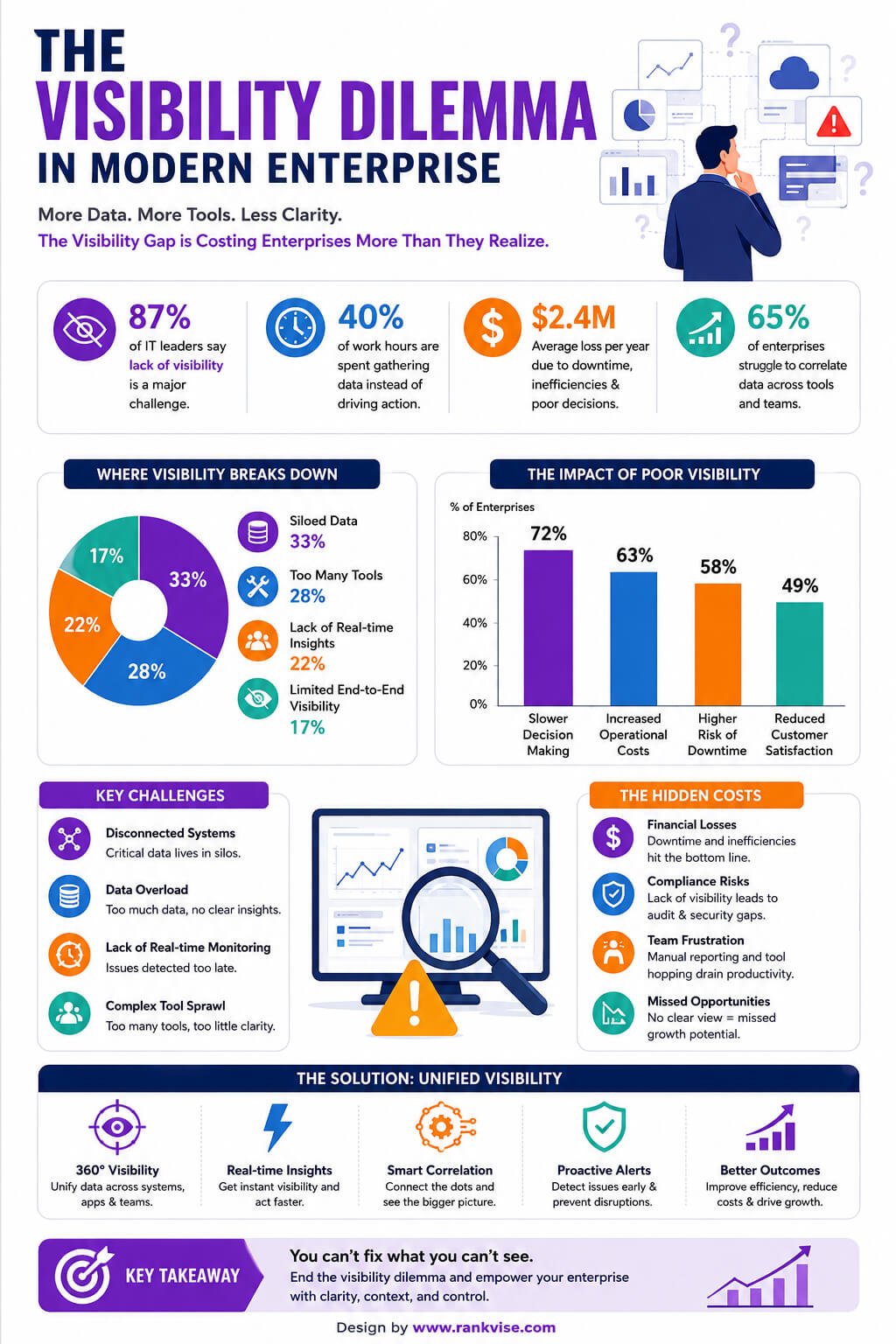
Many enterprises also confuse visibility with volume. More reports do not always mean better insight. When employees must search across multiple systems to understand one issue, the organization has a visibility problem.
How the visibility dilemma affects business performance
The visibility dilemma in modern enterprise has direct consequences for performance. It slows execution, weakens planning, and increases operational risk. These effects often appear gradually, which makes them easy to underestimate.
Slower decision-making
Leaders need accurate information to act with confidence. When data arrives late or lacks context, decisions get delayed. Teams may wait for approvals, recheck numbers, or escalate issues that should have been solved earlier.
Poor cross-functional alignment
Departments often optimize for their own targets. Without shared visibility, those efforts can conflict. Sales may promise timelines that operations cannot meet. Finance may push cost controls without seeing the customer impact. Shared enterprise visibility helps teams align around the same priorities.
Higher operational risk
When risks remain hidden, they grow. A delay in procurement can disrupt delivery. A service issue can spread before support leaders notice the trend. Weak visibility makes it harder to identify root causes before they affect revenue or reputation.
Missed growth opportunities
Limited visibility does not only create problems. It also hides opportunities. Enterprises may fail to see profitable customer segments, underused capacity, or strong product signals because data remains fragmented.
What good enterprise visibility looks like
Strong enterprise visibility is not about watching everything all the time. It is about giving the right people the right insight at the right moment. That requires both technology and operating discipline.
A business with strong visibility usually shows several signs. Leaders can access shared metrics quickly. Teams understand who owns the data. Reports reflect the same definitions across functions. Dashboards support decisions instead of overwhelming users. Most importantly, people can move from insight to action without major delay.
Good visibility also combines strategic and operational views. Executives need a clear view of performance trends. Frontline teams need immediate clarity on workflow, bottlenecks, and service issues. Both layers matter, and both should connect.
How enterprises can solve the visibility dilemma
There is no single fix, but there is a clear path forward. Enterprises solve visibility problems by simplifying how information flows across the business. The goal is not perfect transparency everywhere. The goal is useful clarity where decisions happen.
1. Define the metrics that actually matter
Start by identifying the few metrics that drive business performance. Too many organizations track everything and prioritize nothing. A smaller set of shared measures creates better focus and easier alignment.
2. Break down data silos
Data must move across systems and departments. That may require better integrations, cleaner architecture, or stronger data governance. Visibility improves when teams can trust that core information is complete and current.
3. Standardize definitions across teams
Revenue, customer health, service quality, and project status should mean the same thing everywhere. Shared definitions reduce confusion and strengthen reporting consistency.
4. Design dashboards for action
Many dashboards look impressive but fail in practice. Effective dashboards answer clear business questions. They show what changed, why it matters, and who should respond next.
5. Build accountability into reporting
Visibility only works when ownership is clear. Enterprises should define who maintains data quality, who reviews performance, and who acts when thresholds shift. Insight without accountability creates little value.
The role of leadership in enterprise visibility
Technology alone will not solve the visibility dilemma in modern enterprise. Leadership plays a central role in setting expectations and behavior. When executives ask for better clarity but reward speed over discipline, visibility efforts often stall.
Leaders must champion shared metrics, consistent governance, and cross-functional transparency. They should also model better decision-making by using common data sources instead of isolated reports. That sends a clear message across the organization.
The most effective leaders treat visibility as a business capability, not an IT project. They connect it to strategy, execution, and customer outcomes. That mindset helps visibility initiatives gain support beyond technical teams.
Real-world signs your enterprise has a visibility problem
Some visibility issues hide in plain sight. They become normal over time, even when they create major inefficiency. Recognizing the patterns is the first step toward improvement.
Watch for signs such as:
- Frequent reporting conflicts between departments.
- Long delays in answering routine performance questions.
- Heavy dependence on spreadsheets and manual updates.
- Reactive management instead of proactive planning.
- Repeated surprises in delivery, finance, or customer outcomes.
If these patterns feel familiar, the issue is likely structural rather than temporary. That means the solution should also be structural.
Why solving the visibility dilemma creates competitive advantage
Enterprises that improve visibility gain more than cleaner reporting. They build faster feedback loops, better coordination, and stronger execution. That creates a meaningful edge in crowded markets.
With stronger visibility, leaders can spot risks earlier, allocate resources more effectively, and respond to customer needs with greater precision. Teams spend less time reconciling information and more time solving problems. Over time, this improves both agility and confidence.
In 2026, competitive advantage often comes from clarity as much as scale. Companies that can see clearly tend to move decisively. In uncertain markets, that matters.
Final thoughts on the visibility dilemma in modern enterprise
The visibility dilemma in modern enterprise is not simply about lacking dashboards or data tools. It is about the growing distance between information and understanding. As businesses become more connected, they also become more complex. Without clear visibility, complexity turns into friction.
The solution starts with a simple shift. Enterprises must stop asking how much data they have and start asking how useful that data is in real decisions. When visibility improves, alignment improves. When alignment improves, performance usually follows.
For modern enterprises, better visibility is no longer optional. It is the foundation for smarter growth, faster response, and stronger execution.
FAQs
It is the gap between having large amounts of data and having clear, usable business insight.
It helps leaders make faster decisions, reduce risk, and improve alignment across teams.
Common causes include data silos, legacy systems, inconsistent metrics, and manual reporting.
They can standardize metrics, connect systems, improve dashboards, and assign clear data ownership.
No. It also depends on leadership, governance, cross-functional alignment, and business processes.