AEO, SEO, GEO, there are now more acronyms than ever to describe optimising a page for organic visibility. But with so many new acronyms popping up, it’s hard to know how these acronyms actually affect what optimising a website actually mean.
Over the last two years, marketers have started using terms like AEO, GEO, LLMO, and AI SEO to describe how content appears in AI-generated answers.
Even at the time of writing, the terminology is still messy (and confusing), and even within the industry there is no universal agreement on what each label means.
What is clear is that search is moving beyond ten blue links. Google now serves AI Overviews and AI Mode, while Microsoft is surfacing citations across Copilot and Bing’s AI experiences.
What is AEO?
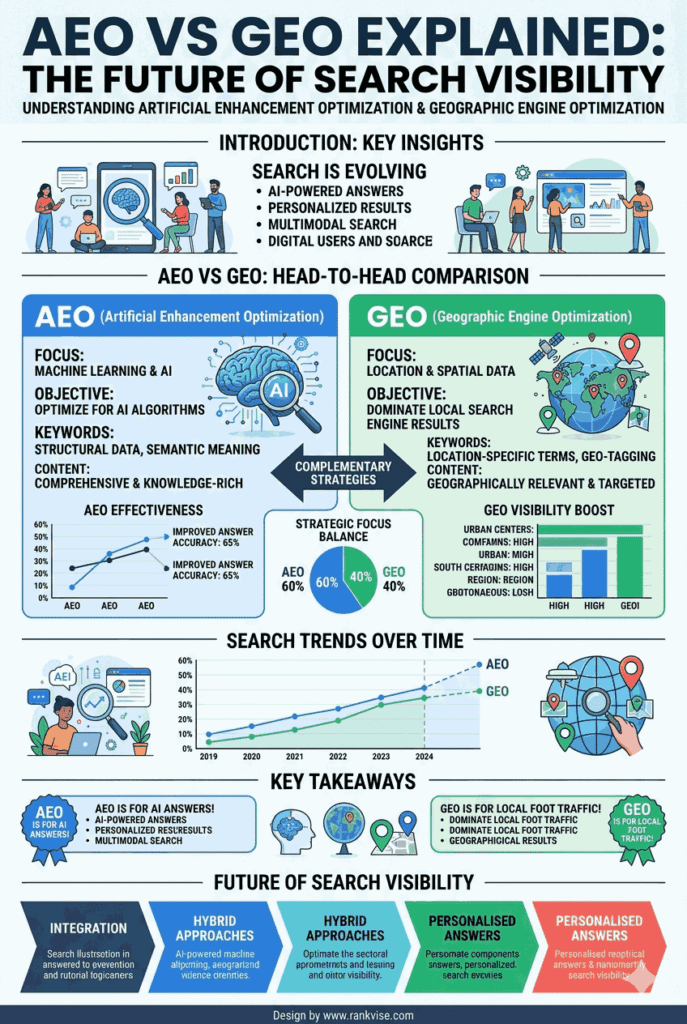
AEO, or Answer Engine Optimization, is usually used to describe content that is easy for search engines and assistants to extract into a direct answer.
Think of AEO as short definitions, clean FAQ sections, concise explanations, and pages that resolve a question quickly.
What is GEO?
GEO, or Generative Engine Optimization, is usually framed more broadly. It is about increasing the chances that your brand, site, or page is cited, mentioned, or used in AI-generated responses that synthesize information from multiple sources.
In practice, that means your content needs to be understandable, quotable, trustworthy, and supported by broader signals around the web.
The temptation is to treat AEO and GEO as two entirely separate disciplines. That is probably the wrong way to think about it.
Should you be replacing your SEO strategy with AEO/GEO?
This is perhaps the most asked question the movement. Should your SEO strategy be focussing on GEO/AEO?
No. AEO and GEO should not replace SEO. They should be viewed as an extension of SEO, not a separate discipline that makes traditional search optimisation irrelevant.
The reality is that most of the fundamentals that drive visibility in AI-generated answers are the same fundamentals that have always supported strong SEO performance: clear site structure, crawlable content, topical depth, strong internal linking, authority signals, and content that directly answers user questions. What is changing is the way that information is discovered and presented, not the need for SEO itself.
According to research from Safari Digital SEO Agency, AI tools and large language models are still contributing less than 1% of conversions across 100 tracked accounts. While the conversion quality from AI-assisted visits appears promising, the traffic volume is still extremely small relative to traditional organic search. That means businesses should be careful not to overreact or divert resources away from proven SEO activity in favour of a channel that remains difficult to measure reliably.
One of the biggest current limitations is attribution. While Google Analytics 4 can show that some visits are coming from AI tools, there is still no reliable way to understand how AI search experiences influence impressions, clicks, assisted conversions, or purchases at scale. Third-party SEO platforms are beginning to introduce their own AEO or GEO visibility reporting, but the data is inconsistent and, at this stage, largely speculative. Safari Digital notes that different tools can produce wildly different estimates for the same brand, making them unreliable as a basis for strategic decision-making.
What does Google say about GEO/AEO?
Google’s official guidance is pretty straightforward: the same foundational SEO best practices still apply for AI Overviews and AI Mode.
There are no extra technical requirements just for AI features. Your pages still need to be crawlable, indexable, helpful, and eligible to show snippets in standard search.
So rather than asking whether you need SEO, AEO, or GEO, the better question is this: how do you create content that works across all three environments?
Step 1: Formatting
If a page cannot answer a question directly, it is unlikely to win snippets, voice responses, or quick AI citations. This is where AEO-style structure helps. Effective SEO copywriting means creating pages that open with a direct answer, then expand with detail, examples, and related subtopics.
Step 2: Content Depth
Generative systems are not just looking for a one-line definition. They often assemble responses from multiple sources. Google says AI Mode breaks queries into subtopics and searches across them simultaneously. That means shallow content may answer the first question but fail on the follow-up questions that AI systems also explore.
Step 3: Credible Signals
The original GEO research found that content with citations, quotations, and statistics was more visible in generative responses. That does not mean stuffing pages with data for the sake of it. It means making your claims easy to trust, easy to verify, and easy to reuse.
Step 4: Off-Page Signals
Traditional SEO often focuses heavily on ranking your page. AI discovery is broader. Generative systems may pull from your website, use brand signals, third-party reviews, editorial mentions, forums, documentation, and public references about your brand. In that sense, AI visibility is partly a content problem and partly a digital authority problem.
This is why the best approach is not to replace SEO with AEO or GEO. It is to build on SEO.
- Strong technical SEO makes content accessible.
- Strong on-page SEO makes topics understandable.
- Strong editorial structure makes answers extractable.
- Strong brand authority makes you more cite-worthy.
For most businesses, the practical playbook is simple:
- Create pages that answer one intent clearly.
- Put the answer near the top. Expand into supporting context.
- Use facts, examples, original observations, and where appropriate, named sources.
- Cover adjacent follow-up questions instead of stopping at a surface-level explanation.
- Make sure the site itself still meets normal search best practices.
The brands that will win in AI search are not the ones chasing the newest acronym. They are the ones publishing content that is easy to extract, hard to misinterpret, and strong enough to be trusted when an engine needs to build an answer.
In other words, AEO and GEO are useful labels. But the real job is still the same: become one of the best sources on the web for the question being asked.