A software category built around this problem grew by an enormous margin in 2026, and the pitch behind most of it is that AI visibility is a brand new discipline requiring brand new tools.
- Ensure AI crawlers can reach and read your HTML: check server logs, robots.txt, bot blockers, JavaScript-rendered content, and CDN rate limits.
- Format for extraction: use question-style headings, answer in first sentences, self-contained paragraphs, lists and tables, and clear schema markup.
- Create quotable substance: publish original data, first-hand tests, named expert authors, clear positions, and visibly updated dates.
- Build corroboration across the web: earn listicle inclusions, review-site presence, trustworthy references, press mentions, and consistent entity details everywhere.
- Measure per engine and over time: track citations across engines, repeat fixed questions, expect gradual gains, and avoid keyword stuffing or volume-only tactics.
Google’s own guidance, published in May 2026, says something less exciting: answer engine optimisation is still SEO.
Both things are partly true. Most of what earns citations is unglamorous fundamentals — being crawlable, being clearly written, being genuinely worth quoting. A smaller but real portion is new: engines source differently from each other, third-party mentions matter more than they used to, and AI crawlers are not the same as search crawlers.
This guide separates the two, so you spend effort on what actually moves citations.
How Engines Pick Sources
Traditional search ranks documents. Answer engines do something different: they retrieve passages, then synthesise an answer from several of them.
Two consequences follow, and they explain most of the tactics below.
Retrieval happens at the passage level. The engine is not deciding whether your page is good. It is deciding whether a specific chunk of your page answers a specific question cleanly enough to include. A brilliant article where the answer is buried in paragraph nine is a weak retrieval candidate.
Selection works by consensus across sources. Rather than trusting one page, these systems triangulate. If five independent sources describe your product the same way, the model has confidence. If only your own website makes a claim, it has much less.
That second point is why brand mentions across the wider web now carry weight comparable to, and by some analyses greater than, backlinks. You are not building link equity. You are building corroboration.
Start Where Most Brands Are Silently Broken
Before tactics, check that engines can reach you at all.
AI crawlers are separate from search crawlers. GPTBot, ClaudeBot, PerplexityBot, OAI-SearchBot and others are distinct user agents. A robots.txt rule, firewall setting, or bot-management product can be blocking them while Googlebot passes freely — and nothing in your search analytics will tell you.
Check your server logs for these agents. If they are absent, that is your entire problem and no amount of content restructuring will fix it.
Content must be in the HTML. Text rendered only by client-side JavaScript is unreliable for retrieval. If the answer does not appear in the raw source, assume it may not be seen.
Aggressive rate limiting hurts. Some bot protection throttles AI crawlers hard enough to prevent meaningful indexing. Worth reviewing with whoever manages your CDN.
Structure Content for Extraction
This is the highest-leverage content work, and it is mostly formatting discipline.
- Use question-style headings. “How much does a logo cost?” retrieves better than “Pricing considerations.”
- Answer in the first one or two sentences under each heading, then expand. Lead with the conclusion, not the build-up.
- Keep answer passages self-contained. A paragraph that depends on the three above it for context does not survive extraction.
- Use lists and tables for comparisons, steps, and specifications. These extract cleanly and mirror how answers are presented back to users.
- Front-load specificity. Numbers, dates, and named entities make a passage more quotable than qualitative description.
- Add FAQ sections with real questions and direct answers.
- Implement schema markup — Organization, Product, FAQPage, Article — so entity relationships are machine-readable rather than inferred.
A useful test: take any heading on your page, read the two sentences below it in isolation, and ask whether they answer the question without further context. If not, rewrite them so they do.
Be Worth Citing
Structure gets you retrieved. Substance gets you selected.
Engines are synthesising from many sources at once. If your page says what nine other pages say, there is no reason to pick yours. What creates a reason:
- Original data. Surveys, internal benchmarks, aggregate customer data. Anything with a number nobody else can produce.
- First-hand experience. Testing, implementation notes, documented outcomes.
- Genuine expertise, attributed. Named authors with credentials, not a house byline.
- Clear positions. Content that commits to a view is more quotable than content that surveys all views neutrally.
- Currency. Dated content, updated visibly, with the date in the page.
This is the part no tool can shortcut. If nothing on your site is worth quoting, optimisation is rearranging furniture.
Build Third-Party Presence
Because selection works by consensus, what others say about you matters as much as what you say about yourself.
Practical work, roughly in order of value:
- Get into the listicles. “Best [category] tools” roundups are heavily cited by answer engines. Being included in third-party comparisons is often worth more than another blog post.
- Earn review-site presence. G2, Capterra, Trustpilot and their sector equivalents are frequently retrieved when engines assess products.
- Maintain accurate reference sources. Wikipedia where eligible, Crunchbase, industry directories, and any structured database in your sector.
- Pursue expert quotes and commentary. Journalist source platforms and podcast appearances put your name in contexts you do not control, which is precisely why they carry weight.
- Keep entity details consistent. Company name, description, category, and founding details should match everywhere. Inconsistency creates ambiguity in entity resolution, and ambiguous entities get cited less.
- Participate where your buyers discuss things. Community and forum discussion is retrieved, though this only works if participation is genuine.
Engines Differ — Optimise Accordingly
Overlap between which domains different engines cite is low. Treating them as one target wastes effort.
| Engine | Sourcing behaviour | What to prioritise |
|---|---|---|
| Perplexity | Always searches live before answering, always cites | Freshness, recent publication dates, clear citations in your own content |
| ChatGPT | Answers from internal knowledge unless a query triggers search | Broad, established presence across many sources over time |
| Google AI Overviews | Draws heavily on existing organic results | Conventional SEO strength for the query |
| Gemini | Blends indexed knowledge with live retrieval | Both the above |
The practical implication: if you need visibility quickly, Perplexity is the most responsive to fresh, well-structured content. ChatGPT visibility accumulates more slowly, because it depends on your presence being established broadly rather than on any single page.
What Does Not Work
- Keyword stuffing for AI. These systems parse meaning. Density does nothing.
- Publishing volume. More generic pages does not increase citation probability. It dilutes.
- Hidden text or content that differs from what users see. Visible content and machine-readable content should match.
- Special AI-directed files. Google has stated that no special markup or file is required for AI Overviews or AI Mode eligibility. Standard search eligibility is the bar.
- Chasing a single lucky answer. Responses are non-deterministic — the same question asked twice can produce different brands. One favourable answer is not a result.
How Long This Takes
Set expectations honestly. Vendors selling this work commonly describe initial citations appearing within one to two months, with meaningful volume taking three to four months of sustained effort. Treat those as vendor estimates rather than guarantees, but the shape is right: this is slower than a paid channel and faster than building domain authority from scratch.
The variable that matters most is whether you already have third-party presence. A brand with existing review-site coverage and press mentions moves quickly. One starting from nothing is doing PR work before it is doing optimisation work.
Measure Before and After
Track citation rate across a fixed set of buyer questions, per engine, run repeatedly — because non-determinism means single tests are noise. Microsoft added an AI performance view to Bing Webmaster Tools in February 2026, which is a free starting point for the Copilot side.
Watch referral traffic from AI domains too, while remembering it undercounts: many AI referrals arrive without a referrer header and land in your Direct bucket.
Final Thoughts
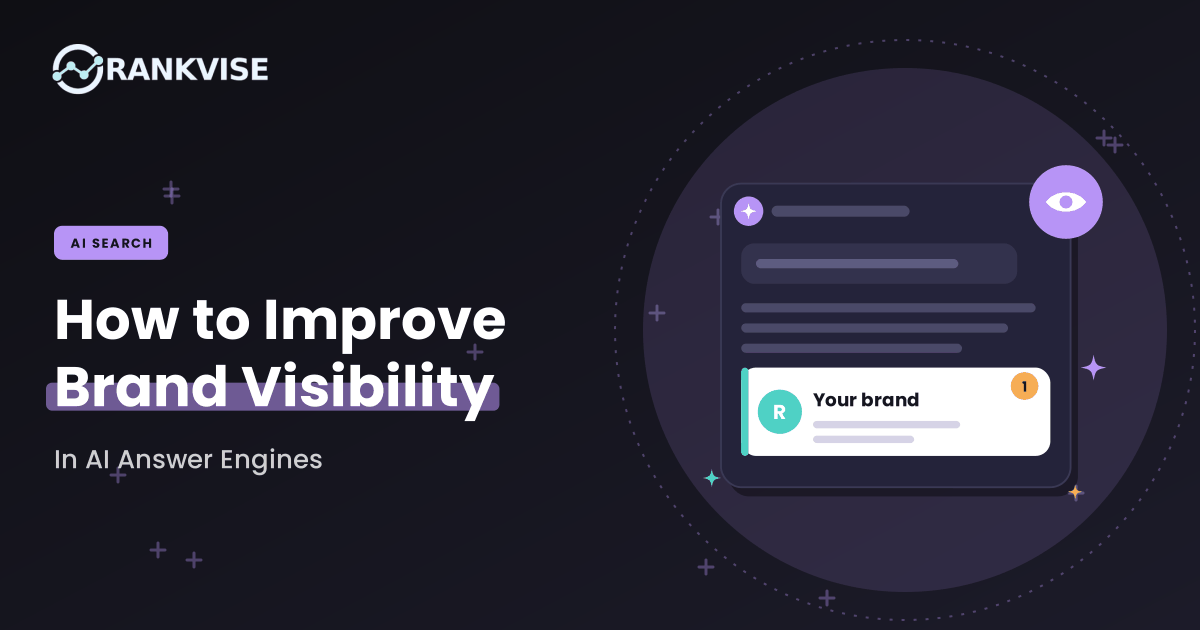
Most of improving brand visibility in AI answer engines is work you would recognise from ordinary good practice: let crawlers in, answer questions directly, publish something worth quoting, and get other credible sources to say it too.
The genuinely new parts are narrow — separate AI crawler access, per-engine sourcing differences, and the shift in weight from links toward mentions. Handle those deliberately, and treat anything promising a shortcut past the fundamentals with suspicion.
FAQs
How do I get my brand cited by ChatGPT?
Build broad third-party presence across review sites, roundups, and press, since ChatGPT often answers from established knowledge rather than live search.
Is AEO different from SEO?
Mostly not. Google’s own guidance states that answer engine optimisation is still SEO, with additional emphasis on extractable structure and third-party corroboration.
Do I need special files or markup for AI search?
No. Google has confirmed no special file or markup is required. Standard search eligibility plus clean schema is sufficient.
Why does my brand appear in AI answers inconsistently?
Responses are non-deterministic and vary by user, location, and moment. Measure across repeated runs of a fixed question set rather than one-off checks.
How long does it take to see results?
Typically one to two months for initial citations and three to four for meaningful volume, though brands with existing third-party coverage move considerably faster.