Ireland’s independent workforce has grown to over 331,000 self-employed people, and the number keeps climbing. Research into Ireland’s project economy found that highly skilled freelancers earn roughly 58% more than equivalent employees — and report higher job satisfaction while facing less age and gender discrimination. Whether you’re transitioning from a permanent role, building a side income into a full-time practice, or relocating to Ireland as a remote worker, the opportunity is real.
This guide covers every practical dimension of freelancing in Ireland: how to register, which business structure suits you, what taxes you owe, how to invoice correctly, and how to protect yourself as an independent professional.
Why Ireland Is a Strong Base for Freelancers
Before the administrative detail, it helps to understand why Ireland specifically works well for independent workers:
- Tech-rich client base. Ireland hosts European headquarters for Google, Meta, LinkedIn, Apple, and hundreds of other multinationals. This creates consistent demand for freelance tech, marketing, design, legal, and consulting work.
- English-speaking EU member. You can invoice EU clients directly under simplified VAT rules, access EU funding and support programs, and work with international clients without language barriers.
- Robust digital infrastructure. Ireland has committed to nationwide gigabit broadband, and urban connectivity already supports reliable remote work in all major cities and most towns.
- Supportive small business ecosystem. The Local Enterprise Office (LEO) network provides free mentoring, grants, and workshops specifically for self-employed individuals and small businesses across every county.
Vetting Clients and Staying Safe as an Independent Worker
Freelancers receive a constant stream of inbound contact — from genuine potential clients, recruiters, project leads, and platform messages, but also from bad actors who specifically target independent workers. Common approaches include fake project offers that require upfront “admin fees,” payment fraud through manipulated invoicing, and phishing attempts via WhatsApp or SMS from spoofed Irish numbers.
When you receive a cold call or message from an unknown Irish number claiming to represent a business, you have no employer’s IT security team standing behind you. The verification step falls entirely on you. Using an Ireland phone number tracker like Detectico lets you look up an unfamiliar number before responding — checking associated identity, location, and registration details in seconds.
If a caller claims to be from a specific company but the number traces to an unrelated source, that’s information worth having before you share your portfolio, banking details, or sign anything. As a freelancer, your instinct to verify first is not paranoia — it’s basic due diligence.
How to Register as Self-Employed in Ireland
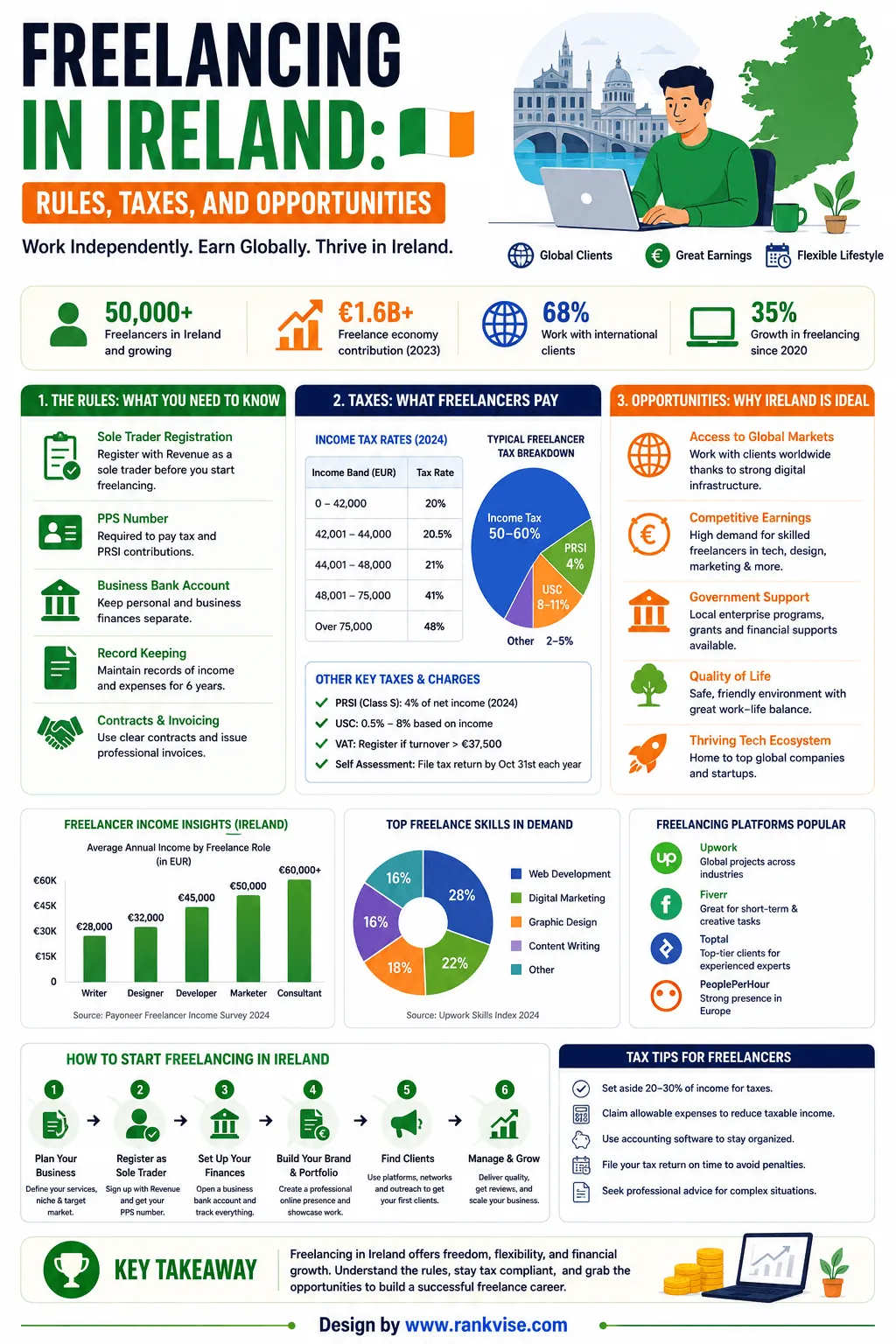
Registration with Revenue is free and the process is straightforward. Follow these steps:
- Register via ROS or submit Form TR1. If you already have a myAccount login with Revenue, you can register for self-assessment through the eRegistration service on ROS. New registrants submit a TR1 form (individuals) or TR1(FT) for non-residents.
- Allow 5–10 working days for processing. Revenue recommends this window, particularly for the digital certificate component of ROS access.
- Receive your tax registration number. This is your PPS number followed by a letter. Use it on all invoices and tax correspondence.
- Register a trading name (optional). If you want to operate under a business name rather than your personal name, register it with the Companies Registration Office (CRO) for €20 online.
- First-year note: You are not required to file a Form 11 in your first year of self-employment. You file for year one and year two together in year two — but preliminary tax for the current year is still due by 31 October.
As a self-employed person, you move from the PAYE system to self-assessment. Revenue no longer deducts tax automatically — that responsibility sits with you.
Choosing Your Business Structure: Sole Trader vs Limited Company
Most freelancers in Ireland start as sole traders because the setup is immediate and free. As income grows, the tax maths often tips toward incorporation. Here’s how the two structures compare:
| Feature | Sole Trader | Limited Company |
|---|---|---|
| Setup cost | Free | €50–€300+ (CRO + legal) |
| Setup time | Same day (ROS registration) | 3–10 working days |
| Personal liability | Unlimited — personal assets at risk | Limited to shareholding |
| Income tax rate | 20%/40% personal rates | 12.5% corporation tax on retained profits |
| Admin burden | Low — annual Form 11 only | Higher — annual CRO returns, statutory accounts |
| Credibility with larger clients | Lower | Higher |
| Best suited for | Starting out, under ~€40k–€50k net profit | Established practice, profits above €50k |
The general threshold in Ireland is clear: once your net annual profit consistently exceeds €40,000–€50,000, the corporation tax rate of 12.5% on retained profits makes a limited company structurally more efficient than paying personal income tax rates on everything you earn. Below that level, the additional compliance cost of a company typically outweighs the tax saving.
Taxes Every Irish Freelancer Must Understand
Self-employed individuals in Ireland pay three distinct taxes on their profits:
| Tax | Rate | Notes |
|---|---|---|
| Income Tax | 20% up to €44,000; 40% above | Earned Income Tax Credit of €2,000 reduces liability directly |
| PRSI | 4.1% (rising to 4.2% from Oct 2025) | Minimum contribution €650/year; exempt if income under €5,000 |
| USC | 0.5%–8% (graduated) | 3% surcharge on income over €100,000 for self-employed |
At higher income levels, the combined marginal rate can exceed 52%. This is the honest figure to budget around when setting your freelance rates.
Key dates:
- Preliminary tax (estimate of current year liability): due 31 October each year
- Form 11 (self-assessment return for prior year): due 31 October by post, or 18 November if filed and paid via ROS
- Underpaying preliminary tax triggers Revenue interest at 8% per annum — budget conservatively
Remote working relief: If you work from home, you can claim 30% of annual broadband costs and 10% of heat and electricity costs attributable to home working days. This is a specific and underused relief — keep records of your utility bills and working days throughout the year.
VAT: When You Need It and When You Don’t
VAT registration becomes mandatory once your annual turnover exceeds:
- €42,500 for services (including most freelance work)
- €85,000 for goods
The standard VAT rate in Ireland is 23%, with reduced rates of 13.5% and 9% for specific categories. If VAT-registered, you charge VAT on invoices to Irish clients and remit it to Revenue bi-monthly via a VAT3 return.
Why voluntary registration can make sense: If your business has significant expenses — equipment, software, office costs — voluntary VAT registration lets you reclaim the VAT on those purchases even before you hit the mandatory threshold. The trade-off is charging VAT to clients, which effectively raises your prices by 23% for non-VAT-registered customers.
Selling digital services to EU clients: If your total EU cross-border digital service revenue exceeds €10,000 per year, you must either register for VAT in each customer’s country or use Ireland’s One-Stop Shop (OSS) system, which handles EU VAT compliance from a single Irish filing. This affects freelance designers, developers, copywriters, and consultants working across multiple EU markets.
Allowable Expenses: What You Can Claim
You pay income tax on profit, not turnover. Legitimate business expenses reduce your taxable profit directly — and Revenue’s allowable categories are broad for freelancers:
- Home office costs: A proportion of rent, heat, electricity, and broadband attributable to business use. The remote working relief (30% broadband, 10% utilities) is the clearest calculation method.
- Equipment and technology: Laptops, monitors, cameras, microphones, software subscriptions — capital allowances apply over time; smaller items are immediately deductible.
- Professional fees: Accountant fees, legal advice, professional association memberships.
- Travel: Mileage for client visits and business travel (not your regular commute). Keep a mileage log.
- Professional development: Courses, certifications, industry conferences — allowable if directly related to your freelance practice.
- Marketing and tools: Website hosting, portfolio platforms, advertising, CRM subscriptions.
Keep all records — receipts, bank statements, invoices — for a minimum of six years. Revenue can and does audit self-employed individuals going back that far, and every expense claim needs a corresponding document.
Invoicing Clients Correctly in Ireland
Professional, compliant invoices protect your cash flow and your Revenue standing. Every invoice you issue must include:
- Your full name or business name and address
- Your client’s name and address
- A unique sequential invoice number
- Invoice date and payment due date
- Clear description of services provided
- Amount charged (exclusive and inclusive of VAT if applicable)
- Your VAT number (mandatory if VAT-registered)
- Accepted payment methods and bank details
Payment terms of 14–30 days are standard in Ireland for B2B work. The EU Late Payment Directive, enacted in Irish law, gives you the legal right to charge interest on overdue invoices — the statutory rate is 8% per annum above the ECB base rate, plus a flat recovery fee of €40–€100 depending on invoice size. Including this clause in your contracts changes client behaviour.
Recommended invoicing tools: FreshBooks, QuickBooks, and Xero are widely used. Big Red Cloud is an Irish-specific accounting platform designed for sole traders and small businesses with built-in Revenue compliance features.
Benefits, Pensions and Sick Pay for Freelancers
The absence of employer-provided benefits is one of the real costs of self-employment that freelancers consistently underestimate.
Sick pay: Self-employed people in Ireland pay PRSI at Class S. After 12 months of PRSI contributions, you become entitled to Illness Benefit from the Department of Social Protection if you are medically certified as unable to work. The payment is not generous (currently around €220–€260 per week depending on your PRSI record), which makes income protection insurance worth considering as a supplement.
Pension: Pension contributions are deductible at your marginal income tax rate — up to 40% relief for higher-rate taxpayers. The maximum contribution as a percentage of income is age-dependent (15% under age 30, rising to 40% for those aged 60+). A €10,000 pension contribution made by a 45-year-old earning above €44,000 saves €4,000 in income tax immediately. This is one of the most effective legal tax reduction mechanisms available to freelancers.
Government support: The Local Enterprise Office provides free mentoring sessions, subsidised training, and in some cases grants for freelancers and micro-business owners. Every county has one — use it.
Where to Work: Coworking Spaces Across Ireland
Working exclusively from home suits some freelancers and erodes others. Coworking spaces provide structure, separation between work and personal life, reliable infrastructure, and networking that home offices cannot replicate.
| Space | City | Hot Desk From |
|---|---|---|
| The Tara Building | Dublin | €285/month |
| Huckletree | Dublin | €195/month |
| Docklands Innovation Park | Dublin | €95/month (2 days) |
| Glandore | Dublin / Cork / Belfast | On request |
| Dogpatch Labs | Dublin | On request |
| Connected Hubs network | Nationwide (rural + urban) | Varies by location |
The government-backed Connected Hubs network is particularly relevant for freelancers outside Dublin. It connects workspaces across Ireland into a single booking platform, making it practical to work from a professional environment in smaller towns and rural areas without commuting to the capital.
Finding Freelance Work in Ireland
The Irish freelance market is relationship-driven. The most effective channels:
- Global platforms: Upwork and Freelancer.com have Irish freelancer communities and active client listings; LinkedIn is essential for B2B positioning and inbound leads
- Irish job platforms: IrishJobs.ie and Jobs.ie post contract and freelance listings alongside permanent roles
- Facebook communities: “Freelancers Ireland” and similar groups circulate local leads, referrals, and honest peer advice
- Direct outreach: Identifying companies in your niche and approaching them directly remains the highest-conversion channel for experienced freelancers
- Local Enterprise Office events: Regional networking events that consistently produce genuine client connections, particularly outside Dublin
Word of mouth and referrals drive the majority of sustained freelance income in Ireland. Every client relationship is a long-term asset — invoice promptly, communicate clearly, and deliver consistently.
Final Checklist Before You Go Independent
Work through this before you leave your last employer or take on your first freelance client:
- Register with Revenue via ROS or Form TR1 — do this before issuing any invoices
- Open a dedicated business bank account, separate from personal finances
- Set up invoicing software with sequential numbering and Irish-compliant fields
- Speak to an accountant in year one — the cost pays for itself in correct preliminary tax calculation alone
- Get professional indemnity insurance appropriate to your field (public liability if you meet clients in person)
- Set aside 30–35% of every payment for tax — keep this in a separate savings account and treat it as untouchable until October
- Join a coworking space or freelance community within the first month — isolation is one of the most underestimated challenges of independent work
Freelancing in Ireland is a legitimate, increasingly mainstream career path. The administrative side is manageable once you understand the system. The financial upside — for those who find their niche, build strong client relationships, and manage their tax position intelligently — is substantial. Start simple, stay compliant, and build from there.