Users are increasingly abandoning physical SIM cards in favor of built-in solutions that allow them to connect to the mobile internet without visiting communication centers and replacing a physical SIM card. Tourist eSIMs are especially actively used for travel, short-term business trips, and long-term stays abroad. The technology allows users to activate a plan in advance, keep their main number, and reduce dependence on roaming services from local operators.
In addition, eSIM receives daily support not only from regular users but also from international service providers. In recent years, users have gained open access to dozens of platforms with regional and global plans, as well as regional solutions for Europe, Asia, the United States, and travel to different countries, which simplifies communication and saves money on international roaming.
This article discusses connection features, limitations, and activation methods for different use cases.
How Do Travel eSIMs Work and How Do They Differ from Conventional eSIMs?
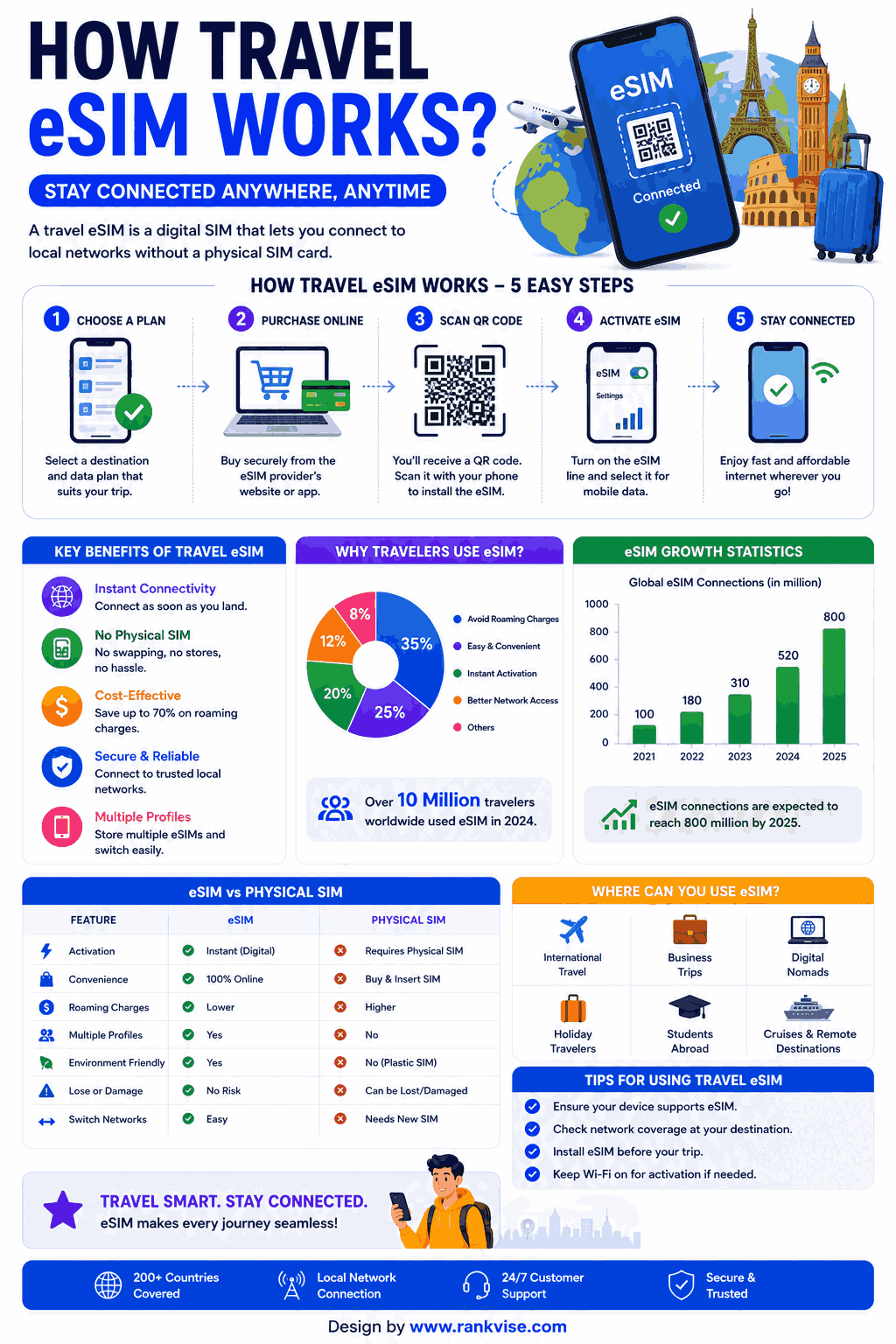
eSIM is a digital module built into a smartphone that replaces a physical SIM card. The operator’s data is remotely downloaded to the device, so the user does not need to replace a physical SIM card or find a service center in another country. When traveling, travel eSIM is most often used for mobile internet: the main number remains active, and a separate profile is responsible for data transmission abroad.
The connection is usually made via a QR code: after purchasing the plan, the user adds a new profile in the cellular settings. You can store multiple profiles on one device and switch between them in different countries.
In What Situations is a Travel eSIM Most Commonly Used?
During vacations and short trips, a travel eSIM is usually used to access mobile internet without the roaming charges of the home carrier. This format allows users to access navigation, messaging, banking, and booking services immediately upon arrival. In addition, travel eSIMs are in demand when traveling to several countries, as there is no need to buy a separate SIM card in each country. One digital plan can work in several regions at once, depending on the plan’s conditions.
On business trips, eSIM is used for quick activation without visiting the carrier stores. This option is convenient for various short-term business trips or minimal transit stops in unplanned locations. In this case, eSIM keeps you connected anywhere in the world and allows you not only to avoid using your main number but also to use the local Internet without restrictions.
Services Where You Can Buy a Travel eSIM
There are several dozen platforms on the eSIM service market that differ in the geography of coverage, payment options, and the activation process. Users most often choose services with remote activation, support for popular payment systems, and the ability to install a profile before traveling. This approach allows users to prepare for mobile internet in advance and avoid purchasing a physical SIM card after arrival.
When choosing, users usually evaluate the number of supported countries, the availability of Internet distribution, and the possibility of topping up data. Through such platforms, people most often buy a travel eSIM today for a vacation, business trip, or long stay abroad.
eSIM Plus
eSIM Plus is a service for mobile internet access abroad using eSIM profiles without a physical SIM card. The platform also offers additional features, including the ability to use UK numbers on eSIM Plus to obtain a UK local number if necessary. The service is aimed at travelers and remote workers who need to have Internet access immediately after arrival, and also offers various plans with different data allowances and validity periods that can be activated before departure or upon arrival.
eSIM365
eSIM365 offers a wide range of destinations and a standard activation process via a QR code. The service is more often used by users who want to set up internet access in advance and not waste time searching for a local operator. For some tariffs, it is possible to replenish traffic without re-installing the profile. Through such platforms, users often prefer to purchase a travel eSIM before starting their trip.
Unisim
A key feature of Unisim is using a single eSIM profile for different countries. Pricing depends on the amount of data actually used, which is convenient for frequent movements between regions. This format is in demand during long trips and when visiting several countries in a short period of time. Many travel eSIMs work on the same principle, with automatic switching between partner networks.
Just eSIM
Just eSIM offers fixed-price plans for specific countries and durations of stay. The user selects the required package, installs a profile, and gets access to the Internet without additional steps.
How to Buy and Activate a Travel eSIM
Before connecting, you should go to the comparison of eSIM services and compare the following conditions: coverage countries, payment methods, the possibility of replenishment, data limits, and hotspot support. After selecting the appropriate platform, you can buy a travel eSIM and proceed with installing the profile.
How to Get a Foreign Number
Step 1. Check eSIM support
First, check that your smartphone supports eSIM. Verification is done in cellular settings or on the manufacturer’s website. It is important to consider not only the device model but also the region of its release.
Step 2. Select the plan region
Next, the user selects a country, a regional package, or a multi-destination plan. This is especially important for transfers and routes across multiple countries, where one profile can replace several local SIM cards.
Step 3. Pay the tariff and get a QR code
After payment, the service sends a QR code or manual setup details. Usually, the tourist eSIM is connected via the mobile network section in the smartphone settings. You need a stable internet connection to download your profile.
Step 4. Install the profile on the device
Scan the received QR code in the settings for adding eSIM and activate the purchased data plan.
Step 5. Set up mobile data
After installation, you need to select eSIM as the mobile data line. In some cases, you will need to enable data roaming, since the connection is made through local partner operators.
Step 6. Check activation
It is best to test it immediately after arrival. Common errors include a weak Internet connection during installation, an incorrect tariff region, or device blocking by the operator. Travel eSIM is usually set up in advance and activated after arrival in the destination country.
Step 7. Consider the validity period
Some tariffs become active immediately after installation, others — after the first connection to a foreign network. Before traveling, it is important to check this item in the terms of service.
What to Consider Before Activating eSIM for Travel?
Before enabling eSIM, evaluate not only the price of the plan but also the terms of use of the package. One of the key factors is data allowance. For short trips, basic 5–10 GB plans are usually enough, but with the active use of navigation, video calls, and streaming services, data usage increases significantly. Therefore, the tourist eSIM should be chosen based on the duration of the trip and the expected load on the network.
It will also be useful to check the consequences of reaching the limit and the policy of a particular service on this issue. Some services completely cut off internet access, while others reduce speeds significantly. Special attention should be paid to Internet distribution support: not all plans allow hotspot usage as an access point for a laptop or other devices. If you need a full phone number during your trip, it is important to keep in mind that the travel eSIM often provides only mobile internet without calls or SMS.
The final step before paying the eSIM data plan is to review the refund policy and the rules for reactivating the profile. Unfortunately, many services limit the number of times a QR code can be used for different services, they also do not refund funds if the eSIM package is unused.
An important tip is to check the stability of the Internet connection after purchase and activation of the eSIM. Detecting any problems at the early stages of use will save you time searching for solutions while traveling, and will also help you contact tech support in a timely manner for qualified help.
Conclusion
The digital mobile communications market is gradually moving towards more flexible solutions for travel, business trips, and relocation. Travel eSIM allows users to prepare internet access in advance, save the main number, and avoid relying on the purchase of a physical SIM card after arrival in another country. However, before connecting, consider not only the cost, but also the validity period of the package, the volume of traffic, support for Internet distribution, payment methods, and activation rules.
When choosing the right solution, you should pay attention to the comparison of eSIM services, where you can compare platforms by coverage regions, connection conditions, payment options, and additional functions. This allows users to compare different services in one place and choose an option for a specific type of trip — from a short vacation to a long stay abroad.