Buying a VPS with cryptocurrency gives you more payment flexibility and, in some cases, more privacy. But payment is only one part of the decision. The bigger question is which operating system fits your goals better.
For most buyers, the choice comes down to Linux vs Windows. Both can run websites, apps, bots, remote desktops, and business tools. Still, they differ a lot in cost, ease of use, software support, and long-term maintenance.
If you choose the wrong OS, you may spend more money and time than necessary. This guide explains the real differences in simple terms so you can pick the right VPS before you pay with Bitcoin, USDT, Monero, or another crypto asset.
If you are deeply looking for highly secure, low-latency European deployment, quickly checking out the highly rated Polish VPS servers offers an absolutely excellent starting point for seamlessly running both complex Linux and demanding Windows server environments.
Why the Operating System Matters When You Buy a VPS
A VPS is a virtual private server. It gives you dedicated resources inside a larger physical machine. You get control, flexibility, and better performance than shared hosting.
The operating system controls how you manage that server. It affects setup time, licensing cost, software compatibility, security updates, and server performance.
That means your OS choice shapes your full hosting experience. It also affects how much value you get from your crypto payment.
What Linux VPS Means for Most Buyers
Linux is the default choice for many VPS providers. It powers a huge part of the web and supports most hosting tasks well.
A Linux VPS usually comes with distributions like Ubuntu, Debian, AlmaLinux, Rocky Linux, or CentOS alternatives. These systems are popular because they are stable, lightweight, and efficient.
Most Linux servers are managed through the command line. Some users add a control panel like cPanel, Plesk, or CyberPanel. That helps if you want a more visual interface.
What Windows VPS Means for Most Buyers
A Windows VPS runs Microsoft Windows Server. It looks and feels more familiar to people used to desktop Windows.
This option is popular with users who need Remote Desktop access, Windows-only applications, ASP.NET projects, MSSQL databases, or a graphical interface. Many beginners also prefer it because the environment feels easier to navigate.
The tradeoff is cost and resource usage. Windows usually needs more RAM, more storage, and a paid license, so the plan often costs more than Linux.
Linux vs Windows VPS: The Quick Comparison
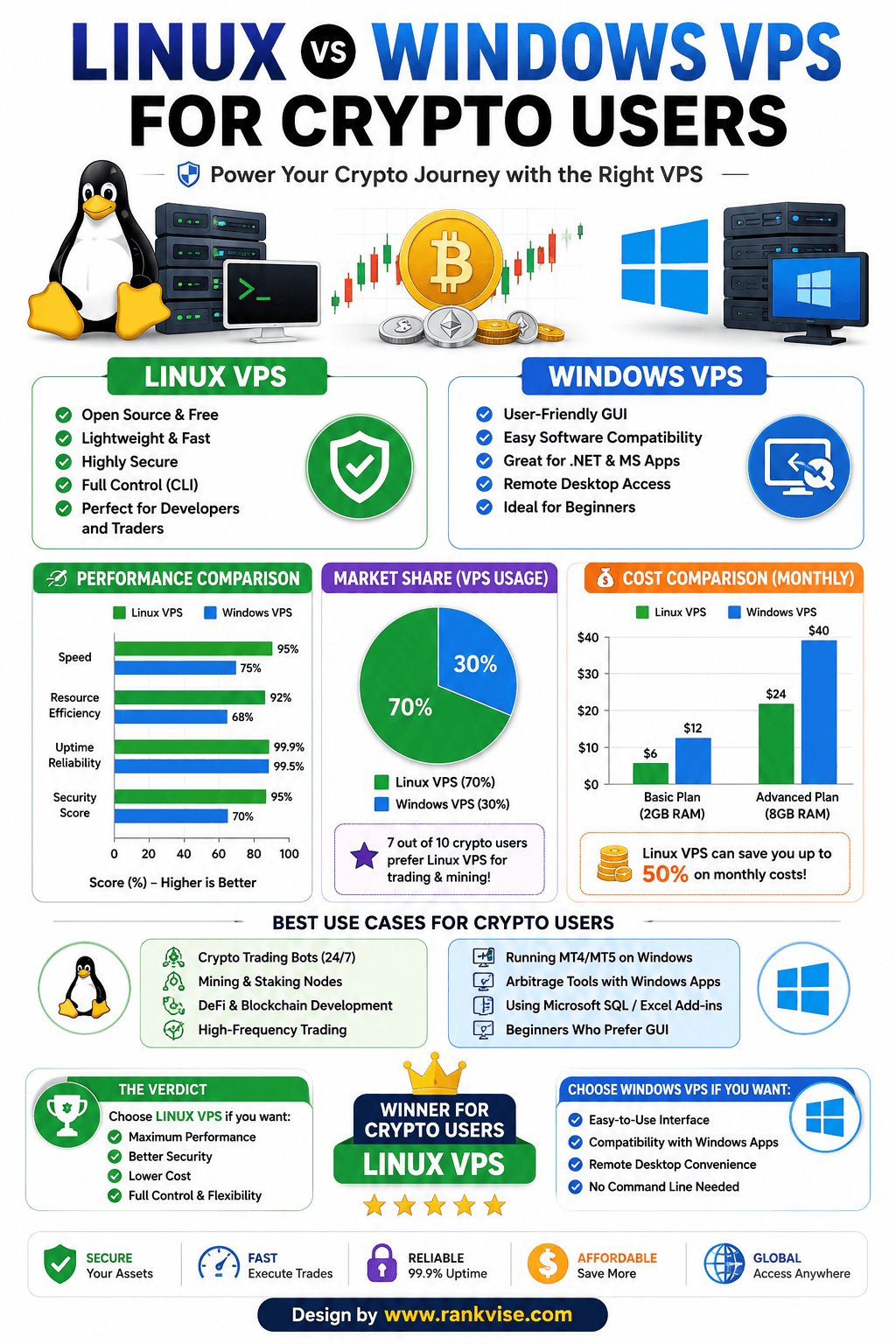
| Factor | Linux VPS | Windows VPS |
|---|---|---|
| Cost | Lower | Higher |
| Resource usage | Lightweight | Heavier |
| Ease for beginners | Harder at first | Easier for Windows users |
| Software support | Excellent for open-source apps | Best for Microsoft stack |
| Remote access | SSH | Remote Desktop |
| Security reputation | Strong | Good, but needs closer patching |
| Customization | Very high | Moderate |
| Licensing fees | Usually none | Usually included in price |
This table gives the short answer. Linux wins on cost, flexibility, and efficiency. Windows wins on familiarity and support for Microsoft software.
When Linux Is the Better VPS Choice
Linux is often the better option if you want maximum value from your crypto payment. It gives you strong performance with fewer resources and lower monthly costs.
It works especially well for websites, web apps, databases, developer environments, VPNs, game backends, and container workloads. If your project uses PHP, Python, Node.js, MySQL, PostgreSQL, Docker, or Nginx, Linux is usually the natural fit.
Linux also makes sense if you want long-term scalability. You can start small and grow without paying extra for operating system licensing.
Best use cases for Linux VPS
- WordPress hosting
- Laravel or PHP applications
- Node.js projects
- Python apps and scripts
- Docker containers
- VPN hosting
- Web servers with Apache or Nginx
- Git and CI/CD environments
For technical users, Linux offers better control. For budget-conscious users, it often delivers better performance per dollar.
When Windows Is the Better VPS Choice
Windows is the better choice when your workflow depends on Microsoft technologies or desktop-style access. If your software requires Windows, the decision is simple.
A Windows VPS is ideal for users who run ASP.NET apps, MSSQL databases, Windows automation tools, or enterprise software built for the Microsoft ecosystem. It also works well for remote office environments and users who prefer GUI management.
If you are not comfortable with terminal commands, Windows may reduce the learning curve. That can matter more than raw cost if ease of use is your top priority.
Best use cases for Windows VPS
- ASP.NET web applications
- MSSQL database hosting
- Remote Desktop workstations
- Windows-only business software
- Forex platforms and trading software
- .NET-based applications
- GUI-based administration tasks
In these cases, Windows is not just convenient. It may be necessary.
Which OS Is Better for Performance?
Linux usually performs better on the same hardware. It uses fewer background resources and leaves more CPU and RAM available for your actual workload.
That matters if you are buying a low-cost VPS with cryptocurrency. You want every part of your payment to go toward usable performance. Linux helps you do that.
Windows can still perform well, but it needs more system resources. A Windows VPS with 2 GB RAM may feel tighter than a Linux VPS with the same spec. That often pushes buyers toward higher-priced plans.
Which OS Is Better for Security?
Both Linux and Windows can be secure if configured properly. The biggest risks usually come from weak passwords, poor patching, and bad server management.
Linux has a strong reputation for server security. It benefits from a mature open-source ecosystem, tight permission controls, and lower exposure to common desktop-style threats. Many admins also prefer its transparency and auditability.
Windows is also secure when maintained well. But it often needs more attention to updates, firewall settings, user privileges, and service exposure. If you use RDP, you must secure it carefully.
Security tips no matter which OS you choose
- Use strong unique passwords
- Enable 2FA where possible
- Change default ports only if it fits your security model
- Keep the OS patched
- Disable unused services
- Use a firewall
- Back up your data regularly
- Restrict admin access by IP when possible
The operating system matters, but good admin habits matter more.
Which OS Is Easier to Manage?
This depends on your experience level.
If you already know Windows, a Windows VPS often feels easier on day one. You log in with Remote Desktop and manage files and settings visually.
Linux feels harder at first because many tasks use SSH and command-line tools. But once you learn the basics, Linux often becomes faster to manage. Many experienced admins prefer it because it is efficient and script-friendly.
So the real answer is simple. Windows is easier to learn for many beginners. Linux is often easier to scale and automate once you understand it.
How Cryptocurrency Changes the VPS Buying Decision
Paying with cryptocurrency does not change OS performance, but it does change how buyers think about privacy, access, and provider selection.
Some users buy VPS plans with crypto because they want faster payments, fewer banking limits, or better international access. Others want more privacy, especially when providers accept coins like Monero or do not require extensive billing details.
In that context, Linux often pairs better with privacy-focused buyers. It is cheaper, lighter, and popular among technical users who value control. Windows can still be bought with crypto, but it usually costs more because of licensing.
That means crypto buyers who want value and efficiency often lean toward Linux. Buyers who need Windows software accept the higher cost because the use case justifies it.
Cost Differences You Should Expect
Linux VPS plans usually cost less than Windows VPS plans. The reason is simple. Linux distributions are generally free to use, while Windows Server licensing adds cost.
That difference can be small on premium plans and more noticeable on budget plans. If you pay monthly in crypto, the extra cost adds up quickly.
Here is the practical takeaway. If your project can run on Linux, Linux usually gives you better ROI. If your project needs Windows, the extra cost is part of the requirement, not a flaw.
Which OS Is Better for Specific Business Scenarios?
Different workloads need different environments. Here is a simple breakdown.
Choose Linux if you are:
- launching a website or blog
- hosting WordPress
- deploying developer tools
- running APIs or web apps
- using Docker or open-source software
- trying to keep VPS costs low
Choose Windows if you are:
- hosting ASP.NET apps
- using MSSQL
- managing software through a desktop interface
- running Windows-only trading or business apps
- creating a remote desktop workspace for staff
The best OS is the one that supports your software without extra workarounds.
Questions to Ask Before You Buy a Crypto VPS
Before you choose Linux or Windows, ask these questions:
- What software do I need to run?
- Do I need a GUI or am I comfortable with SSH?
- Is low cost a priority?
- Do I need Microsoft-specific tools?
- How much RAM and CPU will my workload need?
- Does the provider offer fast OS reinstall options?
- Does the host support secure crypto payments and good uptime?
These questions usually make the answer obvious.
Final Verdict: Linux or Windows for a VPS Bought With Cryptocurrency?
Linux is the better choice for most VPS buyers. It is cheaper, lighter, more flexible, and ideal for web hosting and development workloads. If your goal is performance, value, and scalability, Linux usually wins.
Windows is the better choice when your software depends on the Microsoft ecosystem or when you need a familiar desktop-style interface. It costs more, but it solves specific business needs that Linux may not handle easily.
So do not choose based on habit alone. Choose based on your actual workload. If your tools run well on Linux, it is usually the smartest place to spend your crypto.
FAQs
Yes. Linux VPS plans usually cost less because they do not include Windows Server license fees.
Yes. Many VPS providers accept Bitcoin, USDT, and other cryptocurrencies for Windows plans.
Linux is better for WordPress in most cases because it is lighter, cheaper, and widely supported.
For users familiar with Windows, yes. The graphical interface makes setup and management feel more natural.
Linux is often the better fit because it costs less, uses fewer resources, and appeals to technical, privacy-focused users.